
Best PAP.fr Scrapers in 2026 (Tested for Data, Speed, Cost & Scale)
lobstr.io PAP Search Export is the best PAP.fr scraper in 2026. It ships zero duplicate rows and clears 100,000 listings in 6.2 hours for $100. Apify's Pap.fr Scraper is cheaper under 10,000 listings, but needs 5.3 days and $145 for that same job.
⚡ 30-Second Summary
- I hunted down every PAP.fr scraper I could find, shortlisted four worth a real test, and bought paid plans on three. Two never finished a run. The two that did were scored on six weighted criteria
- lobstr.io PAP Search Export is the best overall, and the cheapest once you scale. Zero duplicates across 241 listings, 100,000 listings in 6.2 hours, and $100 for that job against Apify's $145. Pick it for any recurring PAP job above 10,000 listings. Trade-off: it misses 10 of the 16 virtual tours Apify catches, all of them Giraffe360 embeds
- Apify's Pap.fr Scraper is the best pick for a small one-off job. Its $1.20 per 1,000 flat rate beats lobstr.io below 10,000 listings, and it's the only tool that returns PAP's down-payment figure. Pick it for a single search you run once. Trade-off: it's hard-capped at 512 MB with no concurrency lever, so 100,000 listings takes 5.3 days
- Both tools return comparably good data, so that criterion splits by use case rather than crowning anyone
- Didn't make the cut: Octoparse and Scraping-Bot. Both failed the same criterion. Reasons at the end
If you're here, I'm guessing you've already tried one of those "best PAP.fr scraper" picks and watched it die on a captcha.
Or you're about to.
Either way, I get the frustration. I've been through it, so let me save you the time.
Most "best PAP.fr scraper" lists are recycled marketing. Nobody runs the same job through every tool and counts what comes back.
So I did.
Same search URLs on every tool, multiple runs each, from roughly 100 listings up to 1,000. Only 2 of them survived and one was a total waste of my money I paid for its subscription.
Just tell me which one
| If you want... | Go with | The number |
|---|---|---|
| The best all-rounder | lobstr.io | Wins 4 criteria of 6, level on 2 |
| The cheapest at scale | lobstr.io | $0.50 /1K at 1M listings |
| The cheapest for a one-off job | Apify | $1.20 /1K below 10K listings |
| The fastest on a big job | lobstr.io | 100K in 6.2 h vs 5.3 days |
| Output you don't have to dedupe | lobstr.io | 0 duplicate rows vs 50 |
| The most fields per listing | Apify | 40 meaningful vs 33 |
| Every virtual tour on the page | Apify | 16 of 16 vs 6 |
The two PAP.fr scrapers that survived
| Criteria | lobstr.io PAP Search Export | Apify Pap.fr Scraper |
|---|---|---|
| Field paths (total / meaningful) | 41 / 33 | 48 / 40 |
| Usable ratio | 80.5% | 83.3% |
| Fields populated (mean, 32 shared fields) | 75.5% | 82.5% |
| Value errors (942 field checks) | 0 | 3 fields wrong on all 236 rows |
| Listings returned (benchmark search) | 241 unique | 236 unique (286 rows) |
| Duplicate rows | 0 | 50 (17.5% of output) |
| Listings the other tool missed | 0 | 5 |
Atomic surface area (SIZE, PRICE PER SQM) | ✅ separate fields | ⚠️ inside a text blob |
Down-payment figure (apport_defaut) | ❌ | ✅ |
| Virtual tours found | 6 of 16 | 16 of 16 |
| Filter: newer than | ✅ (free) | ❌ |
| Filter: deduplication | ✅ (free) | ❌ |
| Filter: max per task | ✅ (free) | ❌ |
| Filter: total max listings | ✅ (free) | ✅ (free) |
| Search URLs per job | Thousands | 1 |
| Speed measured, base config | 13.39/min (1 Slot) | 13.11/min (512 MB, its max) |
| Speed at each tool's own maximum | 267.8/min (20 Slots, computed) | 13.11/min (no headroom) |
| Anchor job: 100K listings | 6.2 h computed / $100 | 5.3 days measured / $145 |
| Cost /1K (entry → scale) | $2.00 → $0.50 | $1.20 → $1.20 |
| Effective cost /1K unique | $1.00 at 100K | $1.45 (billed on duplicates) |
| Max listings/month (24/7, base config) | 578,400 (1 Slot) | 566,400 |
| Concurrency | ✅ 20 Slots/Squid | ❌ none on this actor |
| Failure behaviour | Pauses, auto-resumes | Stops, abort only |
| Data retention | 30 days | 30 days |
| Export formats | CSV, Excel, JSON, JSONL | CSV, JSON, HTML |
| Support (actor-scoped) | Help centre + email | Developer's Discord + email |
| User rating | 5.0/5 (33 reviews, Capterra) | 4.06/5 (2 reviews, Apify store) |
| Overall score /10 (how it's weighted) | 8.94 | 6.46 |
Is it legal to scrape PAP.fr?
Disclaimer: I'm not a lawyer and none of this is legal advice. If you're running a serious operation, talk to someone who knows French and EU law.
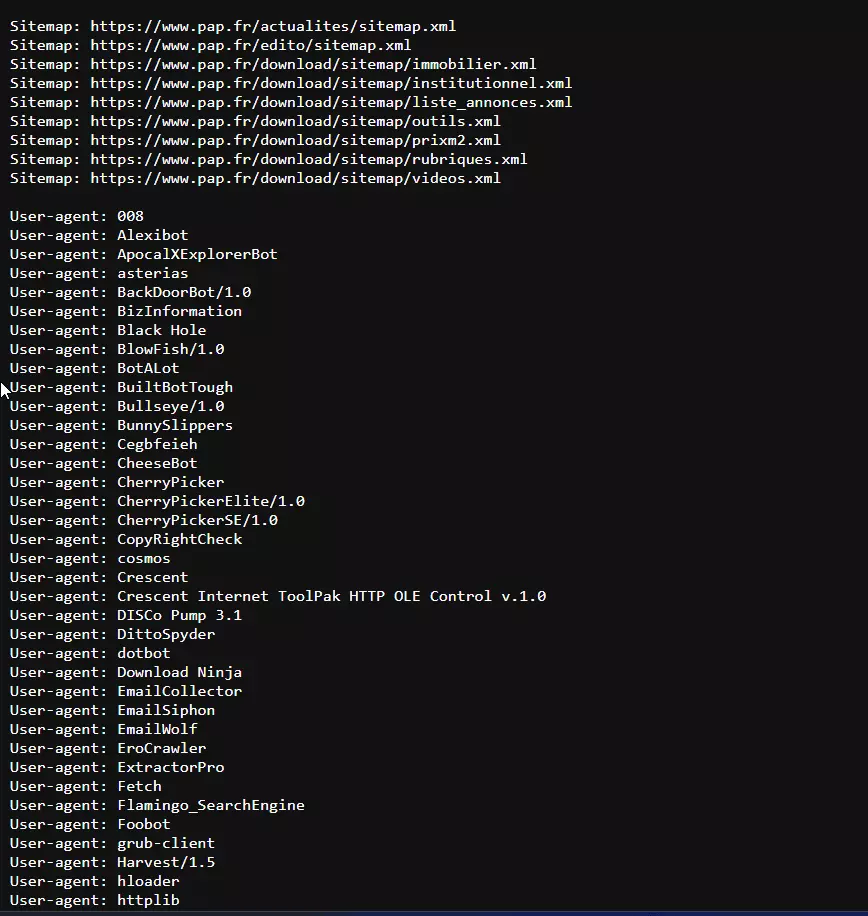
Disallow: /*?* blocks every parameterised URL on the site.But does that make it illegal? Not necessarily, as long as you stay inside GDPR and French law and don't hammer the site.
- Scraping non-substantial data for internal use is generally allowed
- Republishing or commercially redistributing PAP's listings is off limits, and France has won court cases on exactly that
- Seller phone numbers are personal data under GDPR, so you need a lawful basis to collect them
Does PAP.fr have an official API?
No. There isn't one, and that single fact frames the whole buying decision.
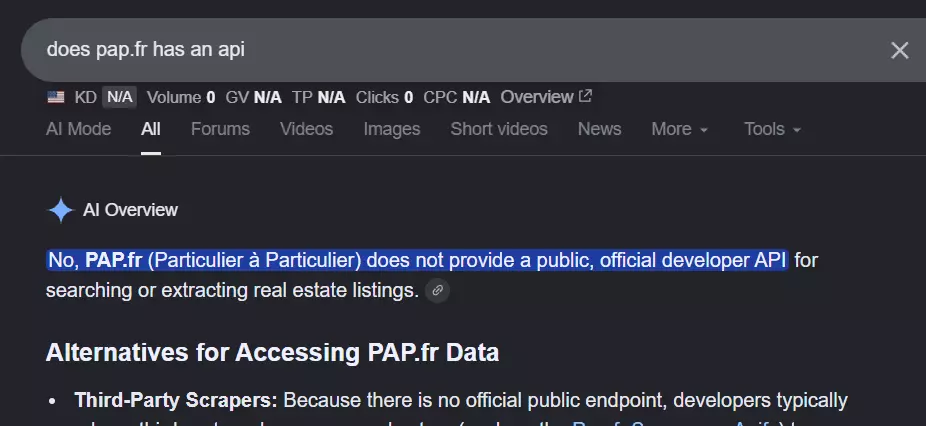
No developer portal, no API reference, no partner endpoint.
What exists instead is third-party aggregation... services like Stream.estate ingest PAP alongside hundreds of other French sources and resell the feed.
So there's no "use the official API instead" escape hatch here. A scraper is the only option, so the pick matters.
How I chose the best PAP.fr scrapers
I went looking for where PAP scraping breaks before testing anything. The interesting part is what I didn't find.
There is no Reddit thread about PAP scraping. No forum post, no complaint log. It's a niche French platform and nobody has written up the failure modes.
I managed to find a few tools online like Lobstr.io (of course 😁), some Apify actors, Octoparse (the overhyped playwright wrapper), and scraping-bot API.
I started testing and scoring them.
Each tool is scored 0-10 on six criteria, weighted in three tiers... Data 2.2 · Cost 2.2 · Usability 1.8 · Speed 1.8 · Scalability 1.0 · Support 1.0.
Tier one is what people buy on, tier two is what they live with daily, tier three is what they hit months later. The aggregate is the weighted sum divided by 10.
Data
I gave them the same PAP URL and compared them field by field against the live PAP pages.
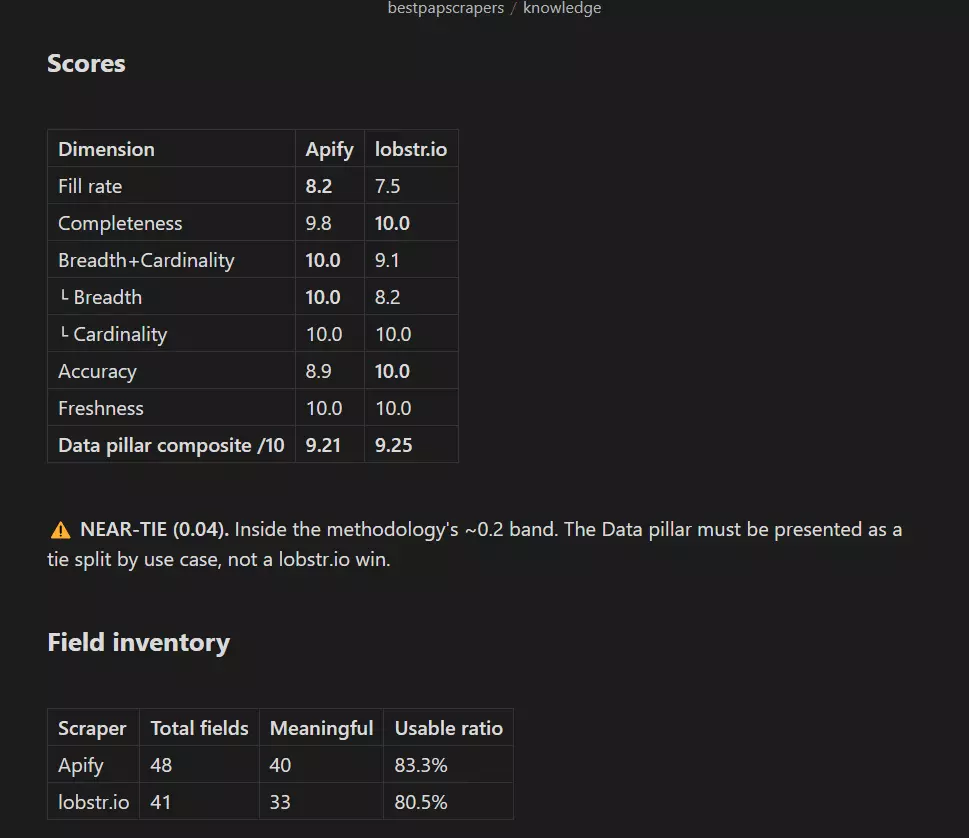
I checked data points returned, freshness and accuracy of data, fill rate, and other data factors.
Usability
Time from signup to first row on screen, then everything you can and can't control before a run.
Filters count as a cost dimension, not a feature checklist. A filter you don't have is a job you pay to over-collect.
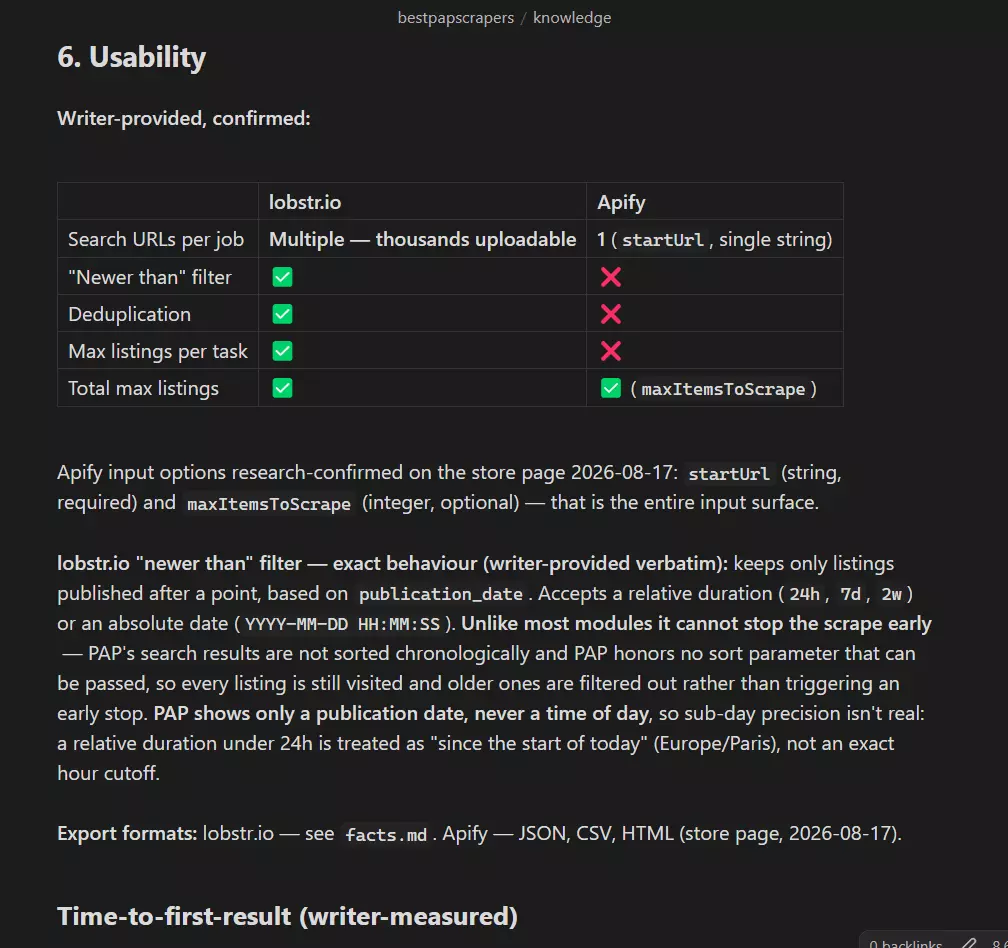
Every documented toggle got tested with and without it enabled.
Speed
Wall-clock on the same search URLs, multiple runs each.
The normalisation rule is one instance of each tool, pushed to its own maximum concurrency. No tool gets credit for headroom it can't reach.
Cost
Everything normalised to cost per 1,000 listings, at entry and at scale, with one anchor job priced in dollars for both tools.
Where a tool bills for output you can't use, I priced what you actually get rather than what the pricing page says.
Scalability
The monthly ceiling is the measured rate × 43,200 minutes at a declared base config, with the concurrency tiers above it labeled as computed.
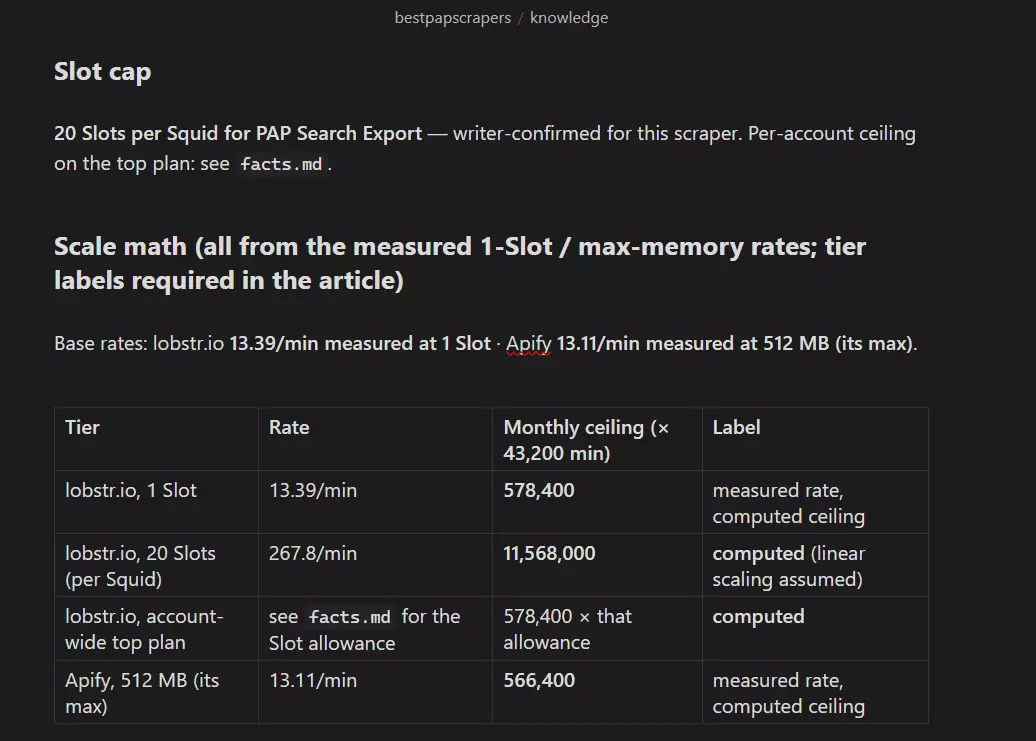
I also logged what each tool does to your collected data when a run fails.
Customer support
I didn't run a timed ticket test, so this one is scored on support channels, the tested actor's own issue history, and review sentiment.
For the Apify actor, that evidence is scoped to the actor itself rather than to Apify the platform.
The scorecard
| Pillar | Weight | lobstr.io | Apify |
|---|---|---|---|
| Data | 2.2 | 9.25 | 9.21 |
| Cost | 2.2 | 8.5 | 6.5 |
| Usability | 1.8 | 9.0 | 4.5 |
| Speed | 1.8 | 9.5 | 5.5 |
| Scalability | 1.0 | 9.0 | 4.0 |
| Support | 1.0 | 8.0 | 8.0 |
| Aggregate /10 | 8.94 | 6.46 |
lobstr.io: (9.25×2.2) + (8.5×2.2) + (9.0×1.8) + (9.5×1.8) + (9.0×1.0) + (8.0×1.0) = 89.35 ÷ 10 = 8.94
Apify: (9.21×2.2) + (6.5×2.2) + (4.5×1.8) + (5.5×1.8) + (4.0×1.0) + (8.0×1.0) = 64.562 ÷ 10 = 6.46
The aggregate hides the most interesting result. Data is a dead heat, 9.25 against 9.21, and Apify takes fill rate and breadth outright.
These two tools return comparably good data. The 2.48-point gap comes from everywhere else... cost, ergonomics, throughput, and what happens when a run breaks.
What I left out and why
- Done-for-you data services. DataShaker and Scrapster sell PAP data as a service rather than a tool you run. You can't put them through the same benchmark yourself, which is the whole premise here
- Ghost actors on Apify. I picked the most-used PAP actor on the marketplace, at 17 monthly users. The nearest alternative has one user, no reviews, and charges $20 per 1,000 listings, 16.7× the actor I teste
Best PAP.fr Scrapers of 2026
Here's the story behind the numbers, tool by tool.
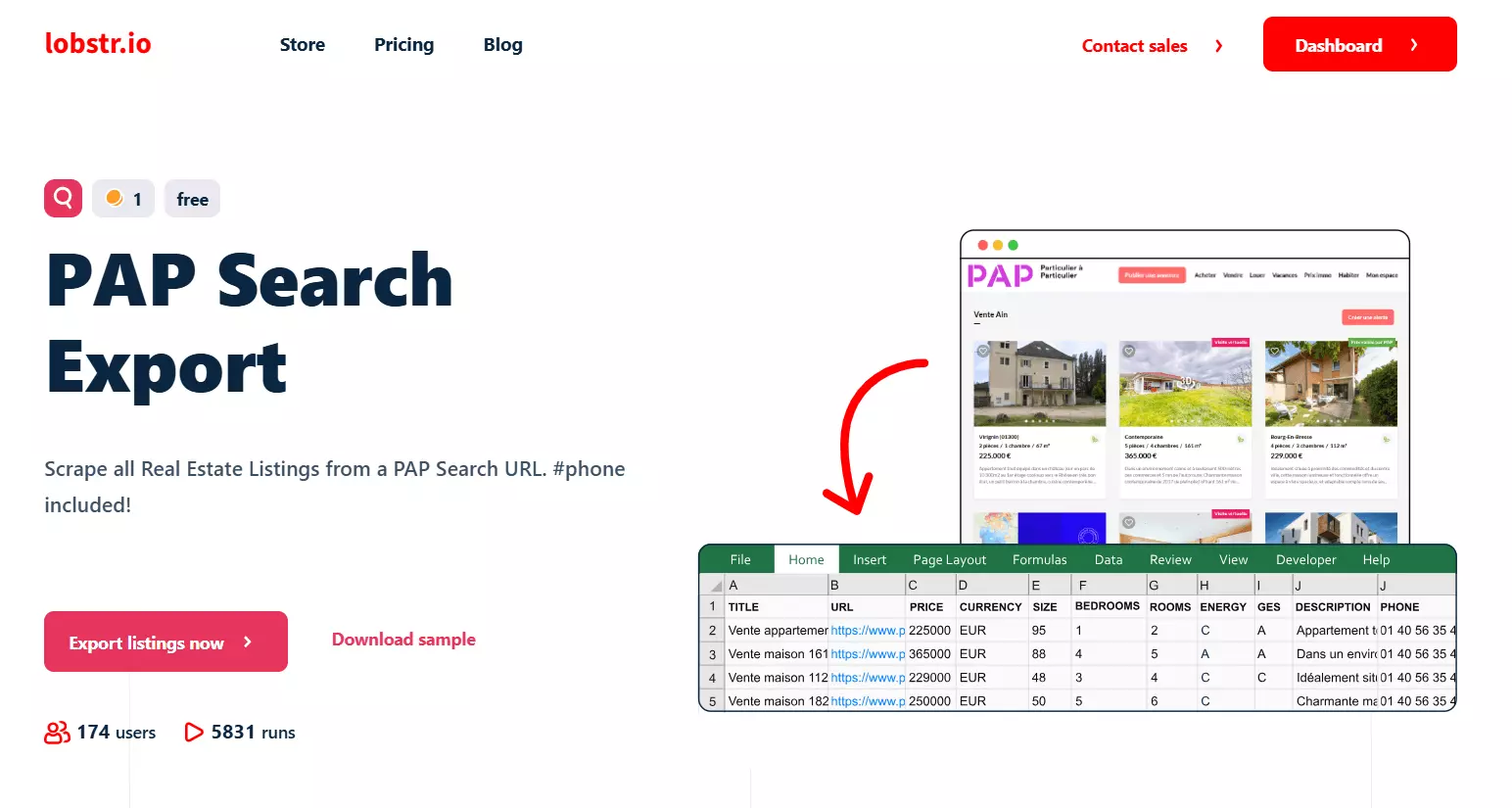
1. lobstr.io PAP Search Export
- User rating: 5.0/5 from 33 reviews on Capterra
- My score: 8.94/10
- Type: no-code cloud scraper
- Pricing from: $20/month
- Strongest at: recurring, high-volume PAP jobs where duplicate rows would cost you money
| Pillar | Score /10 |
|---|---|
| Data | 9.25 |
| Cost | 8.5 |
| Usability | 9.0 |
| Speed | 9.5 |
| Scalability | 9.0 |
| Support | 8.0 |
| Overall | 8.94 |
| Pros | Cons |
|---|---|
| Zero duplicate rows across 241 listings | No apport_defaut down-payment figure |
| Zero value errors across 942 field comparisons | More expensive than Apify below 10,000 listings |
| Found 5 listings Apify missed, and missed none | |
| 20 Slots per Squid, 100K listings in 6.2 hours | |
| Cheapest at scale, $0.50/1K | |
| Failed runs pause and auto-resume instead of dying |
Data
lobstr.io returns 33 meaningful field paths of 41 total, an 80.5% usable ratio.
| Category | Data points |
|---|---|
| 🏠 Listing core | URL, TITLE, BREADCRUMB, REF, PUBLICATION DATE, DESCRIPTION |
| 💰 Price | PRICE, CURRENCY 🎁, PRICE PER SQM 🎁, PRIX VALIDE |
| 📐 Property | TYPEBIEN, TYPEBIEN LABEL, PRODUIT, ROOMS, BEDROOMS, SIZE 🎁 |
| 📍 Location | NEIGHBORHOOD, LAT, LNG, TRANSPORTS |
| ⚡ Energy | ENERGY, ENERGY DESCRIPTION, GES, GES DESCRIPTION |
| 📷 Media | IMAGE URLS, VISITE VIRTUELLE 🐛, VIDEO, APPEL VIDEO |
| ☎️ Contact | PHONE, HAS EMAIL, AFFICHE DEMARCHAGE REFUSE |
| 🏷️ Flags | EXCLUSIVE |
TITLE, BREADCRUMB, CURRENCY, SIZE and PRICE PER SQM.Its biggest win against Apify: zero duplicate rows. 241 listings returned, 241 distinct, against Apify's 50 duplicates on 286 rows.
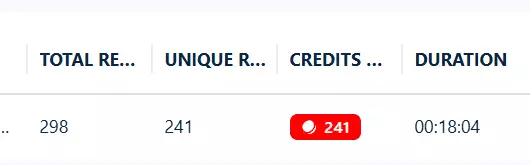
It also caught five listings Apify missed entirely, and missed none of Apify's.
PHONE populated on 171 of the 241.The virtual-tour extractor only understands one provider. 6 of 6 Matterport tours caught, with a cleaner URL than Apify's, but 0 of 10 Giraffe360 tours, confirmed against the live page.
Two listings of 236 also came back with no image, both single-photo listings. On the fix list.
TRANSPORTS arrives as one joined string where Apify nests it, but station counts match on 236 of 236 listings.caracteristiques: lobstr.io returns TYPEBIEN LABEL, ROOMS, SIZE and PRICE PER SQM separately.Verdict. The cleanest, most correct PAP dataset of the two, with one genuine hole in virtual-tour coverage.
Usability
You get thousands of search URLs per job, uploadable in bulk. That's the single biggest ergonomic gap between these two tools.
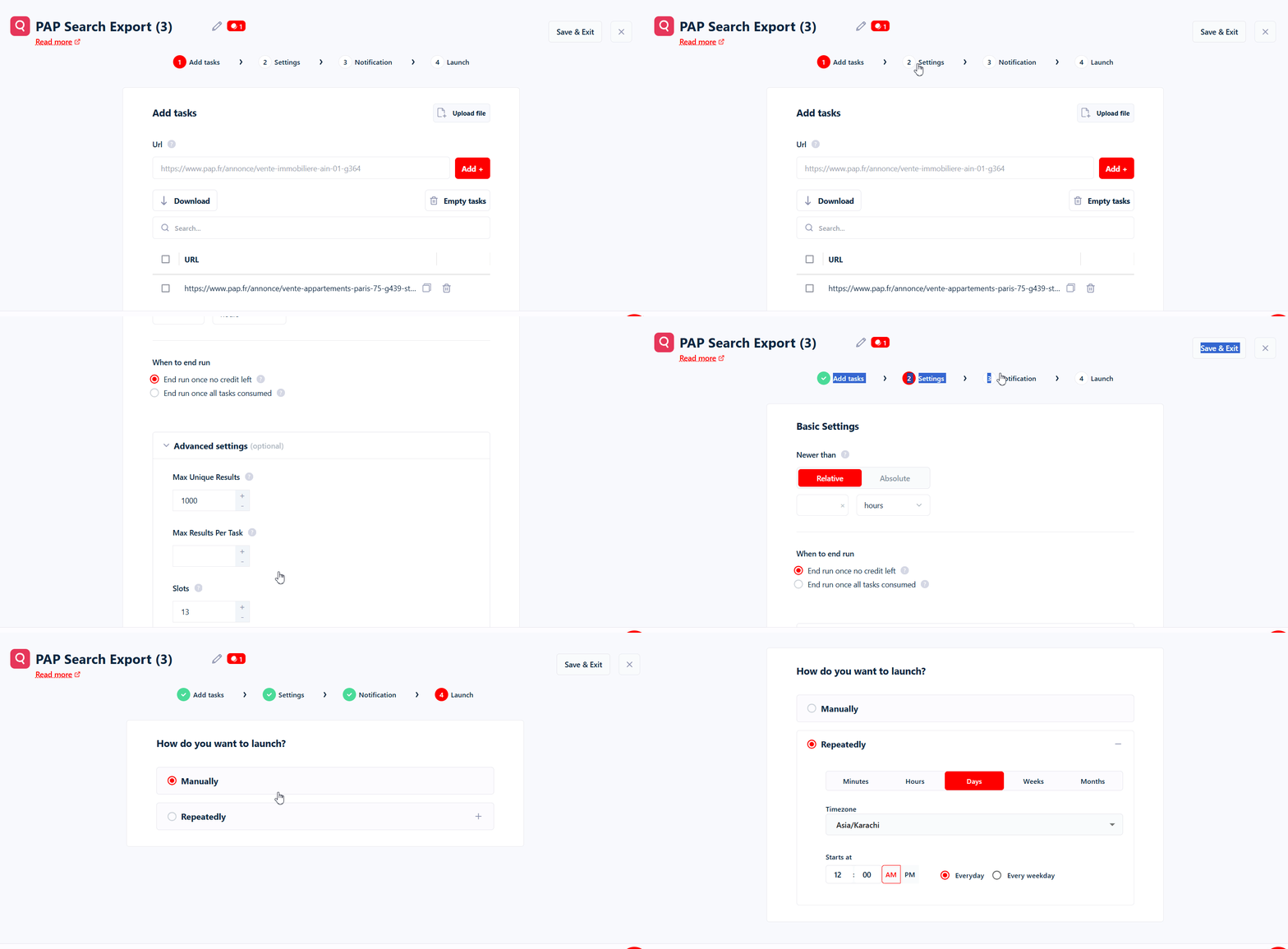
Pre-scrape filters, all free:
- Newer than, keeping only listings published after a relative duration (
24h,7d,2w) or an absolute date - Deduplication, applied before export
- Max listings per task
- Max total listings
The newer-than filter comes with a caveat lobstr.io documents itself.
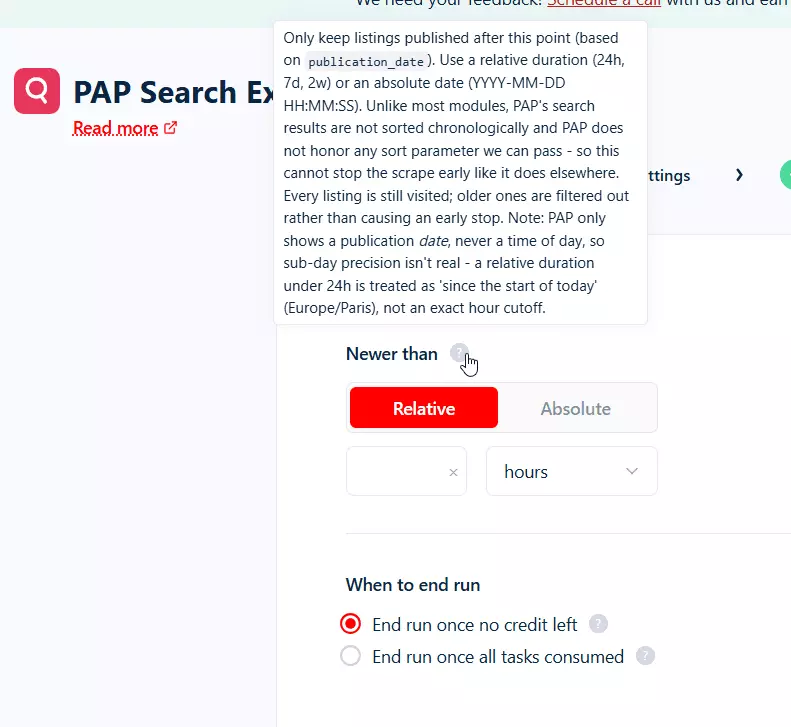
On PAP it filters correctly but can't stop the scrape early, because PAP's results aren't sorted chronologically and honor no sort parameter.
24h means "since the start of today" in Paris time.Exports run to CSV, Excel, JSON and JSONL, with delivery to Google Sheets, Amazon S3, SFTP, email or a webhook.
Scheduling sits in the Squid settings next to everything else, and doesn't need a manual run first.
First result took roughly 30 seconds to a minute. There's genuinely more to set up here than on the alternative.
Verdict. Everything you'd want to control before a run is a free UI field, at the cost of about a minute of setup.
Speed
13.39 listings per minute measured at a single Slot, which is the benchmark search's 241 listings in 18 minutes.
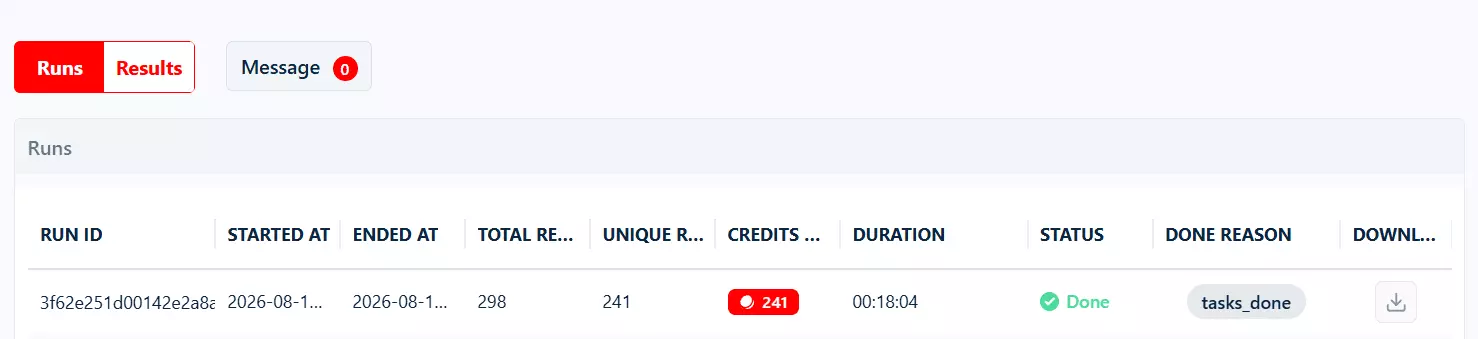
This scraper caps at 20 Slots per Squid, and I never clocked a multi-Slot run, so the scaled figure is computed from the measured single-Slot rate assuming linear scaling: 267.8/min at 20 Slots.
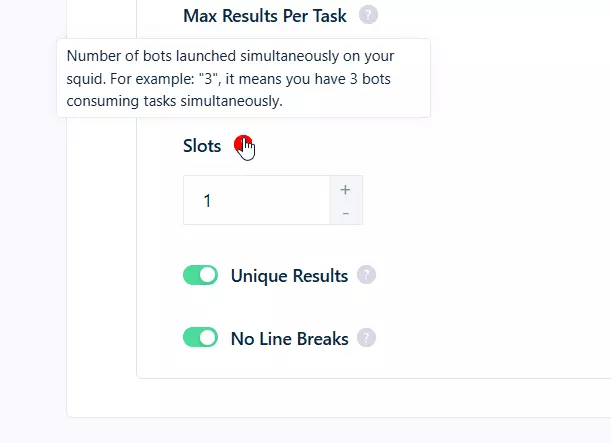
On that basis 100,000 listings takes 6.2 hours. At a single Slot it takes 5.2 days.
Verdict. Twice as fast as advertised at its floor, and the only tool here with a lever you can pull.
Cost
lobstr.io bills credits on a monthly subscription, one credit per listing.
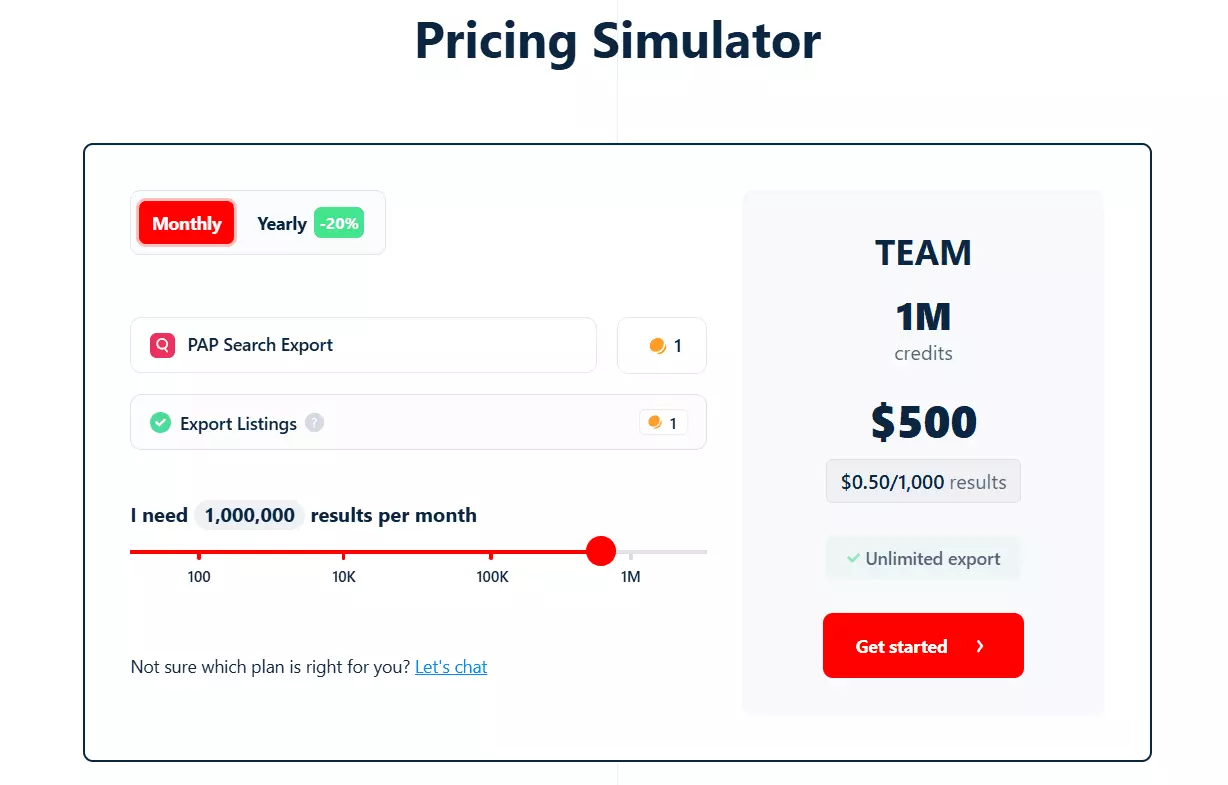
| Plan | Price | Credits | Per 1,000 |
|---|---|---|---|
| Starter | $20 | 10,000 | $2.00 |
| Pro | $100 | 100,000 | $1.00 |
| Team | $500 | 1,000,000 | $0.50 |
| Business | $1,000 | 2,000,000 | $0.50 |
So entry is $2.00/1K and scale is $0.50/1K. The 100,000-listing anchor job lands on Pro at exactly $100.
Failed and empty runs aren't charged.
And because deduplication happens before export, your credits track listings you can use... 298 collected on my run became 241 unique, and only the unique ones counted.
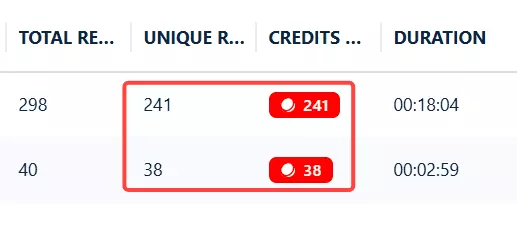
Below roughly 10,000 listings this is the more expensive option, by a clear margin: $2.00/1K on Starter against Apify's $1.20 flat.
That's a real Apify win. Know which side of that line your job sits on.
Verdict. The cheapest option above 10,000 listings and the more expensive one below it.
Scalability
At a single Slot, the measured rate gives a ceiling of 578,400 listings a month.
At 20 Slots, this scraper's cap per Squid, that scales to 11,568,000 listings a month, computed from the same rate. At the $0.50/1K scale price, running flat out all month would cost about $5,784.
Results stay downloadable for 30 days.
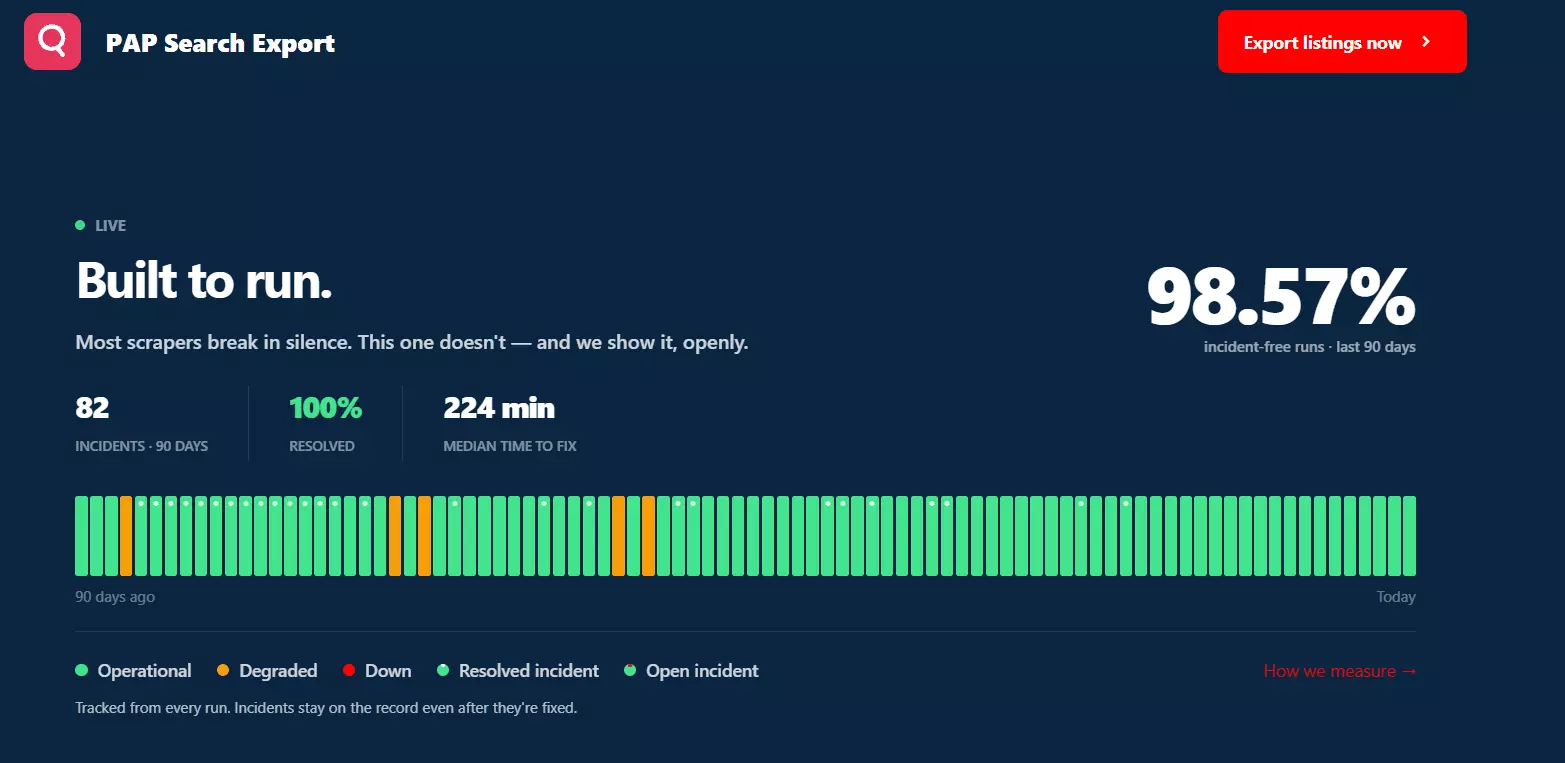
That's the record because a problem run pauses instead of dying. Abort it for partial data, or leave it and it auto-resumes once the fix ships.
Verdict. Real headroom at both Slot tiers, backed by a published incident record most competitors don't show.
Support
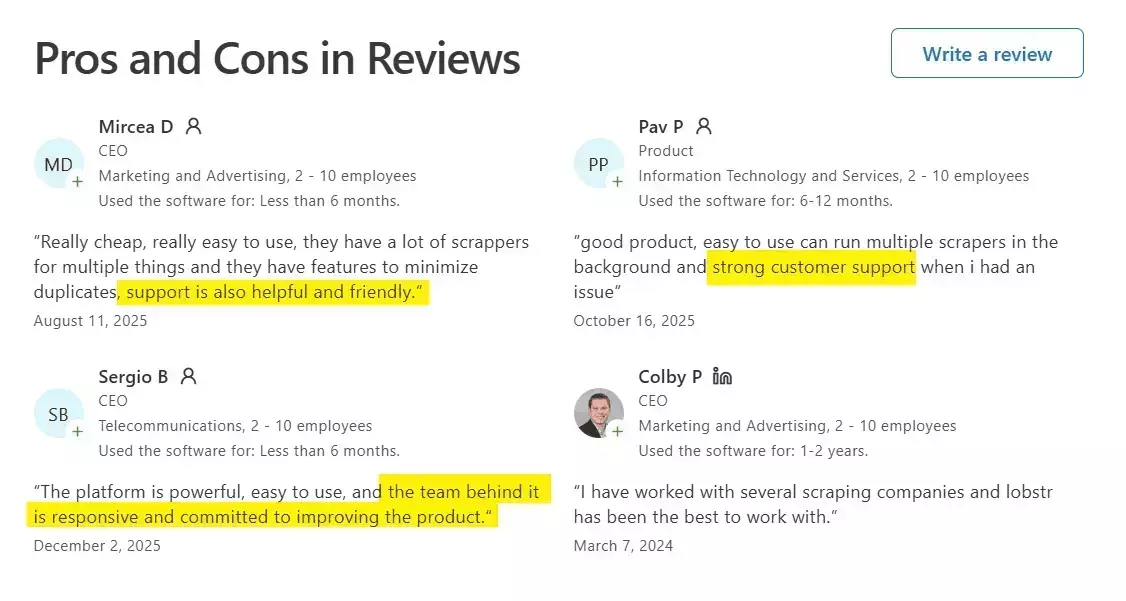
Verdict. Strong, and scored level with the alternative because nothing separated the two here.
Best for: the agency or investor running the same Paris searches every week, who'd rather spend a minute on setup than pay for 50 duplicate rows. You'll want Apify alongside it if virtual tours matter to your pipeline.
2. Apify Pap.fr Scraper
- User rating: 4.06/5 from just 2 reviews on the Apify store
- My score: 6.46/10
- Type: community-published marketplace actor
- Pricing from: $1.20 per 1,000 listings
- Strongest at: the single small search you never repeat
| Pillar | Score /10 |
|---|---|
| Data | 9.21 |
| Cost | 6.5 |
| Usability | 4.5 |
| Speed | 5.5 |
| Scalability | 4.0 |
| Support | 8.0 |
| Overall | 6.46 |
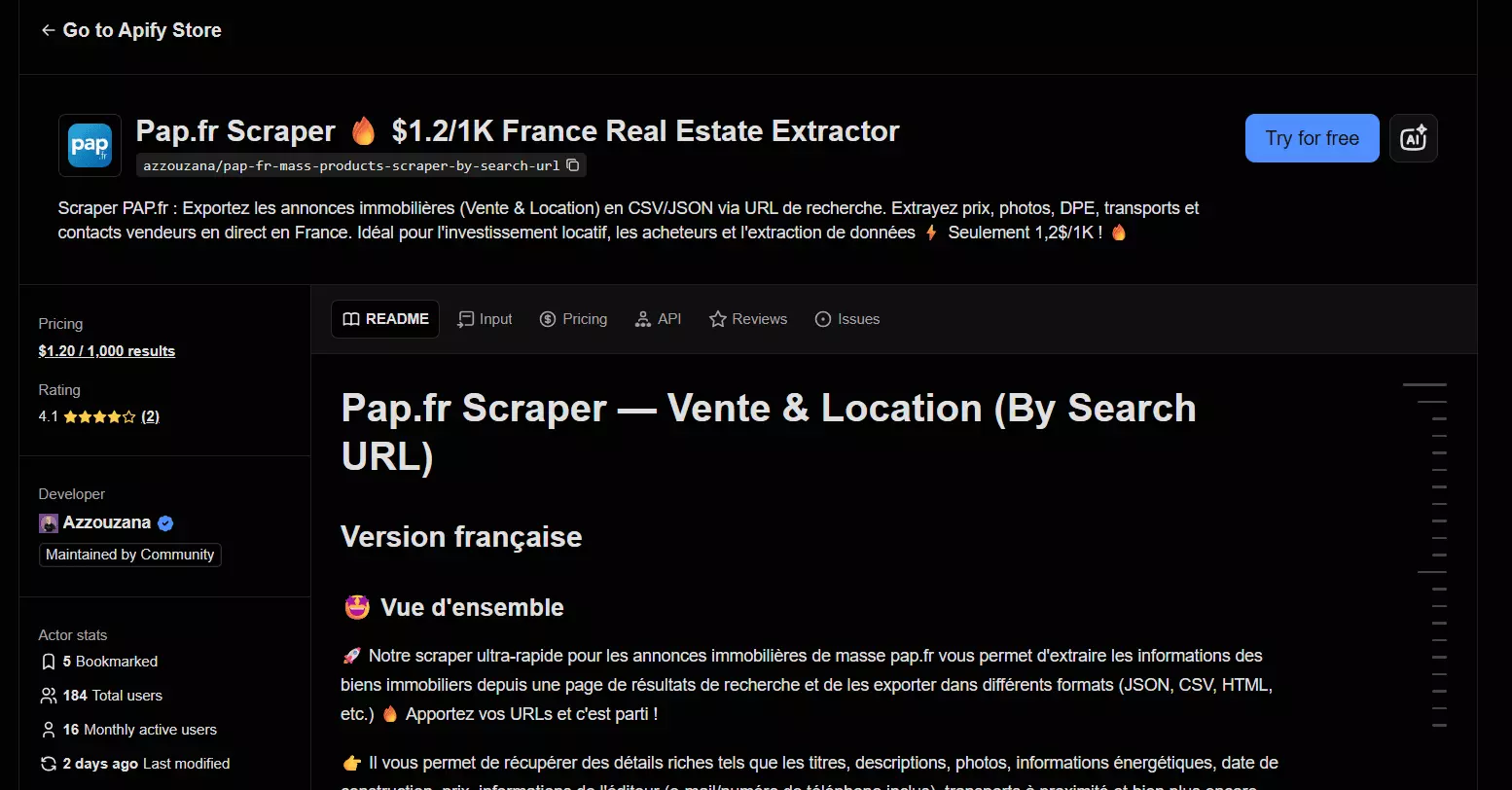
The tool here is Pap.fr Scraper 🔥 $1.2/1K France Real Estate Extractor, published on Apify by the developer Azzouzana.
One thing shapes half this review. It's a community-published actor, not an Apify-maintained one, which changes the ceiling, the support path, and who fixes it when PAP shifts its layout.
| Pros | Cons |
|---|---|
| Most field paths of the two, 40 meaningful | 50 duplicate rows, 17.5% of its own output, all billed |
| Populates more of its own schema, 82.5% | Takes only one search URL per run |
Only tool returning apport_defaut | exclusive flag is dead, wrong on 117 of 236 listings |
| Catches all 16 virtual tours | Every url is missing the listing slug |
| Cheapest below 10,000 listings | No pre-scrape filters beyond a total cap |
| Fastest to first result, about 10 seconds |
Data
Apify returns 40 meaningful field paths of 48 total, an 83.3% usable ratio and the widest surface area of the two.
| Category | Data points |
|---|---|
| 🏠 Listing core | url, reference_courte, date, texte, texte_accroche, texte_contact |
| 💰 Price | prix, prix_valeur, prix_valide, apport_defaut 🎁 |
| 📐 Property | typebien, typebien_slug, typebien_label, produit, nb_pieces, nb_chambres_max, caracteristiques |
| 📍 Location | titre, marker.lat, marker.lng, transports[].label, transports[].pictos[] |
| ⚡ Energy | classe_energie.lettre, classe_energie.description, classe_ges.lettre, classe_ges.description |
| 📷 Media | photos[], visite_virtuelle, video, appel_video[] |
| ☎️ Contact | telephones[], has_email, affiche_demarchage_refuse, site_perso |
| 🏷️ Flags | exclusive 🐛, avant_premiere |
It also fills more of its schema, 82.5% against 75.5%. Both of those wins carry an asterisk, since Apify was the baseline and breadth is scored against its own field set.
Its one clean field-level advantage is apport_defaut, PAP's default down-payment figure, present on all 236 listings and not derivable from the price.
lobstr.io has no equivalent anywhere.
Apify also catches all 16 virtual tours, including the 10 Giraffe360 embeds lobstr.io drops.
Then the problems, all checked against the live PAP pages.
It shipped 50 duplicate rows, 17.5% of the 286 it returned, spread across 34 listings. One listing appears four times, with payloads identical apart from the scrape timestamp.
exclusive flag is a dead field. It returns False on all 236 listings, while PAP shows its exclusivity badge on 117 of them, which I verified on three listings directly.Any filter you build on that field is silently wrong half the time.
url is broken-shaped. It returns pap.fr/annonces/-r462301050 with the slug omitted, on all 236 records.titre on all 236.photos fill rate is flattered too, by five listings where the only "image" is PAP's own visuel-nophoto.png placeholder.apport_defaut, undercut by a dead flag, malformed URLs and 50 rows of noise you pay for.Usability
startUrl and maxItemsToScrape.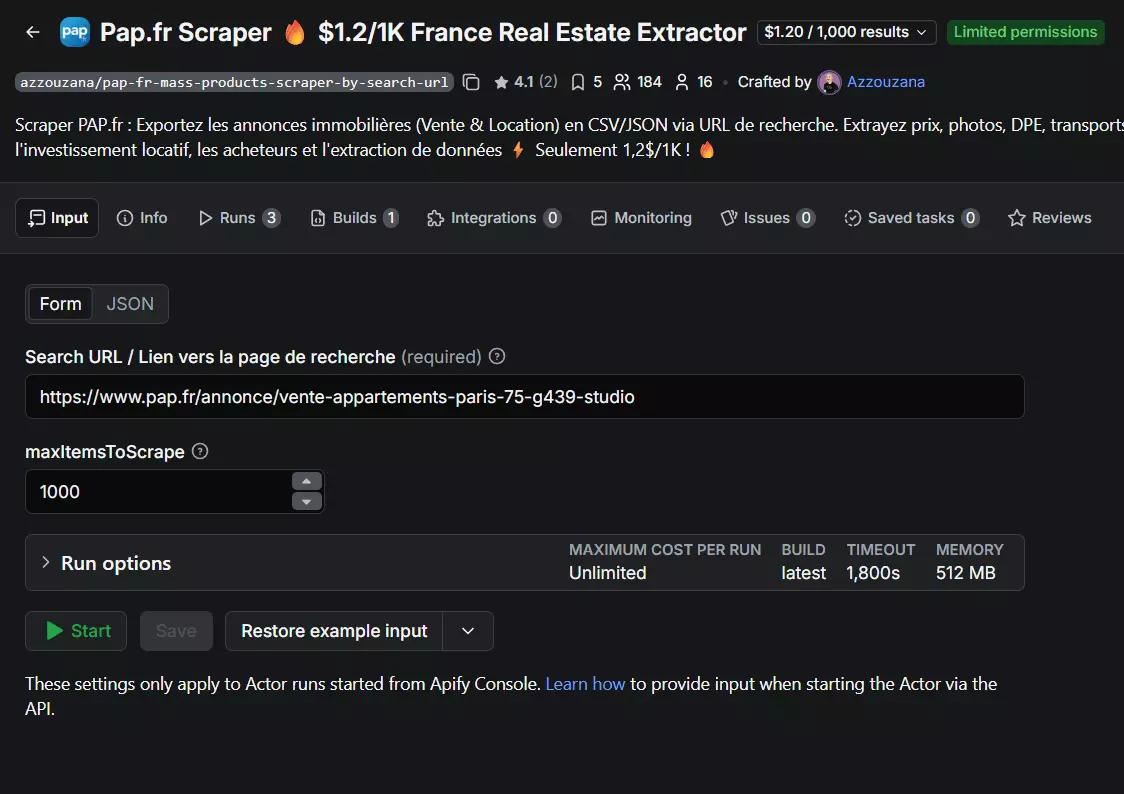
One search URL per run. No newer-than filter, no deduplication, no per-task cap.
Covering ten Paris arrondissements means ten separate runs you orchestrate yourself.
Exports cover JSON, CSV and HTML, and you pick the format at download rather than before the run.
The platform side is genuinely strong. A REST API, webhooks on run success and failure, GitHub-triggered runs, an MCP server.
Documented destinations cover Snowflake, Airtable, Google Drive, HubSpot, n8n, Make and Zapier.
Scheduling exists but sits in a top-right menu away from the actor's own configuration, which took me longer to find than it should have.
Verdict. Ten seconds to your first row, then a wall... one URL, one cap, and nothing else to turn.
Speed
13.11 listings per minute, measured: the benchmark search's 236 distinct listings in 18 minutes at 512 MB.

Here's what decides this pillar. 512 MB is this actor's hard cap, tested, and memory is its only speed control.
There's no Slot slider, no worker count, no concurrency lever of any kind.
So 13.11/min isn't a base rate. It's the ceiling, and 100,000 listings takes 5.3 days with nothing you can buy to shorten it.
On the benchmark search the two tied exactly, both at 18 minutes. That tie is misleading, though, because lobstr.io was throttled to a single Slot while Apify was already flat out.
Let both run at their own maximums and lobstr.io is roughly 20× faster.
Verdict. Fine for one search, structurally stuck for anything bigger, with no upgrade path.
Cost
$1.20 per 1,000 listings, flat, on a pay-per-event model with no separate platform fee and no discount at any volume.
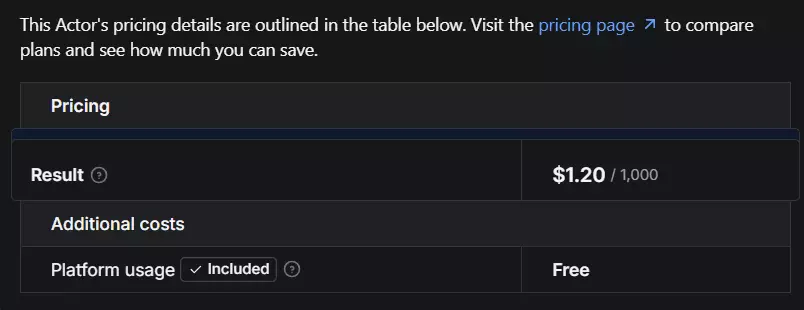
That sticker price isn't what you pay per usable listing. I was billed for all 286 rows, duplicates included, to get 236 unique ones.
Based on this run that's 1.212 billed rows per unique listing, or an effective $1.45 per 1,000 unique listings... a 21% premium over the advertised rate.
At that effective rate the 100,000-listing job costs $145, against $120 at sticker price and $100 on lobstr.io.
The crossover is clean, and it genuinely favours Apify at the bottom:
- Below ~10,000 listings, Apify wins at $1.20 against lobstr.io Starter's $2.00
- 10,000 to 100,000, lobstr.io Pro at $1.00/1K comes in ~31% under Apify's effective rate
- At 1M listings, lobstr.io is 2.9× cheaper, $500 against $1,454
Failed and empty runs aren't charged, which is fair. Duplicate rows are, which isn't.
Verdict. Genuinely the cheaper choice for a small one-off job, and the more expensive one everywhere above 10,000 listings.
Scalability
At 13.11/min across 43,200 minutes, the ceiling is 566,400 listings per month. There are no tiers above it, because there's no concurrency to multiply by.
That's the paper ceiling and the real one at once, because the memory cap that sets its speed is also its only lever.
The single-URL input compounds it. Running many PAP searches means hand-orchestrating many runs rather than loading a list.
When a run breaks, it stops. No pause state, no auto-resume... abort is the only option, and finishing the job means starting over.
Results stay downloadable for 30 days, matching lobstr.io.
On maintenance I have no signal either way. One developer, 17 monthly users, and nothing on how fast it gets fixed when PAP changes its layout.
That's missing evidence rather than evidence of abandonment... the two issues raised against it were both resolved on time.
Verdict. A measured ceiling you cannot raise, and a broken run means starting again.
Support
There is no official Apify support for this scraper. It's community-published, so platform support doesn't own it. Your escalation path is the developer's Discord and email.

On the actor's own record, two issues have been raised and both were resolved on time. That's a clean history on low volume, and the reason this pillar scores level with lobstr.io rather than below it.
One developer's inbox is still a different risk profile from a company's SLA, even when the developer is responsive.
Verdict. No platform safety net, but the developer's actual record on this actor is clean.
apport_defaut or full virtual-tour coverage and will happily dedup the output themselves. Budget for 21% more rows than you need.The PAP.fr scrapers that didn't make the list
These aren't bad products. They lost on the one thing this article can't compromise on... neither could finish a run on PAP.fr.
| Tool | Rows returned | Fields populated | Speed | Cost | Failed criterion |
|---|---|---|---|---|---|
| Octoparse | 16, then stopped | 3 of 11, two of them wrong | 6 lines/min | Paid plan + paid captcha add-on | L3 run failure |
| Scraping-Bot | First 2-3 pages, then 500s | Unknown, run never completed | Not measurable | Never got past login | L3 ~40% success |
Octoparse
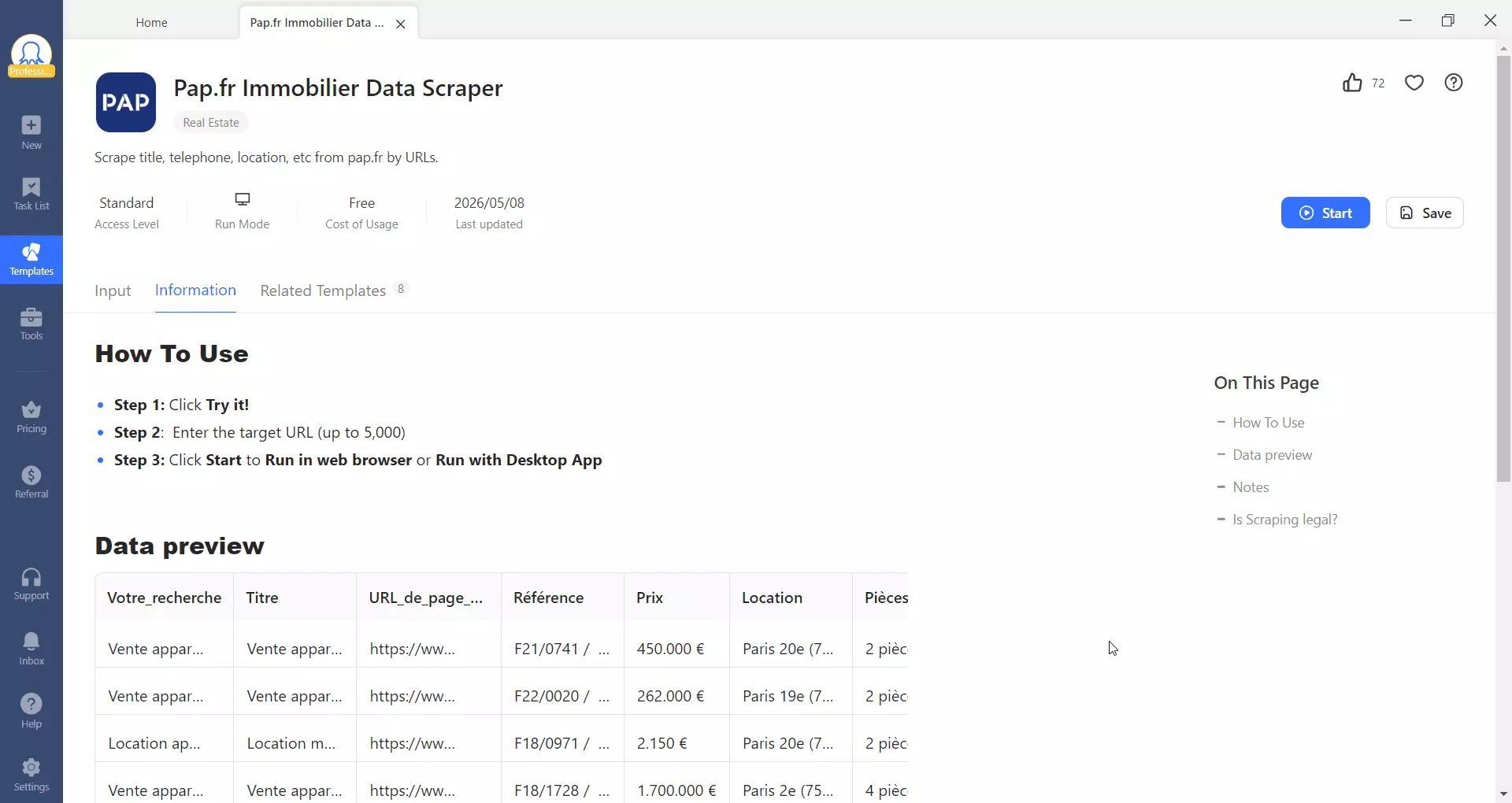
In practice it behaves more like browser automation than a scraper, and it was slow on PAP before it hit any wall at all.
But that's not even the frustrating part. I paid for subscription to use its Captcha solver and Proxies because you can't run PAP scraper without them.
After wasting my money on this crap, I found out, it can't do the job at all.
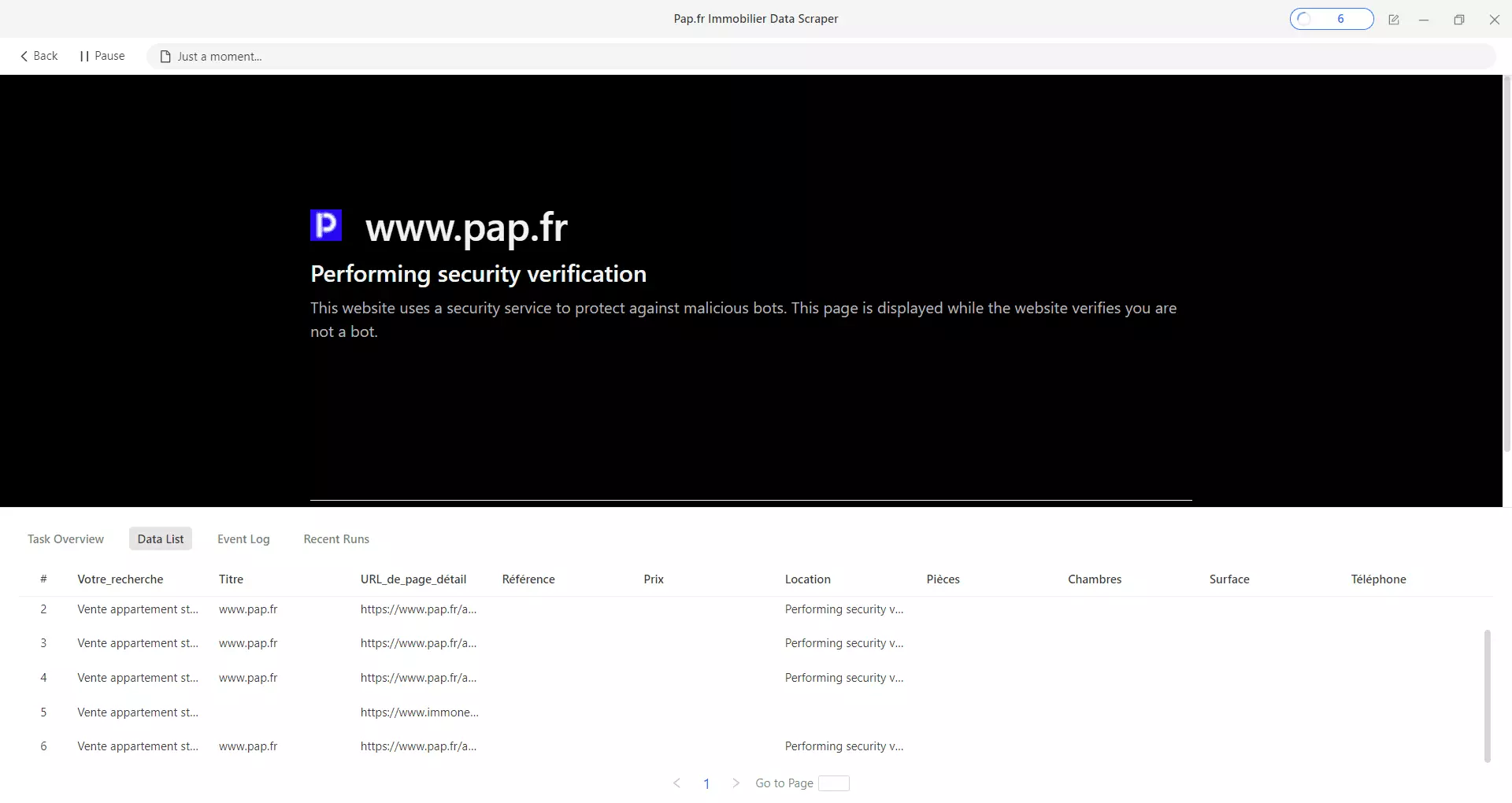
Who it's right for: nobody, for PAP.fr. I'd rather say that plainly than invent a consolation use case for a tool that couldn't return a single price.
Scraping-Bot
invalid Security Verification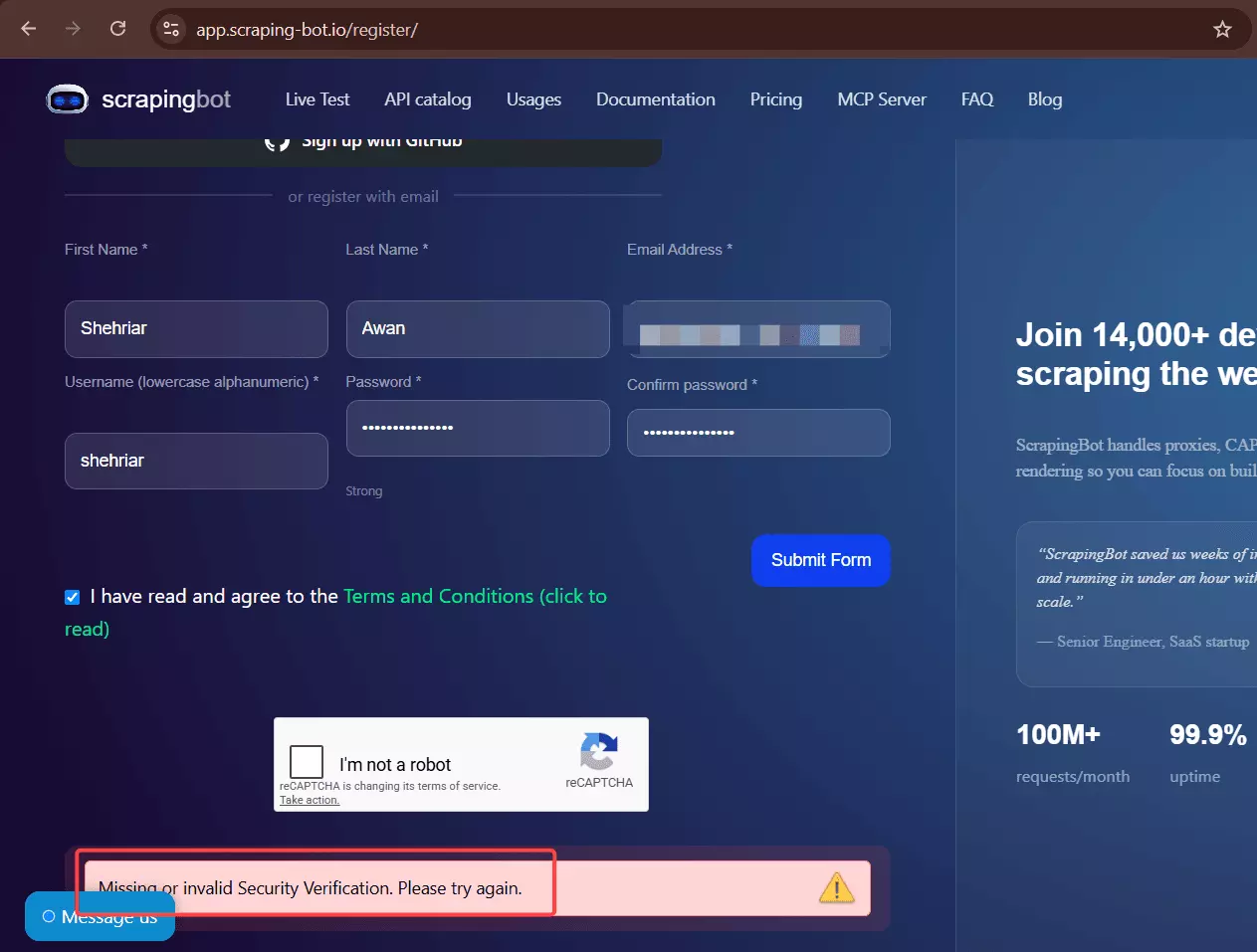
Who it's right for: nobody, on this platform, on the evidence I have. If your stack is already built on Scraping-Bot for other sites, its PAP endpoint might be worth a retest later... it just didn't hold up in mine.
FAQ
Which PAP.fr scraper returns the most data?
Apify edges it on raw coverage, but the two are level on data quality. Apify returns 40 meaningful field paths to lobstr.io's 33, and fills 82.5% of its schema against 75.5%.
It leads breadth partly because it was the measurement baseline.
apport_defaut.What's the cheapest PAP.fr scraper at scale?
lobstr.io, at $0.50 per 1,000 listings on Team ($500 for 1M credits) or Business ($1,000 for 2M).
Apify is flat at $1.20/1K with no volume discount, and its effective rate is $1.45 per 1,000 usable listings because it bills duplicate rows. At 1M listings that's $500 against $1,454.
Which PAP.fr scraper is cheapest for a small job?
Apify, and it's not close. Below roughly 10,000 listings its $1.20/1K flat rate beats lobstr.io's $2.00 Starter rate. Above that line lobstr.io's $1.00/1K takes over.
Which PAP.fr scraper is fastest?
lobstr.io, once you let it run flat out. Both finished the benchmark search in the same 18 minutes, but lobstr.io was throttled to one Slot while Apify was already at its 512 MB maximum.
At 20 Slots lobstr.io clears 100,000 listings in a computed 6.2 hours. Apify needs a measured 5.3 days and has no lever to shorten it.
Which PAP.fr scraper is most accurate?
lobstr.io, with zero value errors across 942 field comparisons.
exclusive flag returns False on all 236 listings when 117 actually carry PAP's exclusivity badge, every url omits the listing slug, and the description tail is truncated on 20 of 236.Best PAP.fr scraper for real estate lead generation?
lobstr.io. It returned a phone number on 171 of 241 listings, and dedups before export so you aren't paying for repeats.
It also takes thousands of search URLs per job, so one run covers every arrondissement you care about.
PAP is private-sellers-only, so treat those numbers as personal data and read the legal section first.
Does PAP.fr have an official API?
No. PAP publishes no developer API, no partner endpoint and no documentation. Third-party aggregators resell PAP data, but PAP itself offers nothing, which is why every option in this article is a scraper.
Is scraping PAP.fr legal?
PAP doesn't allow it, and that isn't the same as illegal. Its robots.txt bans over 150 extraction agents by name and disallows every parameterised URL.
What matters more is what you do next.
Internal analysis of non-substantial data sits in far safer territory than republishing, and seller phone numbers are personal data under GDPR either way. Not legal advice.
What's a good alternative to the Apify PAP scraper?
lobstr.io PAP Search Export, on the numbers here: comparable data quality, roughly 20× the throughput at full concurrency, $100 against $145 for 100,000 listings, and dedup before you're billed.
apport_defaut or complete virtual-tour coverage.Is there a free PAP.fr scraper?
Not one that finished a run in my testing. Both tools I'd recommend are paid, and Octoparse failed on a paid plan with a separately-paid captcha add-on on top of it.
Can I verify these numbers?
Seller phone numbers are redacted in the JSON, since they're personal data under GDPR. They're replaced with a fixed marker rather than deleted, so you can still count exactly how many listings carried one.
Conclusion
That's a wrap on the best PAP.fr scrapers for 2026.
Every PAP.fr scraper I could find, four shortlisted, the same search URLs on each. Two never finished a run.
- lobstr.io PAP Search Export owns volume and correctness. Zero duplicates, zero value errors, 100,000 listings in 6.2 hours for $100, and a failed run that resumes itself. The pick for anything recurring or above 10,000 listings
- Apify's Pap.fr Scraper owns the small job. Cheapest below 10,000 listings, widest field surface, the only source of
apport_defaut, and all 16 virtual tours. The pick for one search you run once and clean up yourself
The two are genuinely level on data quality. Everything separating them is what happens afterwards... what it costs, how fast it goes, and whether a broken run means starting over.
This list evolves as tools ship updates, and I'll keep it current.