Best Trustpilot Reviews Scrapers 2026 [No-Code Edition]
(updated)
Apify is the best Trustpilot review scraper I tested. It returned the most reviews (924), was the fastest across the full 30-day window (1m 31s), and was the only tool with sentiment and topic data on every review. lobstr.io ranks 2nd: it returned 918 reviews and was stronger for scaling, but took longer.
⚡ 30-Second Summary
- I tested four Trustpilot scrapers on the same company and 30-day window. Only two made it past the ~200-review barrier and into the ranking.
- Apify ranks 1st (8.86/10). It had the deepest review data, fastest full-window run, and lowest entry price, but charges a fee each time a run starts.
- lobstr.io ranks 2nd (8.27/10). It returned 918 reviews across the full 30 days and scales well, but it's slower.
- Bright Data and Outscraper stay unranked. Both stalled around 200 reviews in testing, making them a poor fit when you need deeper review history.
Most Trustpilot scrapers have a funny idea of "done."
You ask for 1,000 reviews and they give you 200 like that's the whole job.
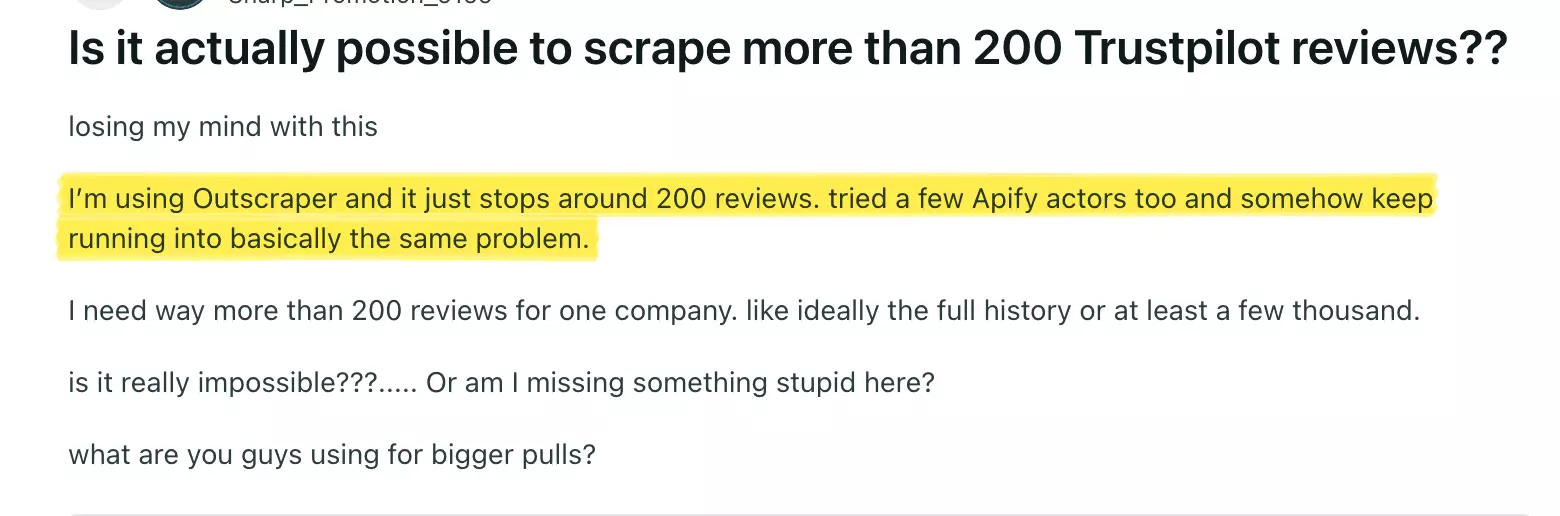
So I tested popular options to see which ones actually keep going.
Each got the same company and the same 30-day window. I compared data, cost, usability, speed, scalability, and support.
Here's what I got.
| What matters | Apify | lobstr.io |
|---|---|---|
| Overall score | 8.86/10 | 8.27/10 |
| Reviews returned (30 days) | 924 | 918 |
| Covered the full 30 days | ✅ | ✅ |
| Useful data points | 59 | 33 |
| Sentiment + topics | ✅ | ❌ |
| Company rating breakdown | ✅ | ❌ |
| Price per 1,000 (entry → scale) | $0.65 → $0.50 | $2.00 → $0.50 |
| Speed (reviews/min) | 612 | 360 |
| Support | Apify Issues | Live chat + email |
| User rating | 4.8/5 (20) | 5.0/5 (33) |
Just tell me which one
| If you care most about... | Go with | Why |
|---|---|---|
| The best review data | Apify | 924 reviews + sentiment and topic tags |
| The lowest cost at scale | lobstr.io | $0.50/1K, with no per-run fee |
| Speed | Apify | 924 reviews in 1m 31s |
| Scaling across companies | lobstr.io | 5,000/5,000 returned + configurable Slots |
| Best support | lobstr.io | Live chat + email + 5/5 Capterra review for support |
⚠️ Disclaimer
Not legal advice. Laws vary by country and change over time. For your situation, check with a qualified lawyer.
Is scraping Trustpilot reviews legal?
Yes, under the right conditions.
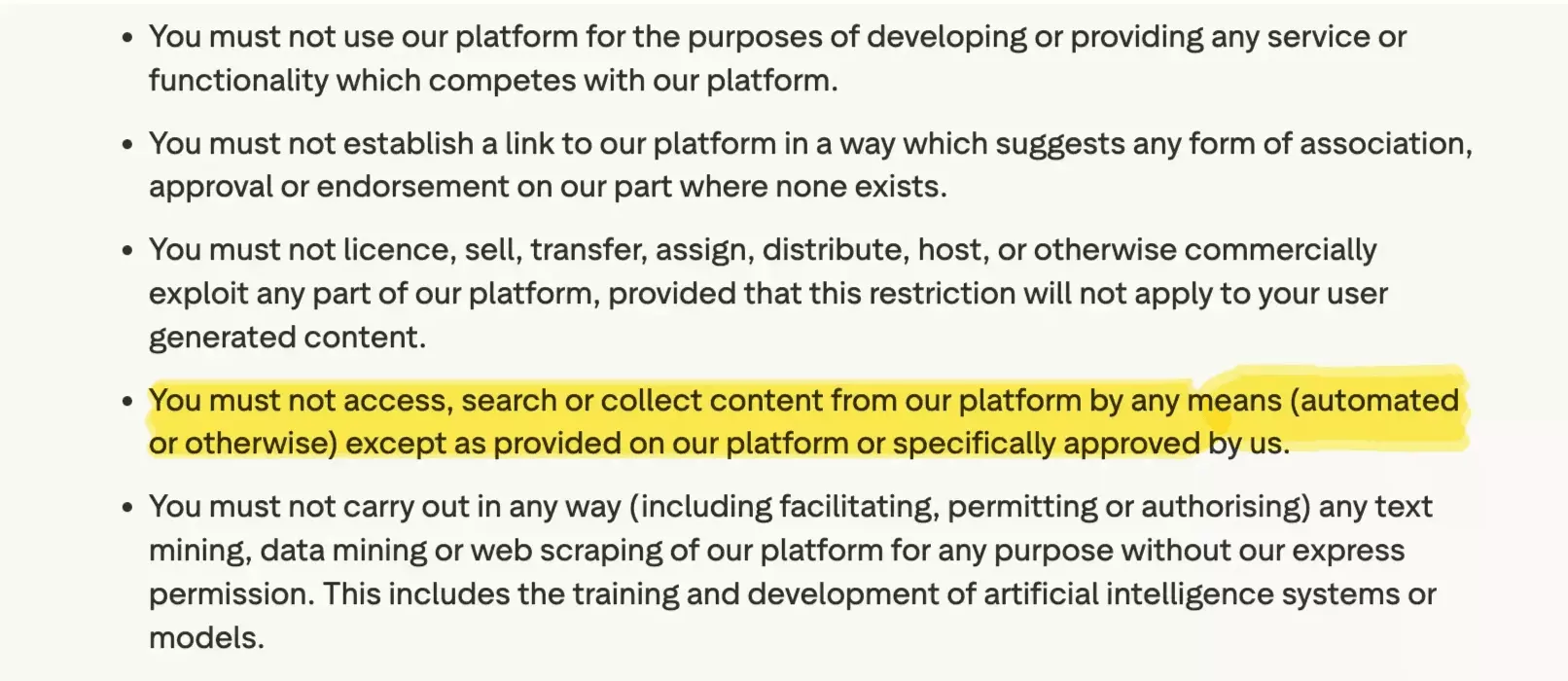
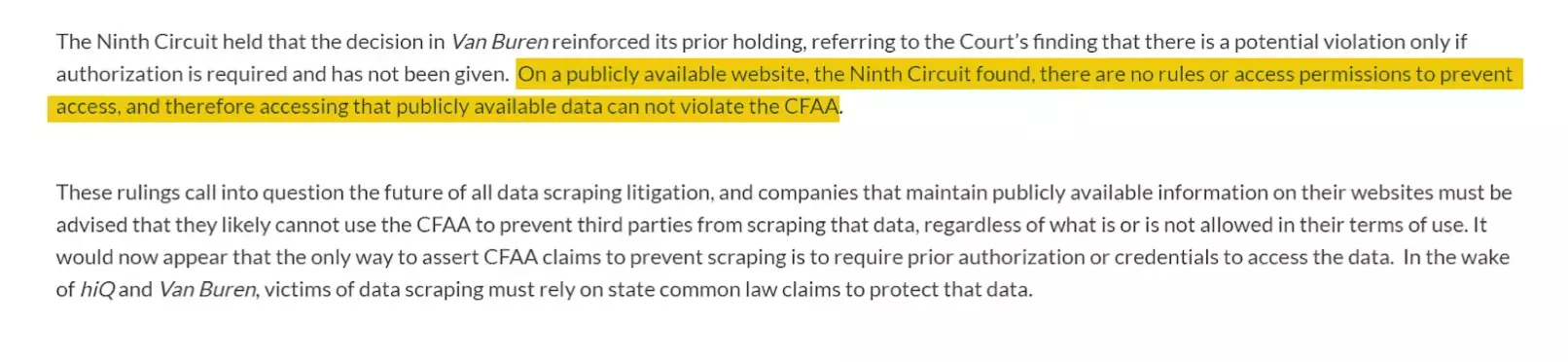
That said, the risk also depends on what you do with the data.
If you store or republish content without permission, you can run into copyright issues.
How to stay on the right side:
- Collect public data internally for research or analysis
- Don't republish Trustpilot reviews on a public-facing surface without permission
- Don't combine the data with PII for profiling without a legal basis
- Respect rate limits... don't hammer the platform
How I chose the best Trustpilot review scrapers
I built a longlist from Google, Reddit, review sites, developer discussions, and AI recommendations.
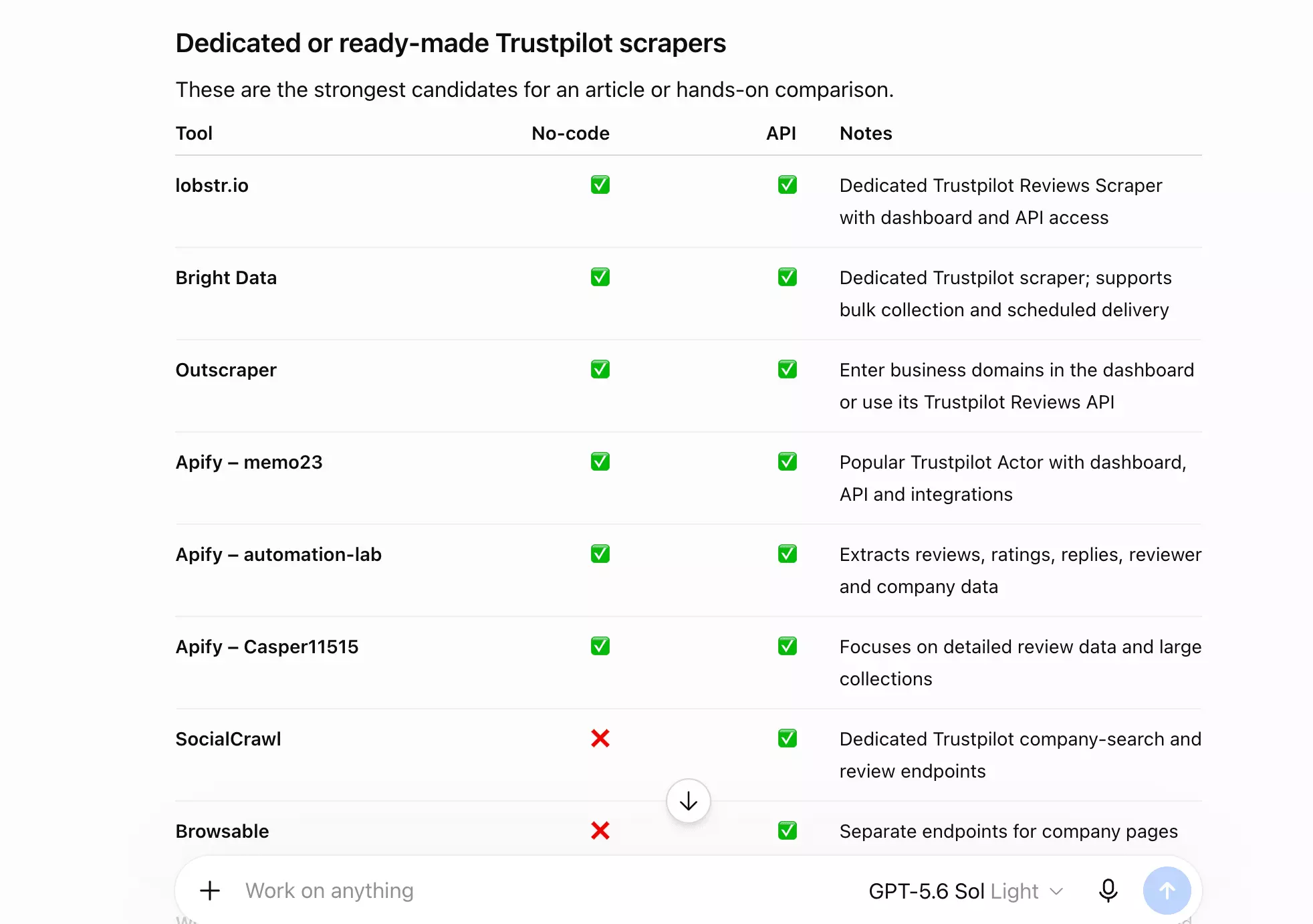
Then came the main cutoff: could it return more than 200 reviews from one Trustpilot company?
Tools capped at 200 didn't make the main list.
What I left out
- General-purpose APIs: no Trustpilot parser, so you build the extraction yourself.
- Browser extensions: no API or unattended scheduling.
- Abandoned open-source tools: no longer maintained for Trustpilot's current pages.
How I tested
I used HelloFresh UK, where the 30-day test window contained well over 200 reviews.
Each scraper got the same company and 30-day window. Where supported, I set a 1,000-review safety cap.
I checked reviews returned, duplicates, date coverage, runtime, errors, and retries.
How I scored them
I scored each tool on six criteria:
- Data: coverage, useful fields, duplicates, and quality
- Cost: entry and scale pricing
- Usability: setup, filters, exports, and automation
- Speed: measured runtime on comparable workloads
- Scalability: batch jobs, concurrency, and limits
- Support: support options and evidence of issue handling
How the scores landed
| Criterion (weight) | Apify | lobstr.io |
|---|---|---|
| Data (2.2) | 9.5 | 7.5 |
| Cost (2.2) | 9.0 | 8.0 |
| Usability (1.8) | 8.5 | 9.0 |
| Speed (1.8) | 9.5 | 8.0 |
| Scalability (1.0) | 7.5 | 9.0 |
| Support (1.0) | 8.0 | 9.0 |
| Weighted overall /10 | 8.86 | 8.27 |
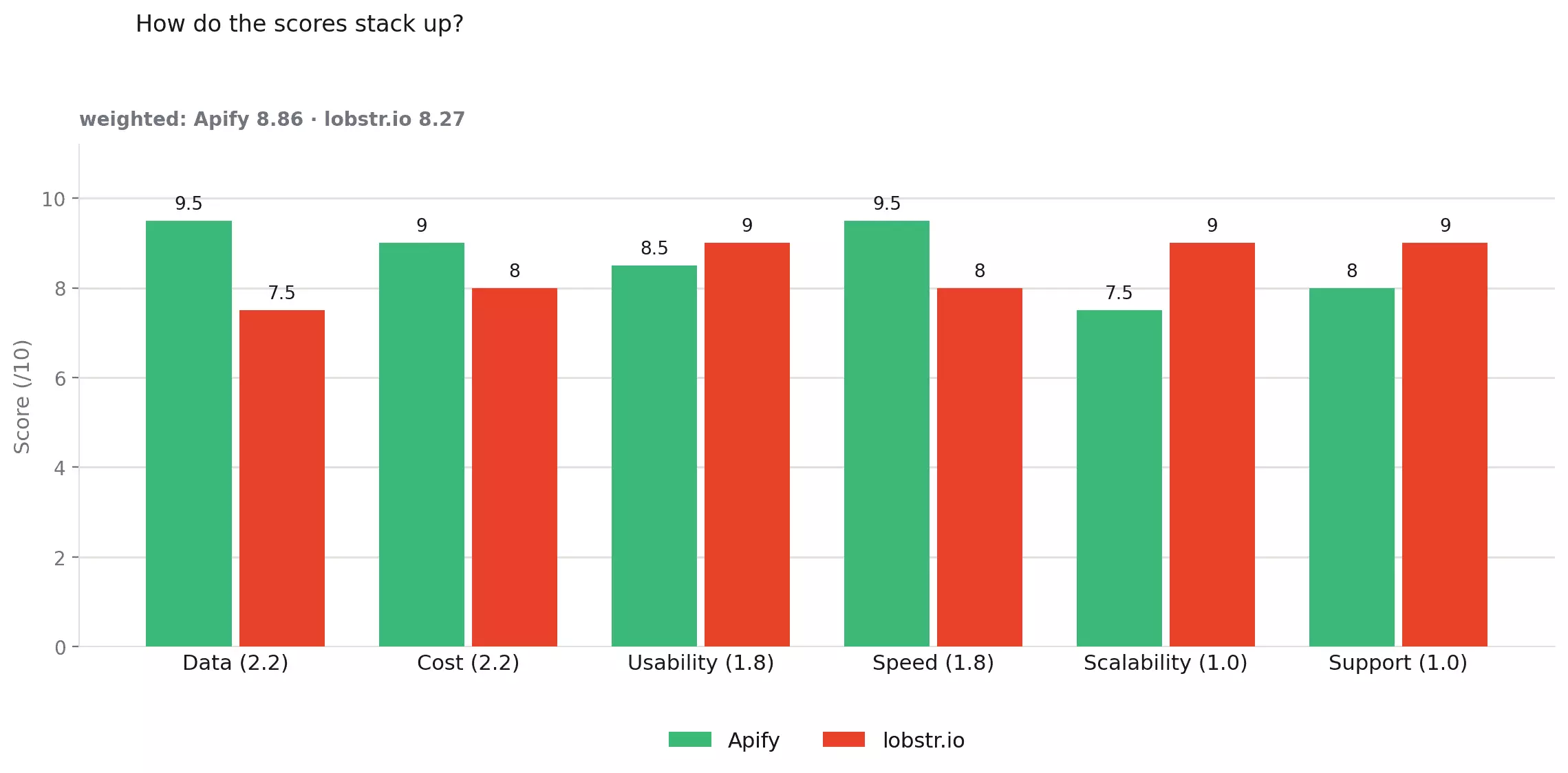
Each criterion is scored from 0 to 10 and weighted by its importance to the buying decision:
Data 2.2 · Cost 2.2 · Usability 1.8 · Speed 1.8 · Scalability 1.0 · Support 1.0
Overall = Σ(criterion score × weight) ÷ 10
The overall score doesn't mean one tool wins every category. lobstr.io scored highest on usability, scalability, and support, while Apify scored highest on data, cost, and speed.
The best Trustpilot review scrapers
| What matters | Apify | lobstr.io |
|---|---|---|
| Overall score | 8.86/10 | 8.27/10 |
| Reviews returned (30 days) | 924 | 918 |
| Covered the full 30 days | ✅ | ✅ |
| Useful data points | 59 | 33 |
| Sentiment + topics | ✅ | ❌ |
| Company rating breakdown | ✅ | ❌ |
| Price per 1,000 (entry → scale) | $0.65 → $0.50 | $2.00 → $0.50 |
| Speed (reviews/min) | 612 | 360 |
| Support | Apify Issues | Live chat + email |
| User rating | 4.8/5 (20) | 5.0/5 (33) |
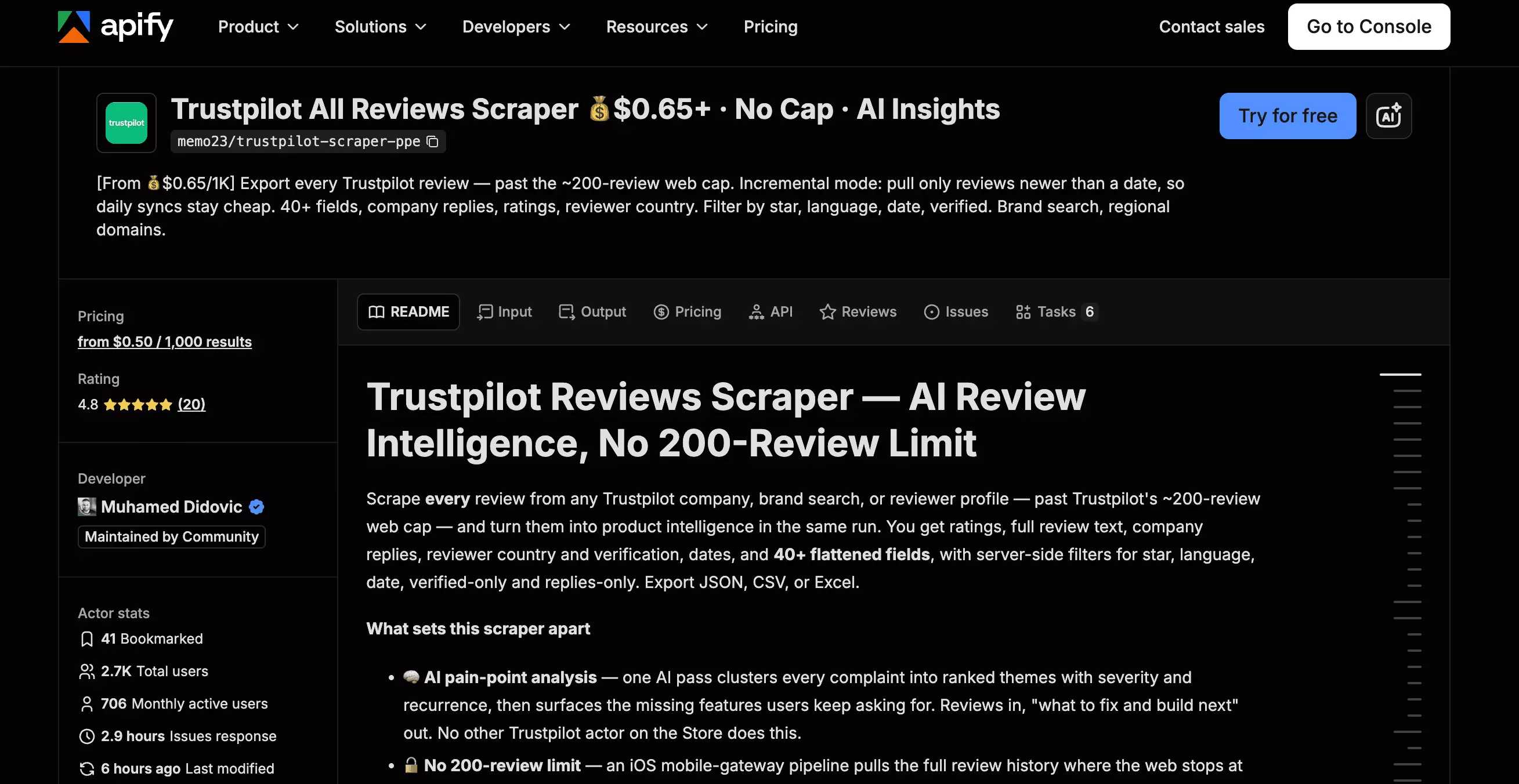
1. Apify — memo23/trustpilot-scraper-ppe
- User rating: 4.8/5 from 20 reviews on Apify Store, as of September 16, 2026
- My rating: 8.86/10
- Type: No-code + API + MCP
- Pricing: Starts at $0.65, scales to $0.50 per 1,000 reviews, plus $0.04 per run
- Strongest at: the deepest review record, Trustpilot's own sentiment tags, and the lowest entry price of anything I tested.
| Pillar | Score /10 |
|---|---|
| Data | 9.5 |
| Cost | 9.0 |
| Usability | 8.5 |
| Speed | 9.5 |
| Scalability | 7.5 |
| Support | 8.0 |
| Overall | 8.86 |
| Pros | Cons |
|---|---|
| Deepest data: 59 useful fields, including sentiment + topics | $0.04 per-run fee makes frequent small jobs more expensive |
| Full 30-day coverage: 924 reviews, no duplicate review IDs | Support depends on the independent Actor developer |
| Fastest full-window run: 924 reviews in 1m 31s | |
| Lowest entry price: $0.65 per 1,000 |
Data
This one gives you the most to work with. 59 useful data points, more than anything else I tested.
| Data | What you get |
|---|---|
| Review | ID, URL, title, text, star rating, language, source |
| Verification | Verified flag, level, subtype, source, verification date |
| Dates | Published, experience, updated |
| Reviewer | Name, ID, image, country, review counts, verified flag |
| Engagement | Likes |
| Company reply | Reply text, published date, updated date |
| Sentiment | Sentiment and topic spans for each review |
| Status | Active/pending, filtered, reports, latest-review flags |
| Company | Name, domain, URL, category, TrustScore, rating, review count |
| Company details | Description, address, phone, category rankings, star distribution, reply statistics |
It pulled 924 reviews with zero duplicates, and every value matched what the other tools returned for the same reviews. So the data is trustworthy. The question is what you get on top.
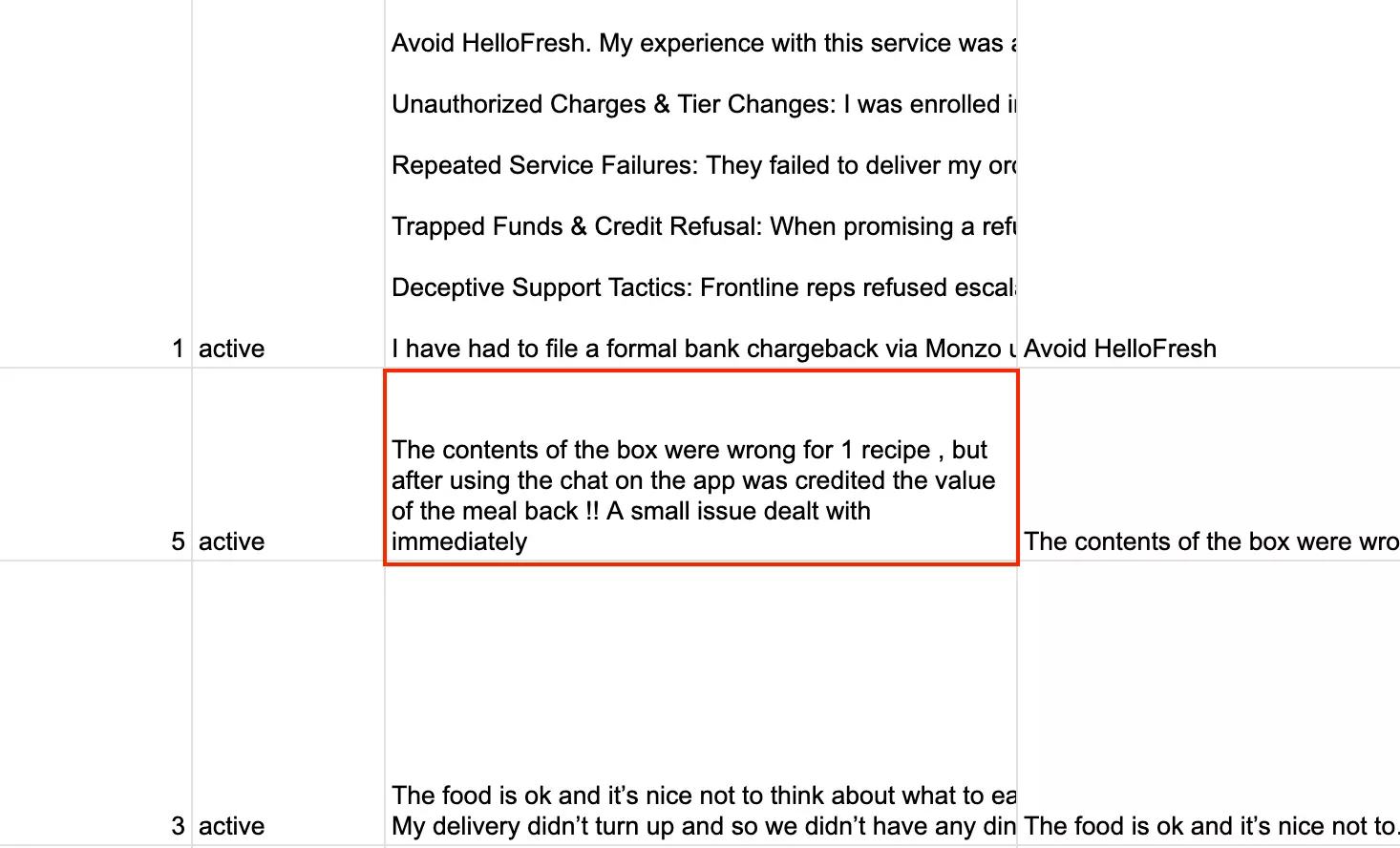
The sentiment tagging is the answer. Every review came back labelled with what it was about... delivery, refunds, cancellations... and whether each part of it was positive or negative.
Here is why you should care. Over half the reviews had mixed feelings inside them, and 31% of the 5-star reviews contained something negative.
One five-star review was about a box arriving wrong, which support then fixed. Look at the star rating and you see a happy customer. Look at the sentiment tags and you see a fulfilment problem you might want to fix.
It also returned 6 older reviews that people had later replaced, which nothing else picked up. Handy if you want to see how someone's opinion shifted.
Honestly, that last bit needs watching. Those older reviews mean six people appear twice in the 924. It barely moves an average rating, since all six repeated the same score. But if you are counting how many customers said something, you are counting six of them twice.
Cost
You pay per review, plus a small charge every time a run starts.
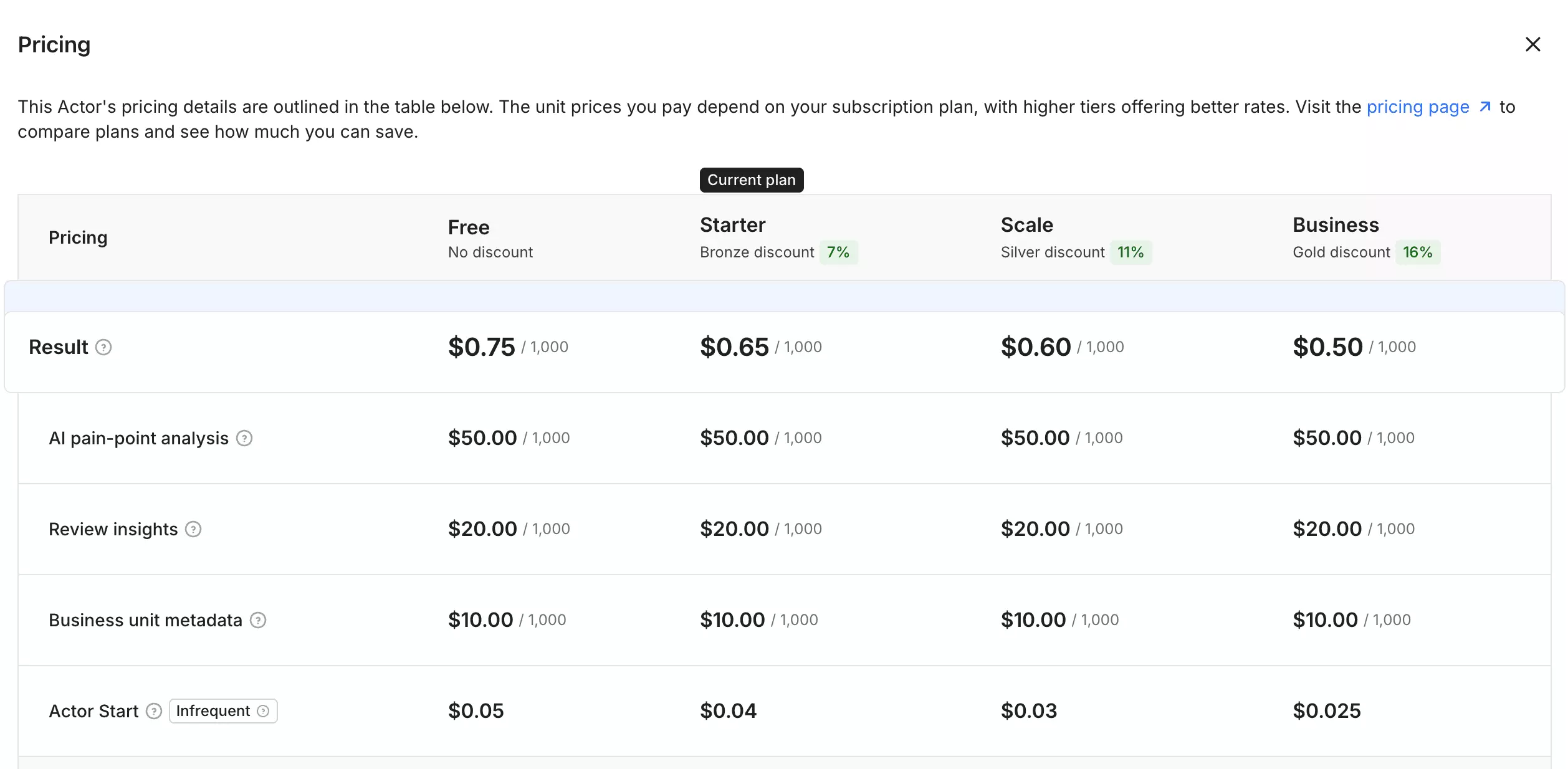
- Starts at $0.65 per 1,000 reviews
- Scales to $0.50 per 1,000 reviews
- $0.04 every time a run starts
That $0.04 looks harmless. It is charged per run, not per review, so it only bites when you run often.
Pull 50 at a time and you pay $1.45 per 1,000. Check 1,000 companies daily with separate runs... $40 a day in fees.
Batch them into one run and it is four cents. Just know that big jobs are where people report collections coming back short.
The paid add-ons are off by default. Leave them off and you pay exactly what the page says.
Usability
You can start with Trustpilot URLs or company names, and add multiple targets to the same run.
You can also point it at a reviewer's profile and pull everything that person has written.
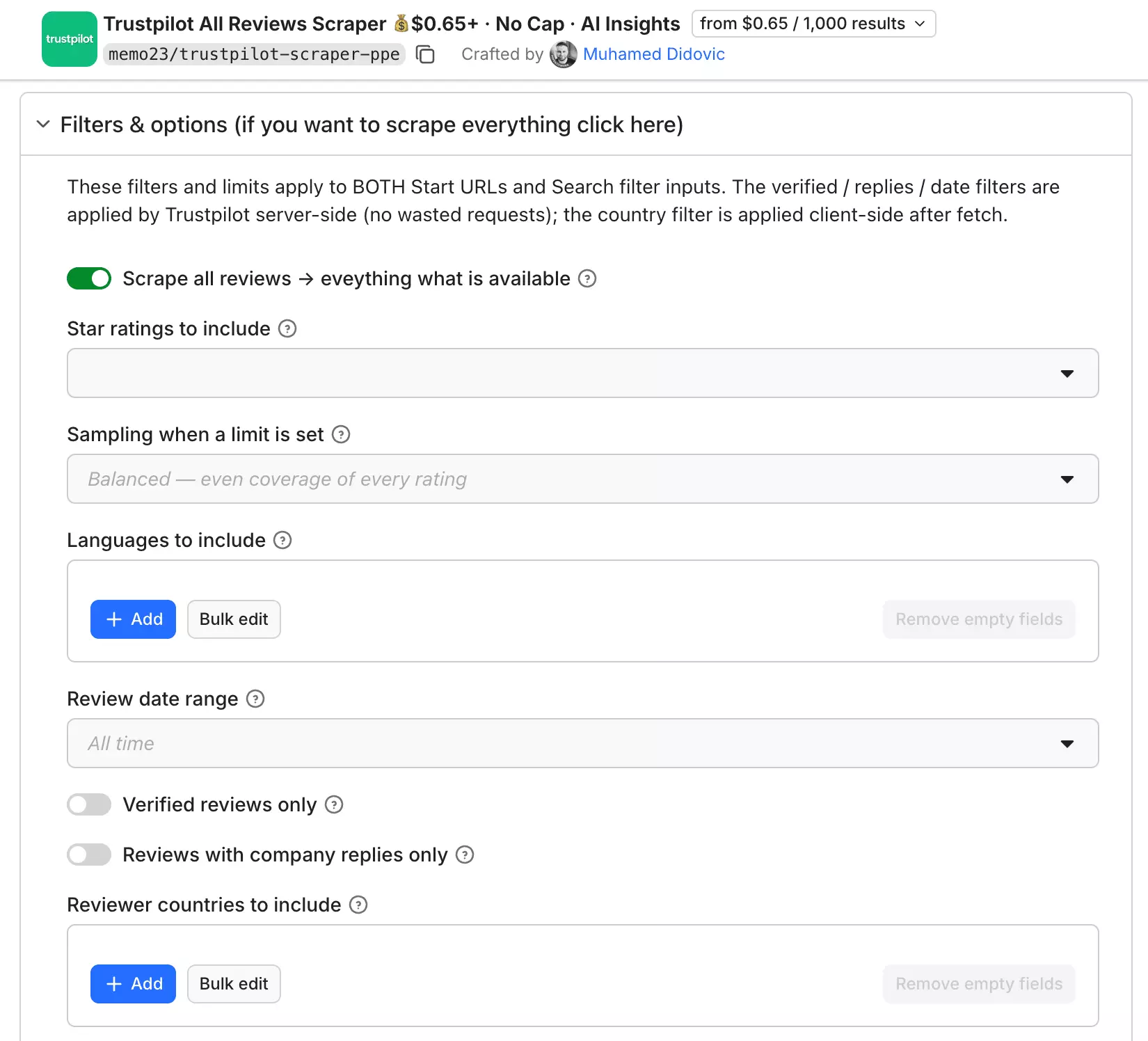
Filtering is the strongest part of the setup. You can narrow reviews by star rating, language, date, verified status, company reply, and reviewer country.
If you set a review limit, you can choose between a balanced mix of star ratings or a sample that reflects the company's actual rating distribution.
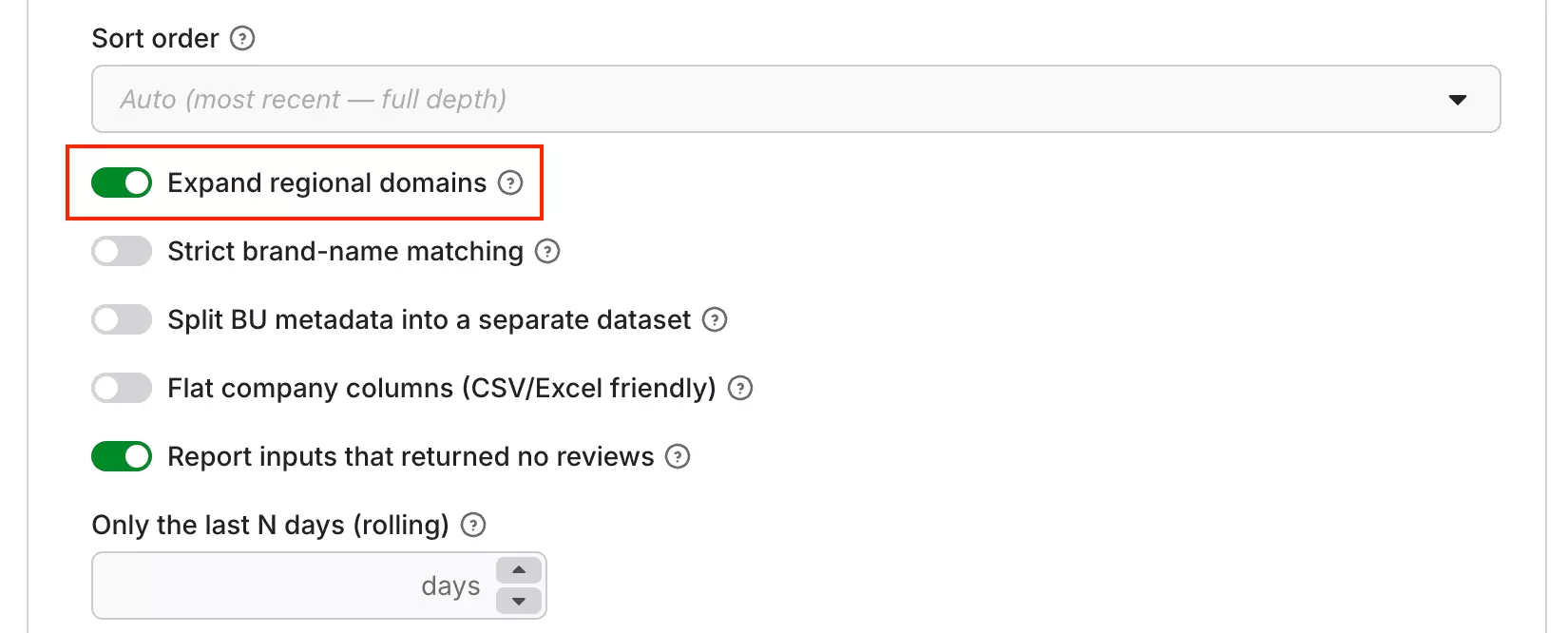
And one default will quietly ruin your data. It collects regional versions of the company too.
So a UK run also drags in the German and French pages.
Turn that off unless you actually want them.
Results export as CSV, Excel, JSON, JSONL, and other dataset formats.
The platform also supports APIs, webhooks, Make, Zapier, n8n, scheduling, and run monitoring.
Speed
Apify collected 924 reviews in 1m 31s, or about 612 reviews/min.
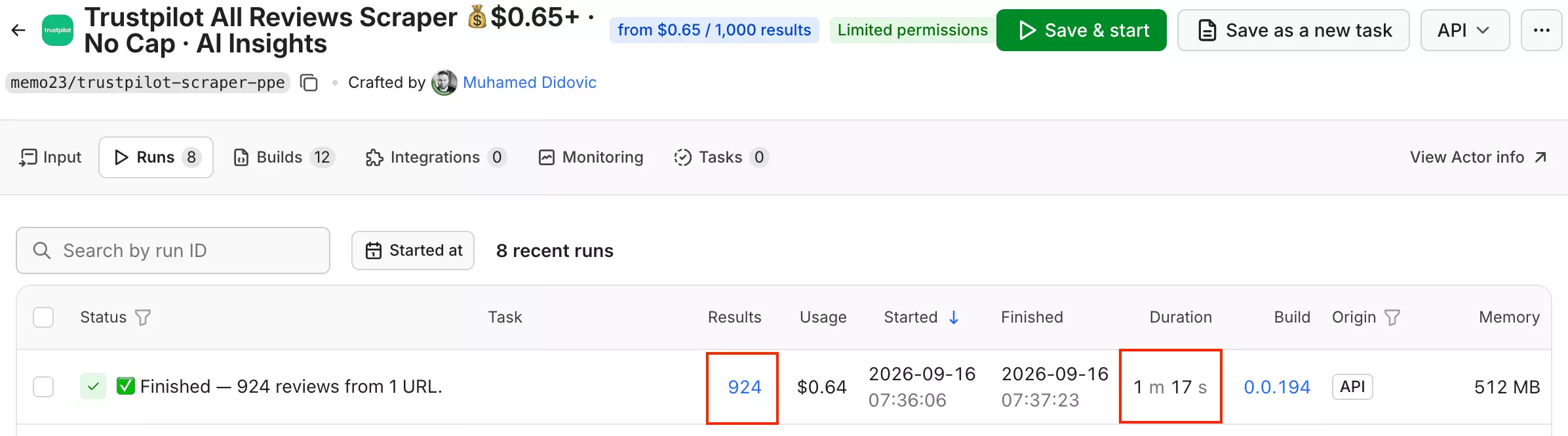
It was the fastest full-window scraper in the test.
Scalability
I pushed it well past the benchmark to see where it gives up. It did not.
2,000 reviews deep on one company: all 2,000 came back. Five companies at 1,000 each: all 5,000, no duplicates.
It also got faster as the job grew. 612 reviews a minute on the benchmark, 2,494 a minute on the 5,000-row run.
That is the opposite of what usually happens, and it means small tests understate it.
For ongoing monitoring, a cutoff setting stops each run at your date instead of walking the whole history again.
The one thing I could not tune is memory. My plan caps this Actor at 1 GB, and it ran everything on 512 MB anyway.
If a segmented run stops, it can also continue from the last scraped page instead of restarting the whole search.
Users report runs coming back short on bigger jobs. I did not see it at 5,000, but that is still not a big job for someone tracking hundreds of companies.
Customer support
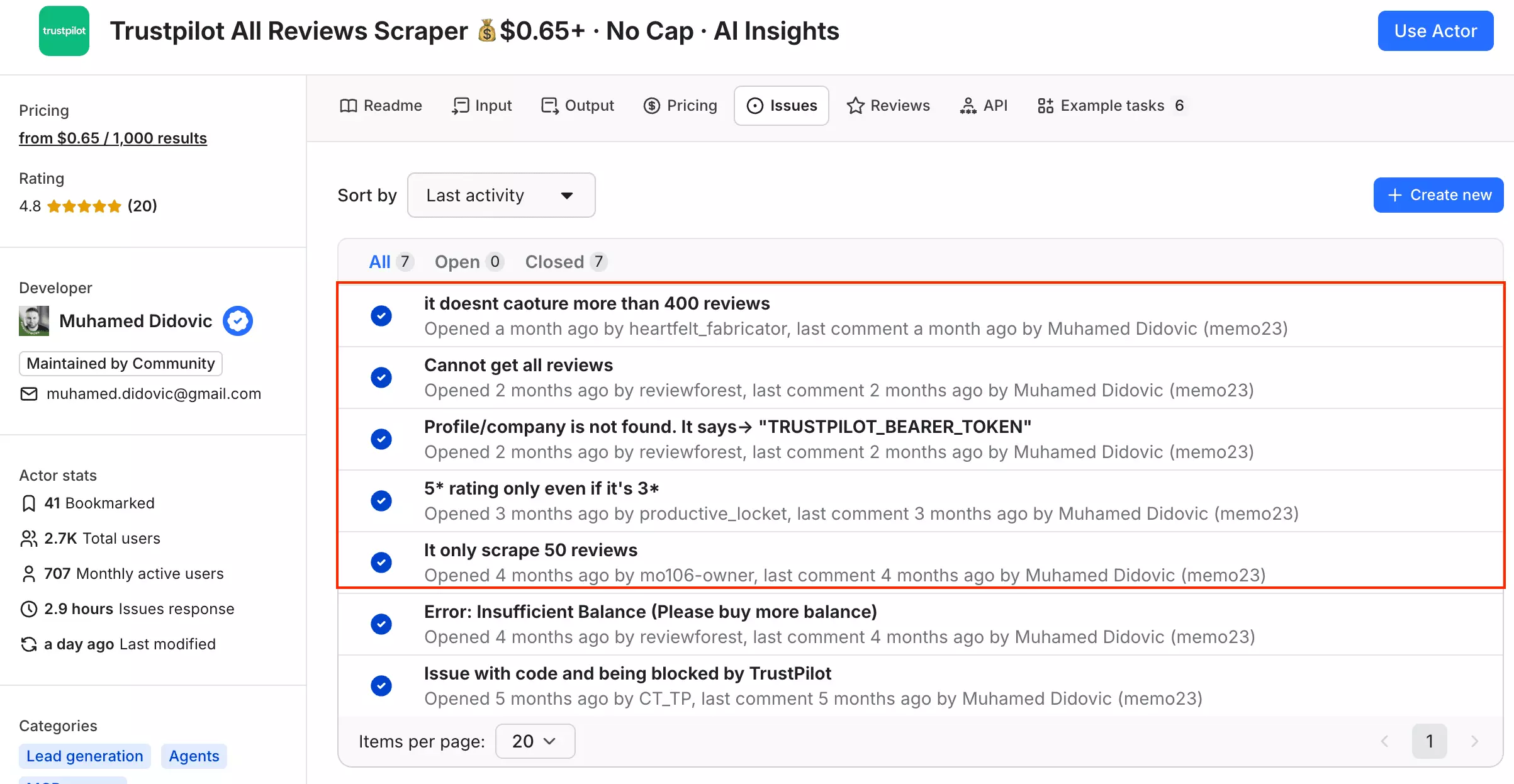
If something breaks, you raise it on Apify Issues and the developer picks it up.
The record looked good. 7 issues, all 7 closed, with replies coming back in 2.9 hours on average.
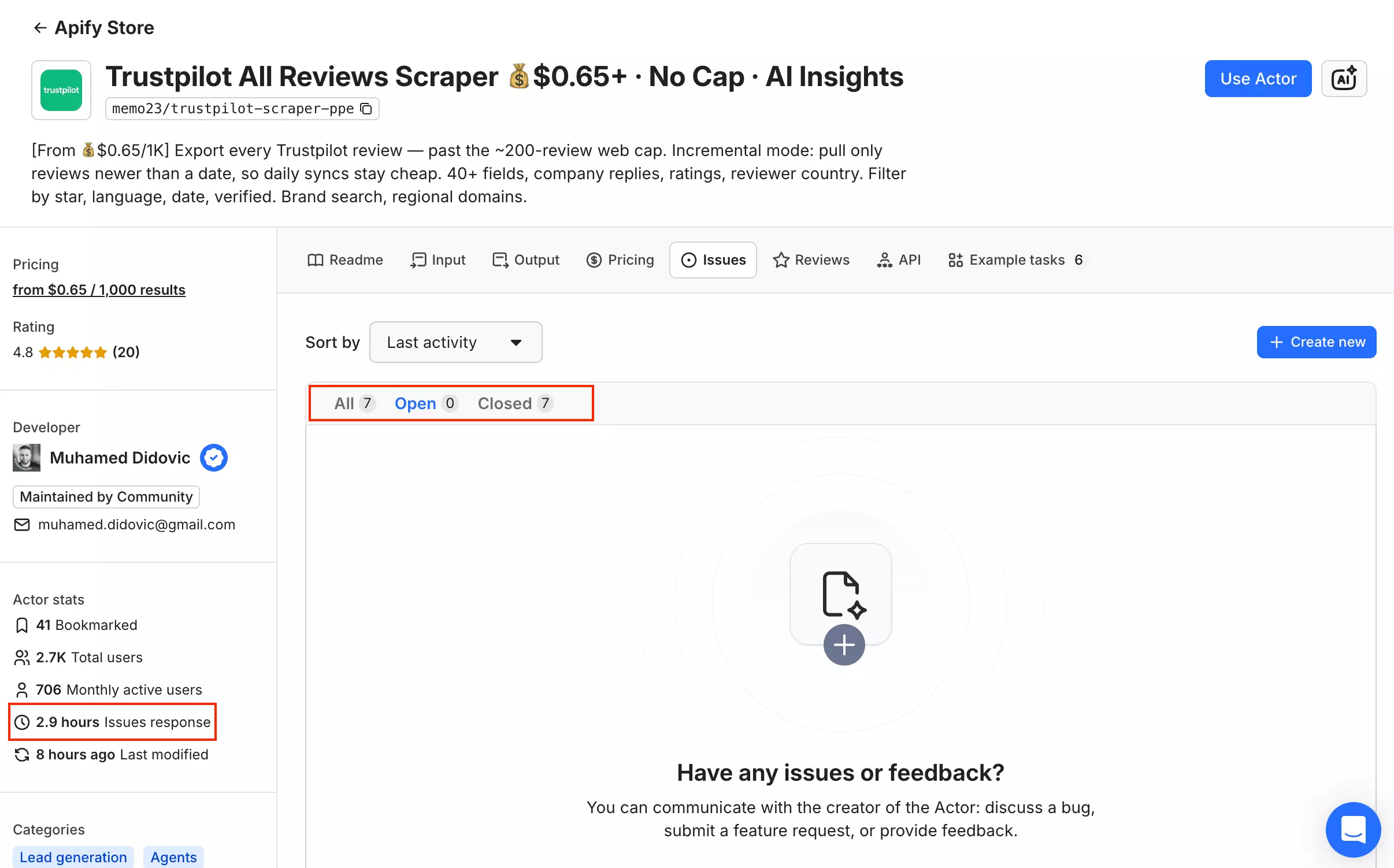
That is how fast someone replies, not how fast things get fixed, and I did not open a ticket myself to check.
One thing to be clear about. Apify runs the platform, but this scraper is one person's work. If they lose interest, that is your support gone. Worth knowing before you build a pipeline on it.
Best for: anyone digging into what customers actually complain about, who wants the deepest data and the lowest cost per review... as long as you remember to strip repeat reviewers before averaging.
2. lobstr.io — Trustpilot Reviews Scraper
- User rating: 5.0/5 from 33 reviews on Capterra, as of September 16, 2026
- My rating: 8.27/10
- Type: No-code + API + CLI + MCP
- Pricing: Starts at $2.00, scales to $0.50 per 1,000 reviews
- Strongest at: setting up once and letting it run, with the filtering and delivery to match.
| Pillar | Score /10 |
|---|---|
| Data | 7.5 |
| Cost | 8.0 |
| Usability | 9.0 |
| Speed | 8.0 |
| Scalability | 9.0 |
| Support | 9.0 |
| Overall | 8.27 |
| Pros | Cons |
|---|---|
| Full 30-day coverage: 918 reviews, no duplicates | Timestamps were 1 to 2 hours off while labelled UTC |
| Scales well across companies: returned 5,000/5,000 with configurable Slots | Sentiment field was empty on all 918 reviews |
| $0.50/1K at scale, with no per-run fee | |
| Direct support: live chat + email |
Data
You get 33 useful data points, and 31 of them actually came back filled.
| Data | What you get |
|---|---|
| Review | ID, URL, title, text, star rating, language, source, verified flag |
| Verification | Invited/not verified, verification source |
| Dates | Published, experience, updated |
| Reviewer | Name, ID, profile image, country, lifetime reviews, reviews on company, verified flag |
| Engagement | Likes |
| Company reply | Reply text, date, updated date |
| Company | Name, category, Trustpilot URL, business ID, TrustScore, star rating, total reviews |
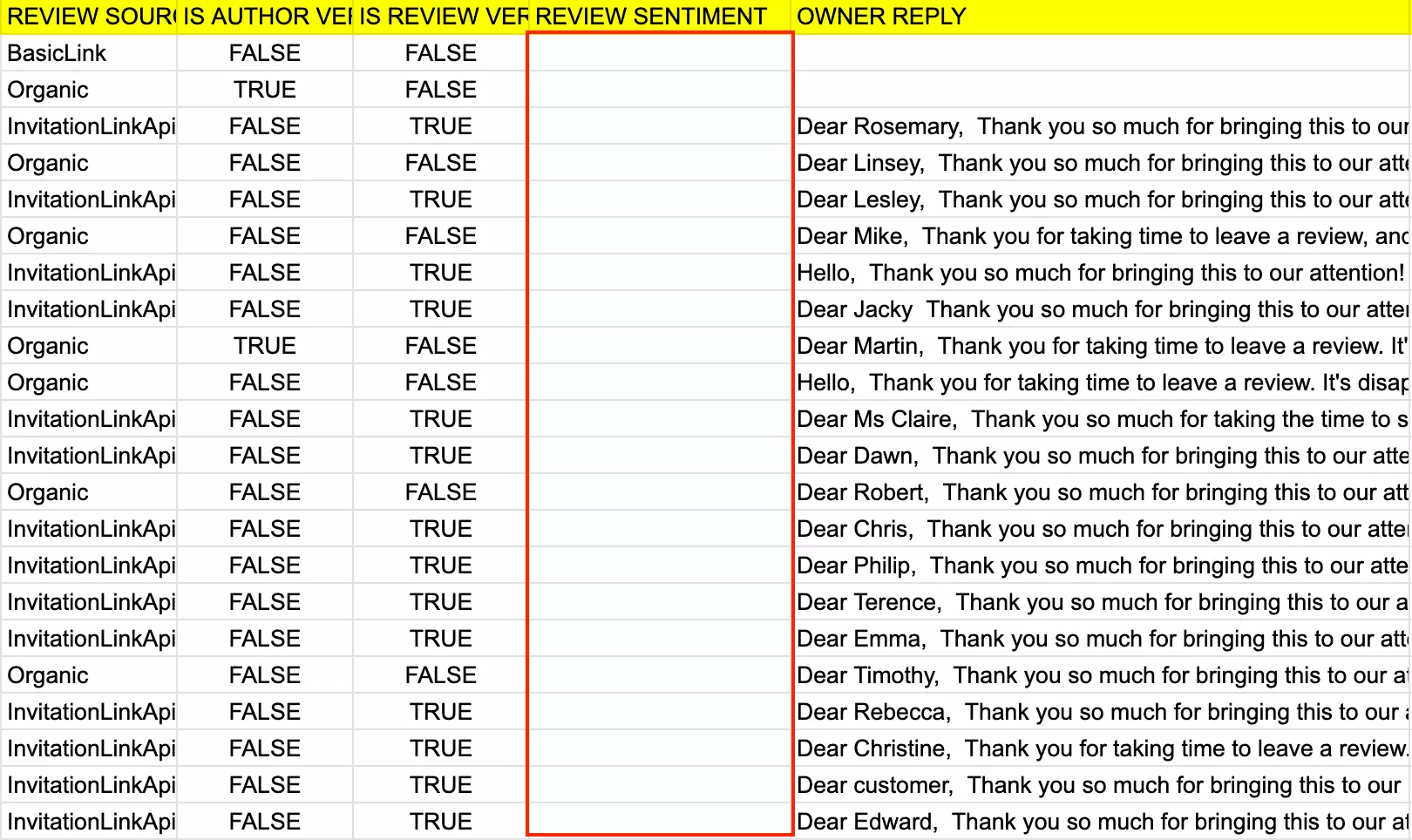
| Sentiment | Field exists, but came back empty every time |
It pulled 918 reviews with no duplicates, and every value was correct. Ratings, text, reviewer names, reply text... all of it matched.
What you get is one review per customer, the most recent one. If someone reviewed the company twice, you get their current opinion, not the one they replaced.
That is usually what you want. Work out an average rating and nobody gets counted twice. If you specifically want to see how someone's view changed over time, this is not the tool for that.
You also get the language of each review, and whether it was invited or left unprompted. That helps you judge how much of a rating is genuine word of mouth.
Now the honest part, and it is a real problem. Every timestamp came back 1 to 2 hours off, carrying local European time while being labelled as UTC.
If you only care what day a review landed, you will probably never notice. If you are looking at what time of day complaints spike, or joining this to anything else, your numbers will be wrong and nothing will warn you. And you cannot just subtract an hour, because the gap changes with daylight saving.
The other gap is sentiment. There is a field for it. It was empty on all 918 reviews.
Cost
lobstr.io charges one credit per review.
- Starts at: $2.00 per 1,000 reviews
- Scales to: $0.50 per 1,000 reviews
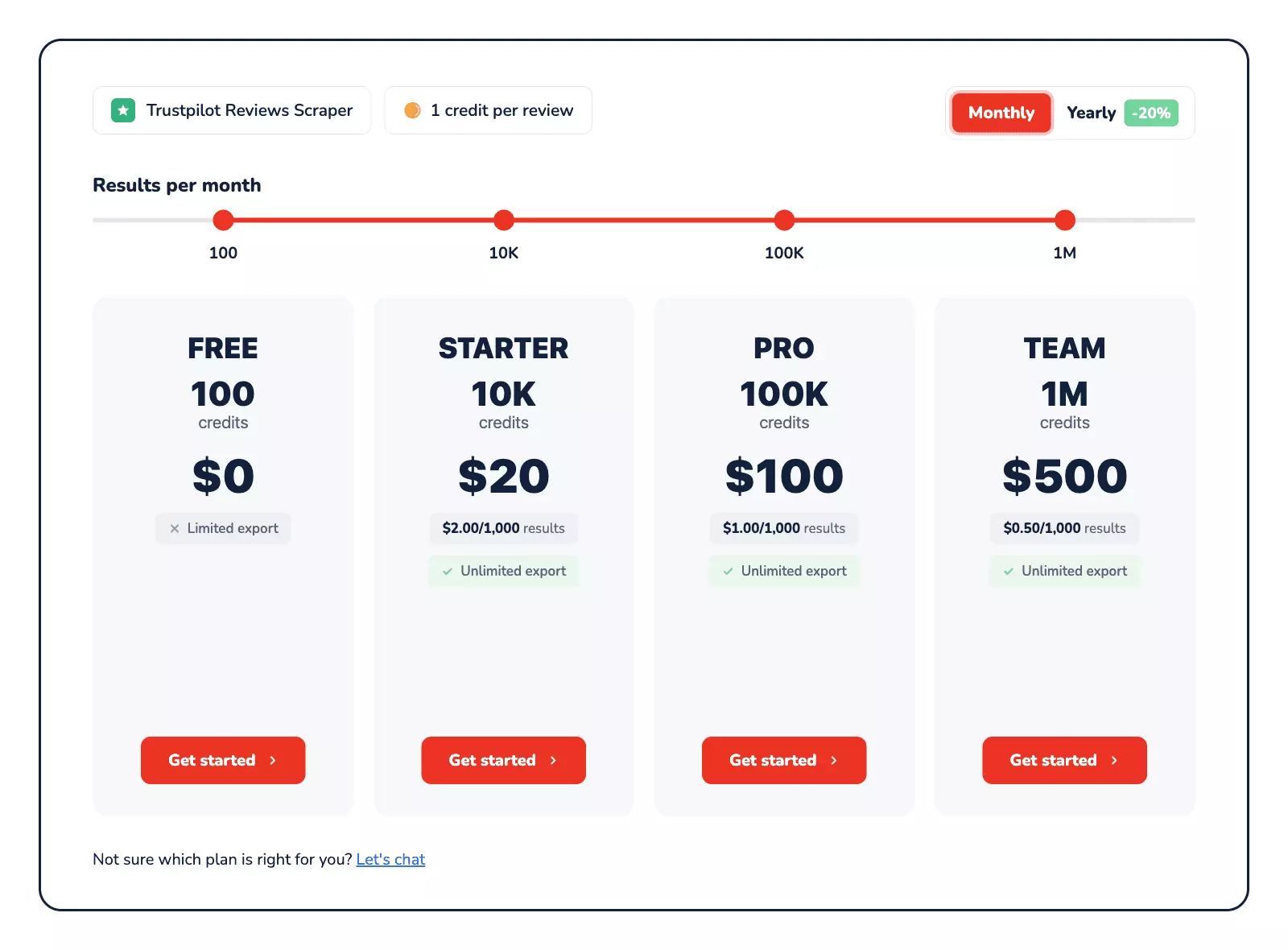
There are no per-run fees, so running several smaller jobs doesn't raise the per-review rate.
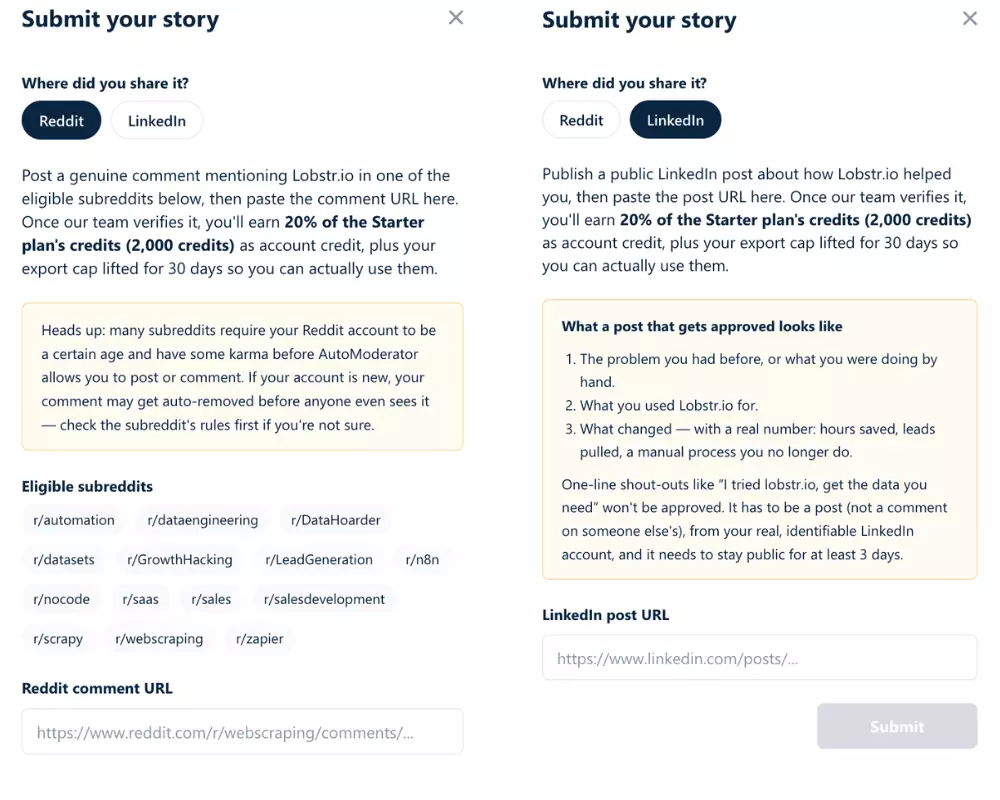
💡 Community contributions can earn bonus credits
lobstr.io offers bonus credits for an approved community contribution, such as an eligible Reddit comment or public LinkedIn post about how you used lobstr.io.
The reward is 20% of your plan's monthly credit allowance, so the number of bonus credits depends on your plan. Approval also lifts the export cap for 30 days.
Usability
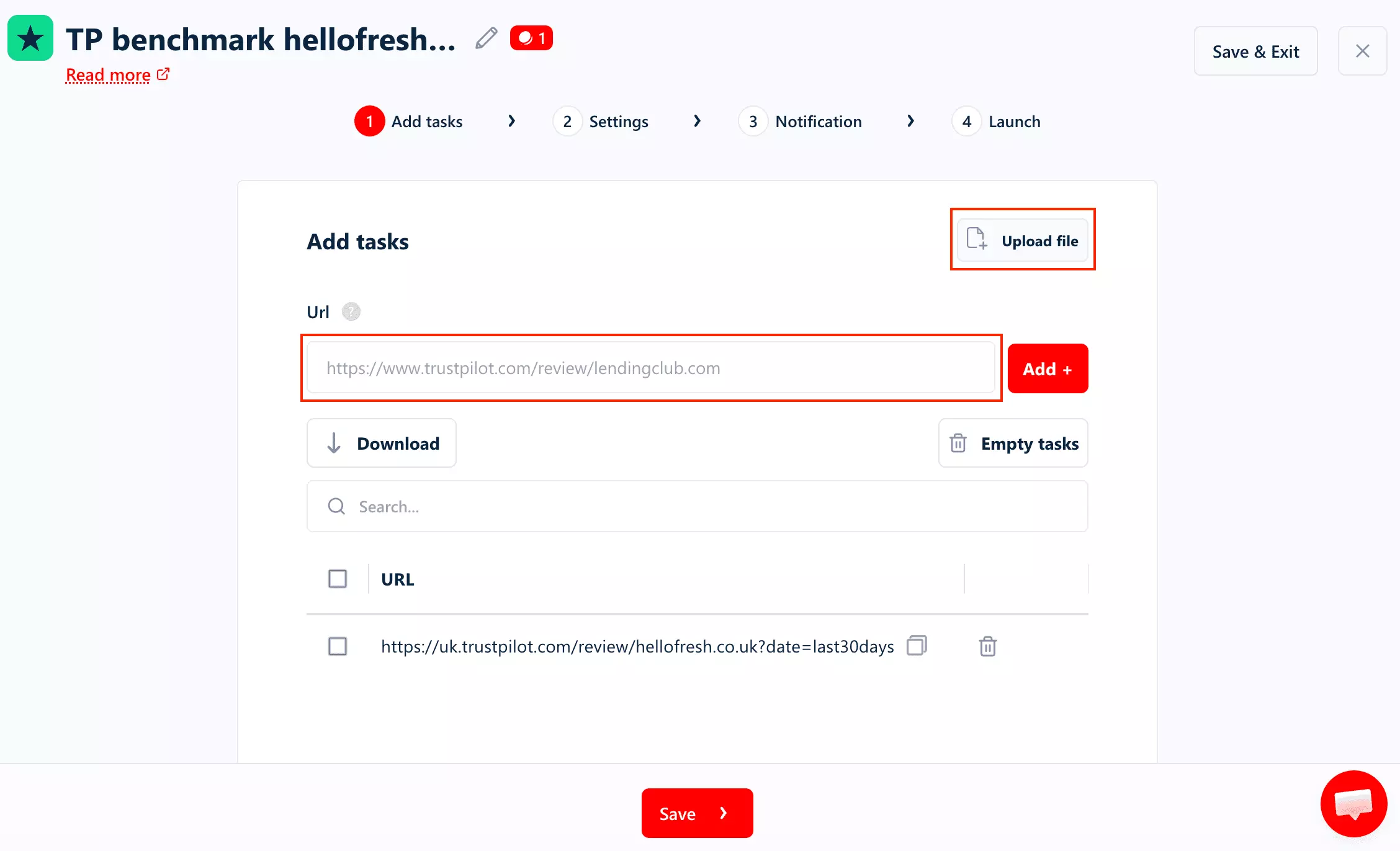
You can start with a Trustpilot company page URL or the company's domain, and add multiple companies to the same run.
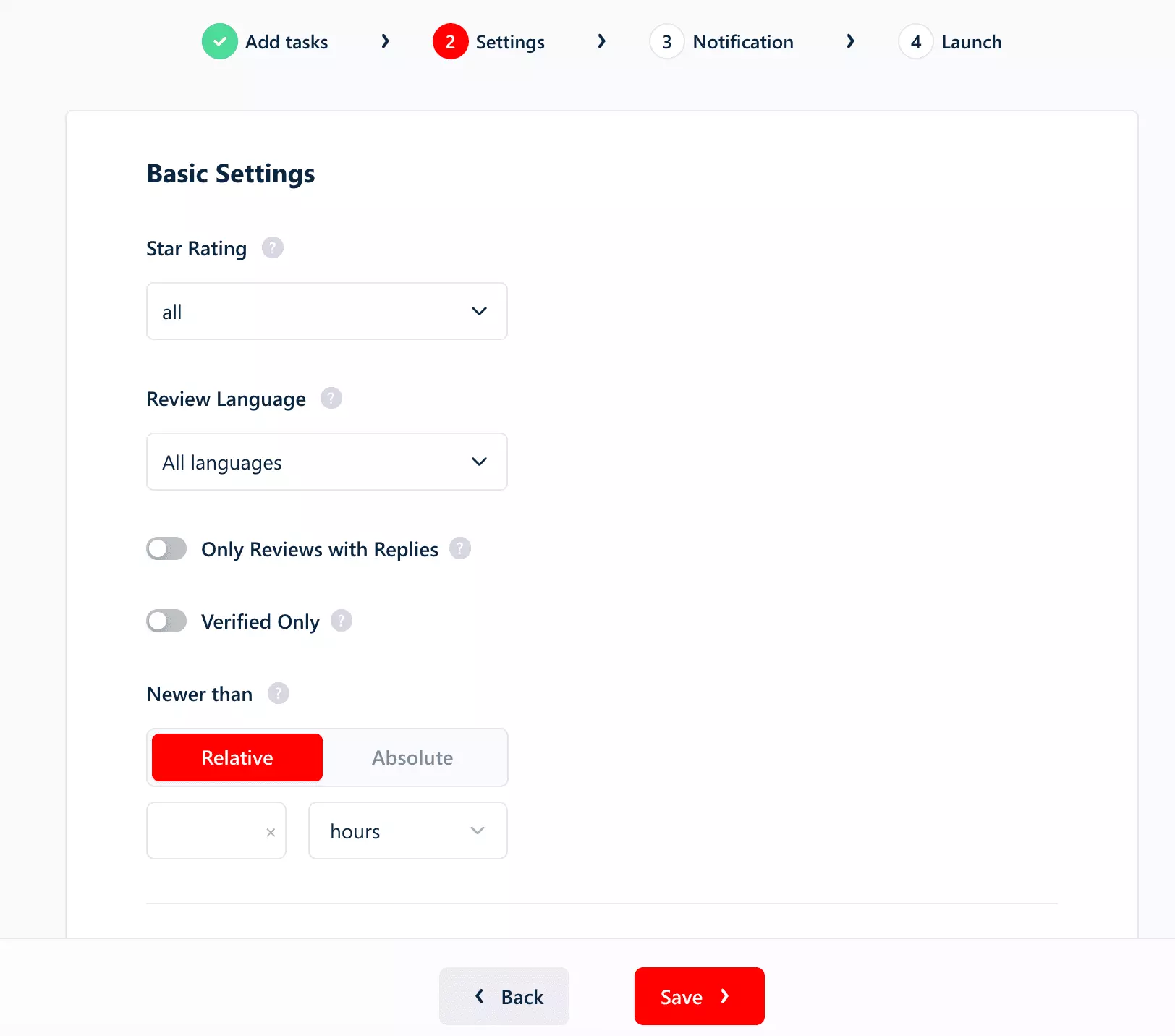
You can filter reviews by date, star rating, language, verified status, and company reply, then set how many reviews you want returned.
For recurring collection, you can pull only newer reviews instead of collecting the same history again.
You can also narrow the collection using Topics or Search.
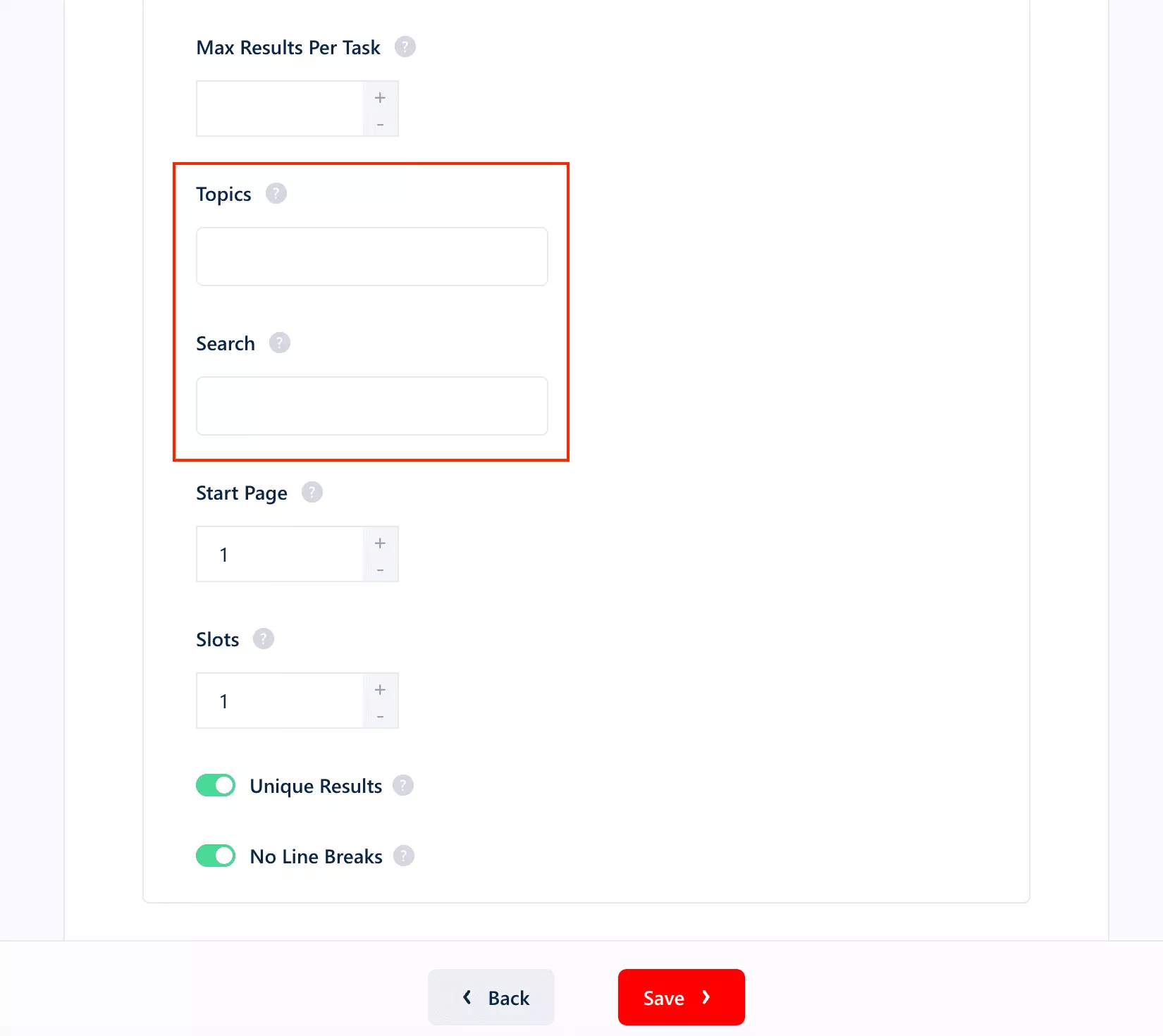
Results can be sent to Google Sheets, S3, SFTP, email, or a webhook.
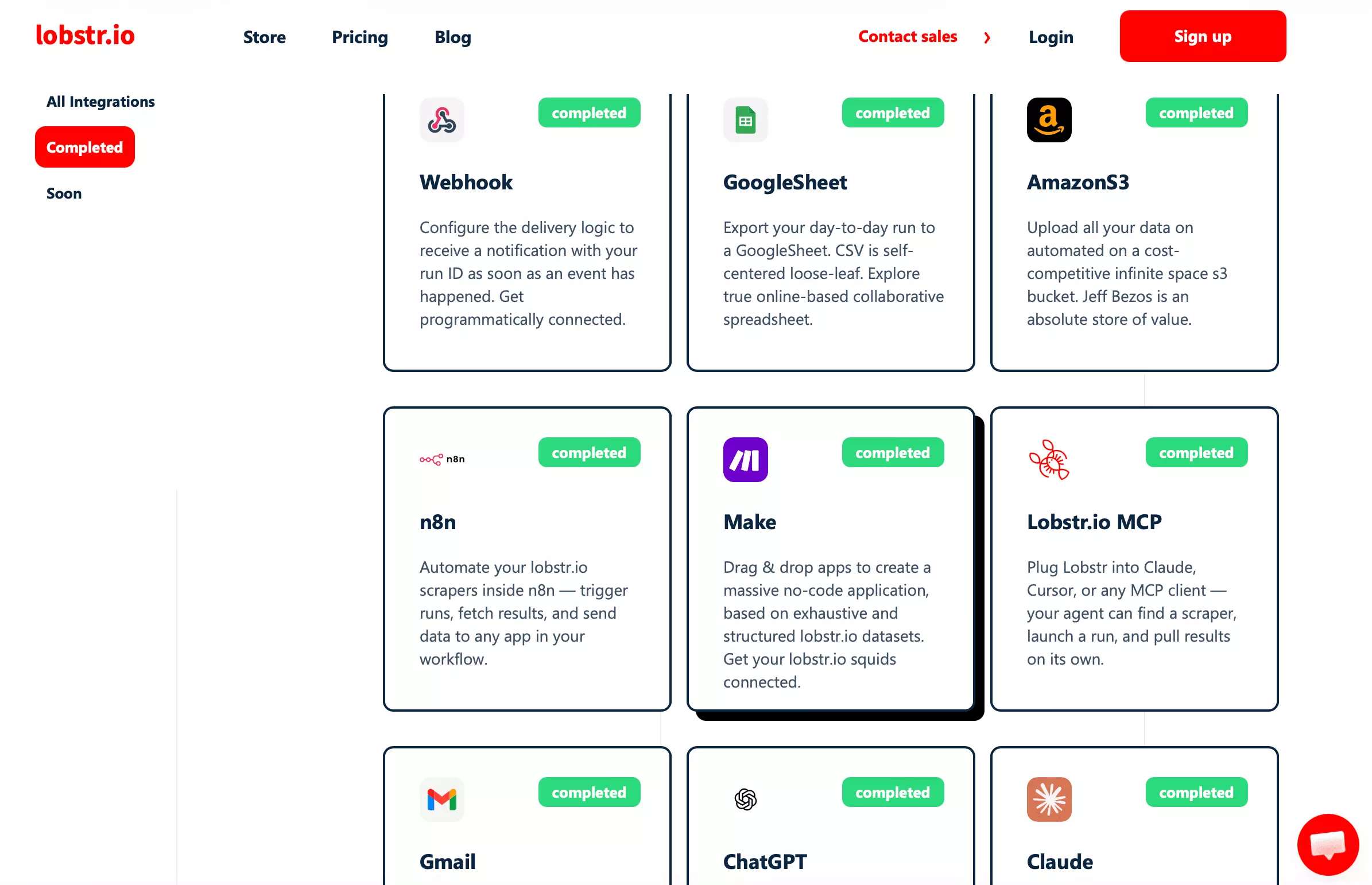
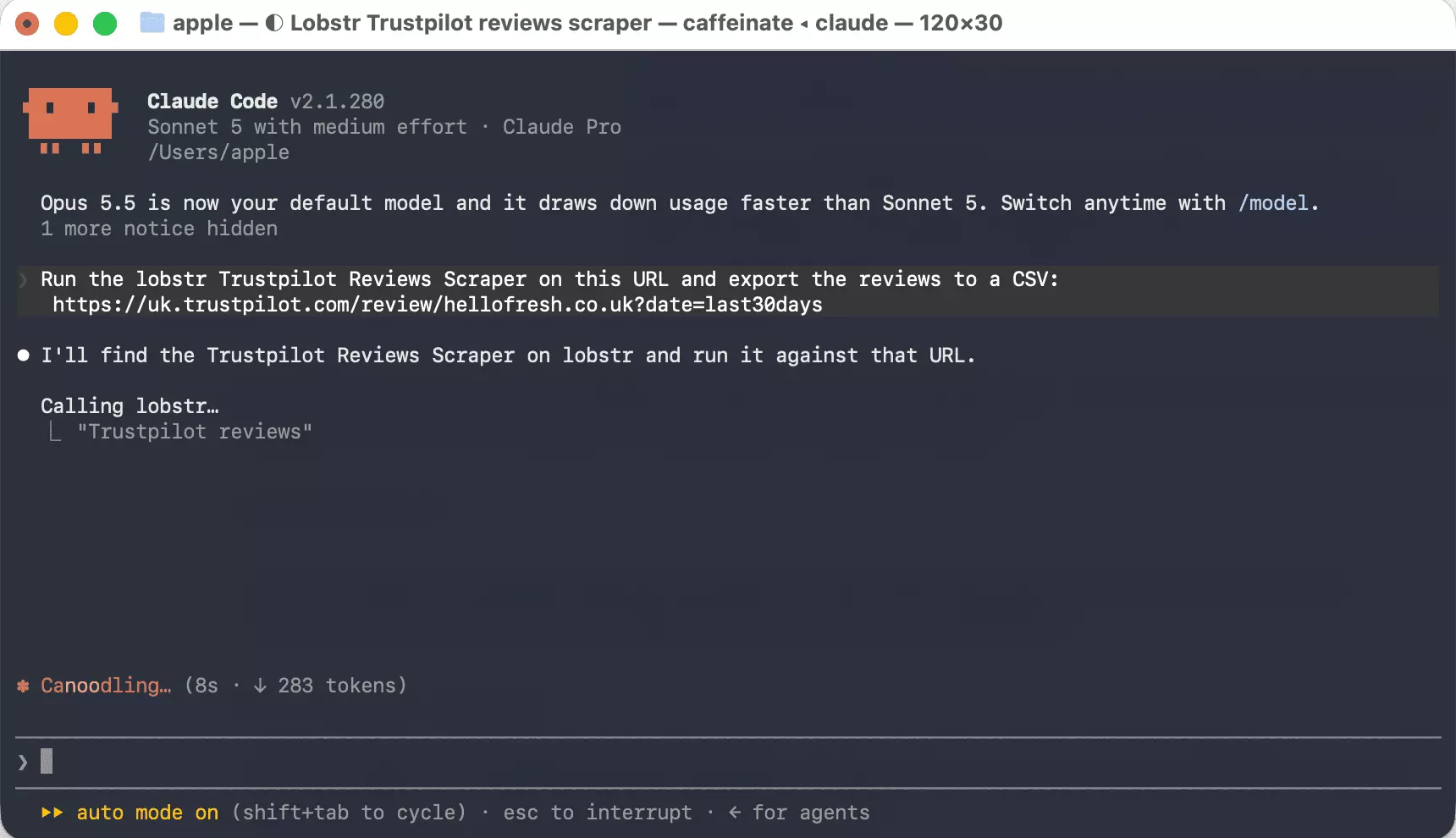
claude mcp add --transport http lobstr https://mcp.lobstr.io/mcpf
pip install lobstrio

lobstr go trustpilot-reviews-scraper \
  "<your Trustpilot company URL>" \
  -o trustpilot.csvf
So you can start in the dashboard and move to the API later without changing tools.
Speed
It collected 918 reviews in 2 minutes 33 seconds, or about 360 a minute.
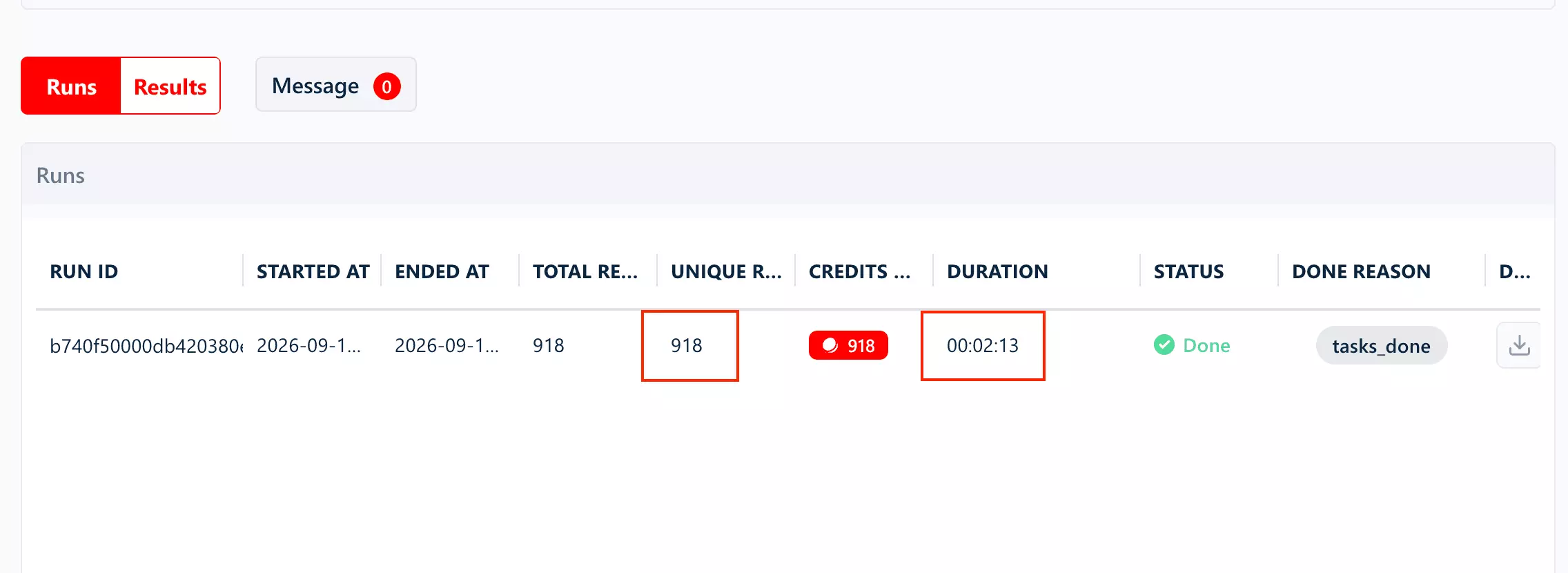
That is the slow end though. On bigger jobs it picked up... 460 a minute at 2,000 reviews, 525 at 5,000 on a single Slot.
Scalability
Those bigger runs are where it gets interesting. I pushed it to 2,000 reviews deep on one company, then 5,000 across five.
Everything came back. No shortfalls, no duplicates, nothing retried.
I ran those same five companies at 1 Slot, then at 10. It dropped from 9 minutes 31 to 3 minutes 20... 2.85× faster.
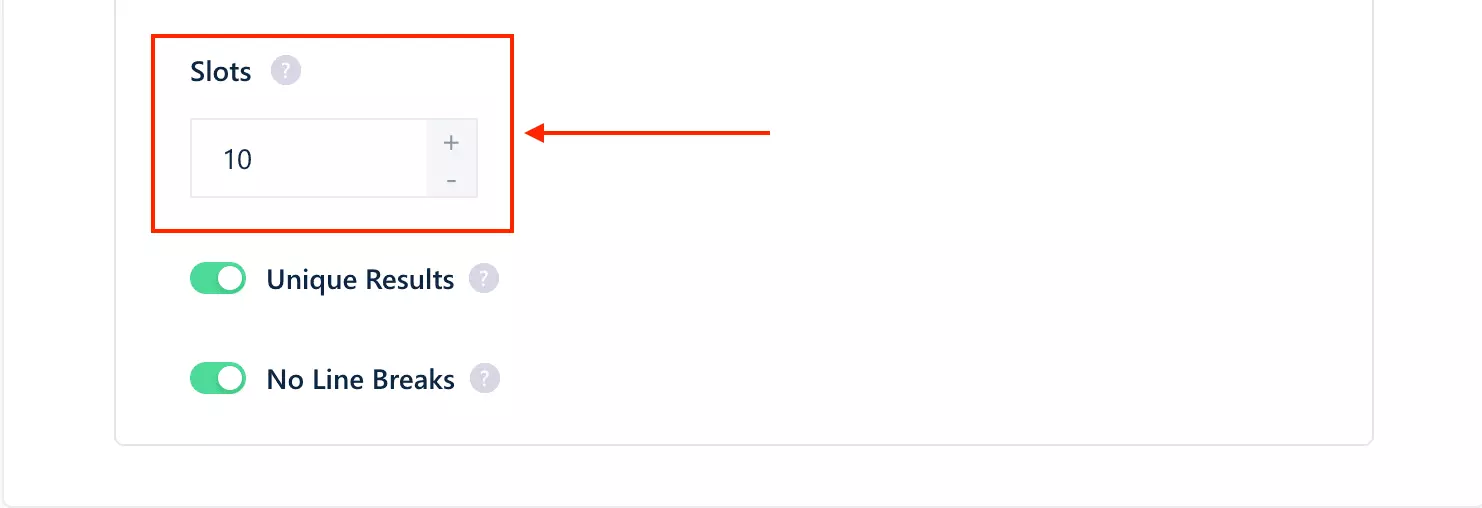
Worth knowing it tops out at the number of companies you are running, so more Slots than companies buys nothing.
Long jobs get a safety net too. Interrupted runs resume from where they stopped.
And a single failed task can be retried without rerunning the whole job.
Customer support
You get live chat and email, straight to the company rather than through a marketplace.
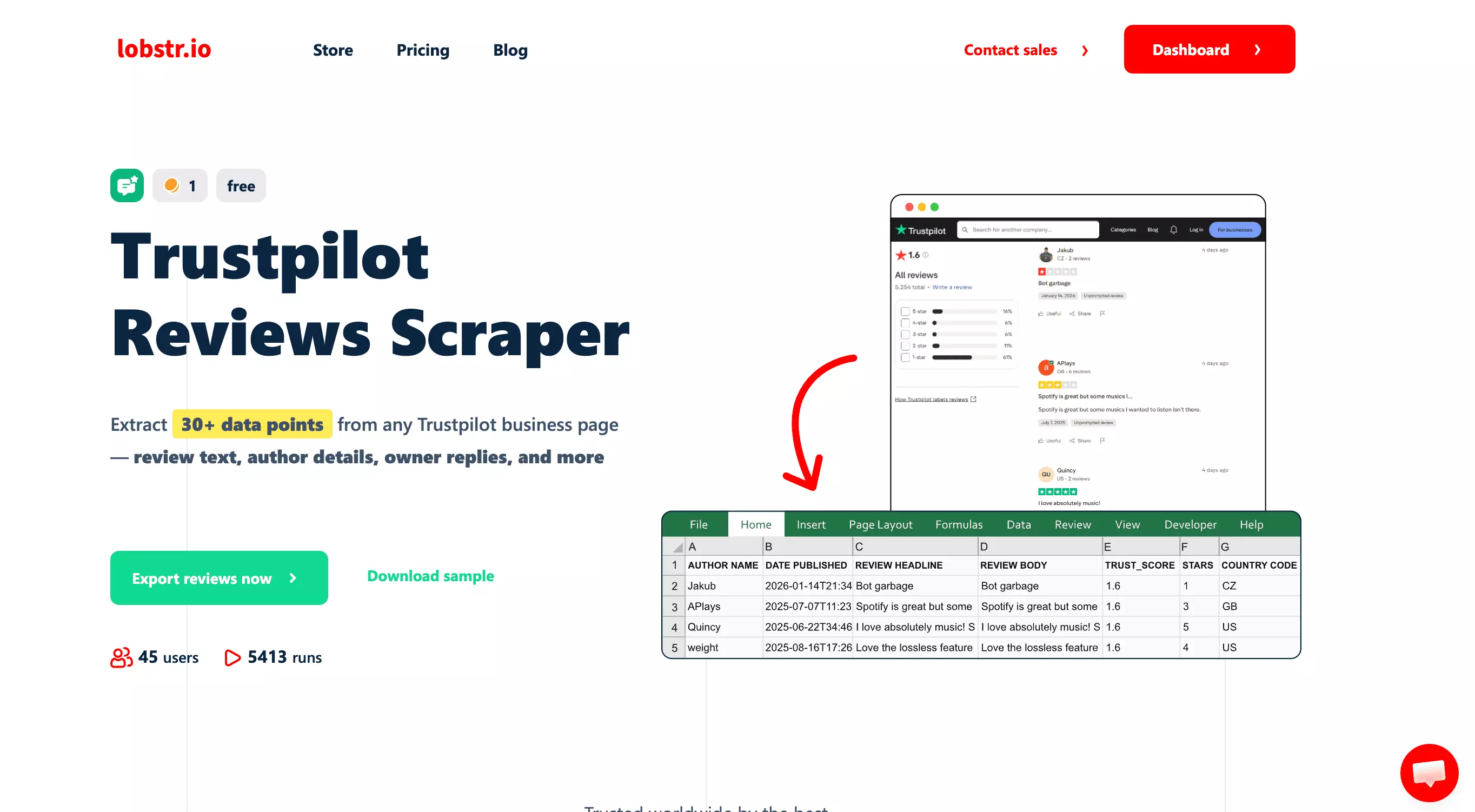
Its Capterra customer service rating is 5.0/5 from 33 reviews.
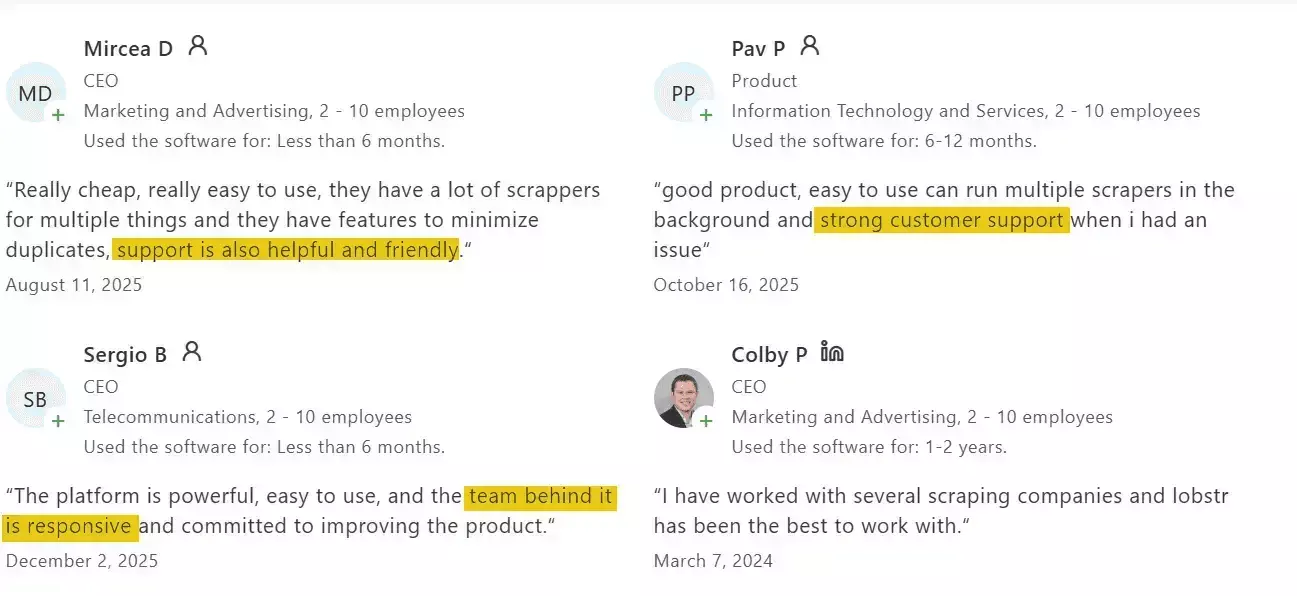
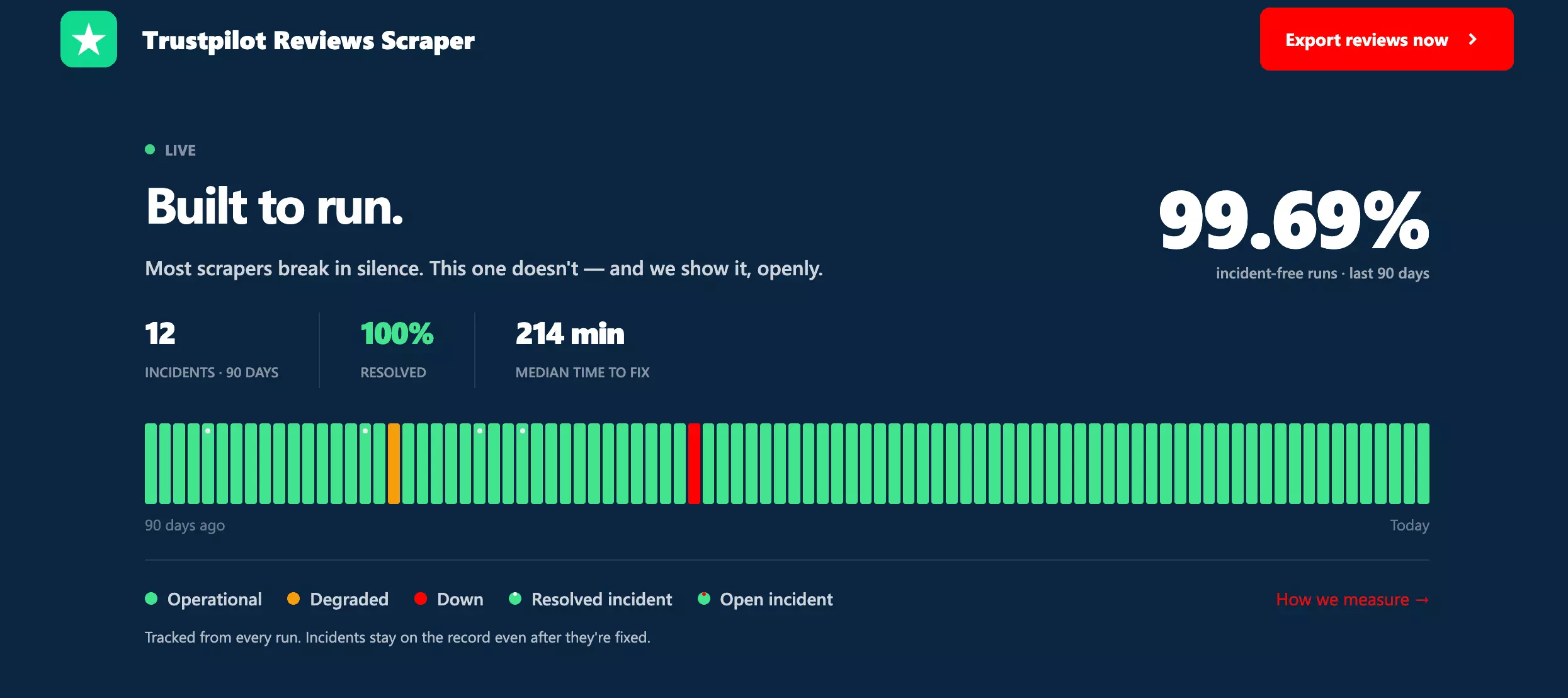
That is how long problems took to fix, not how fast someone replies. I did not open a ticket to test that part. But no other tool here publishes anything like it.
Best for: anyone tracking what customers are saying right now across a lot of companies, who wants it scheduled, filtered and delivered without babysitting... as long as you correct the timestamps before doing anything time-based.
The scrapers that didn't make the list
Bright Data and Outscraper were everywhere when I searched for Trustpilot scrapers, so I tested them too. Both stalled at around 200 reviews, which isn't enough if you need deeper review history.
Bright Data — Trustpilot business reviews
Why it didn't make the list
I asked for the full 30-day window and got 209 reviews, with 203 inside the window. Six were older reviews from 2023, 2024, and 2025.
A second run with the requested limit lowered from 1,000 to 500 returned essentially the same number of reviews. In my testing, Bright Data consistently stalled at around 200 reviews.
Worth knowing
Bright Data gives you useful company context alongside the reviews, including the 1★ to 5★ rating distribution, category rankings, contact details, and registered address.
It also supports warehouse-friendly delivery such as Snowflake, Azure, and Parquet. If around 200 recent reviews are enough and you want company-level data with them, it can still be useful.
Outscraper
Why it didn't make the list
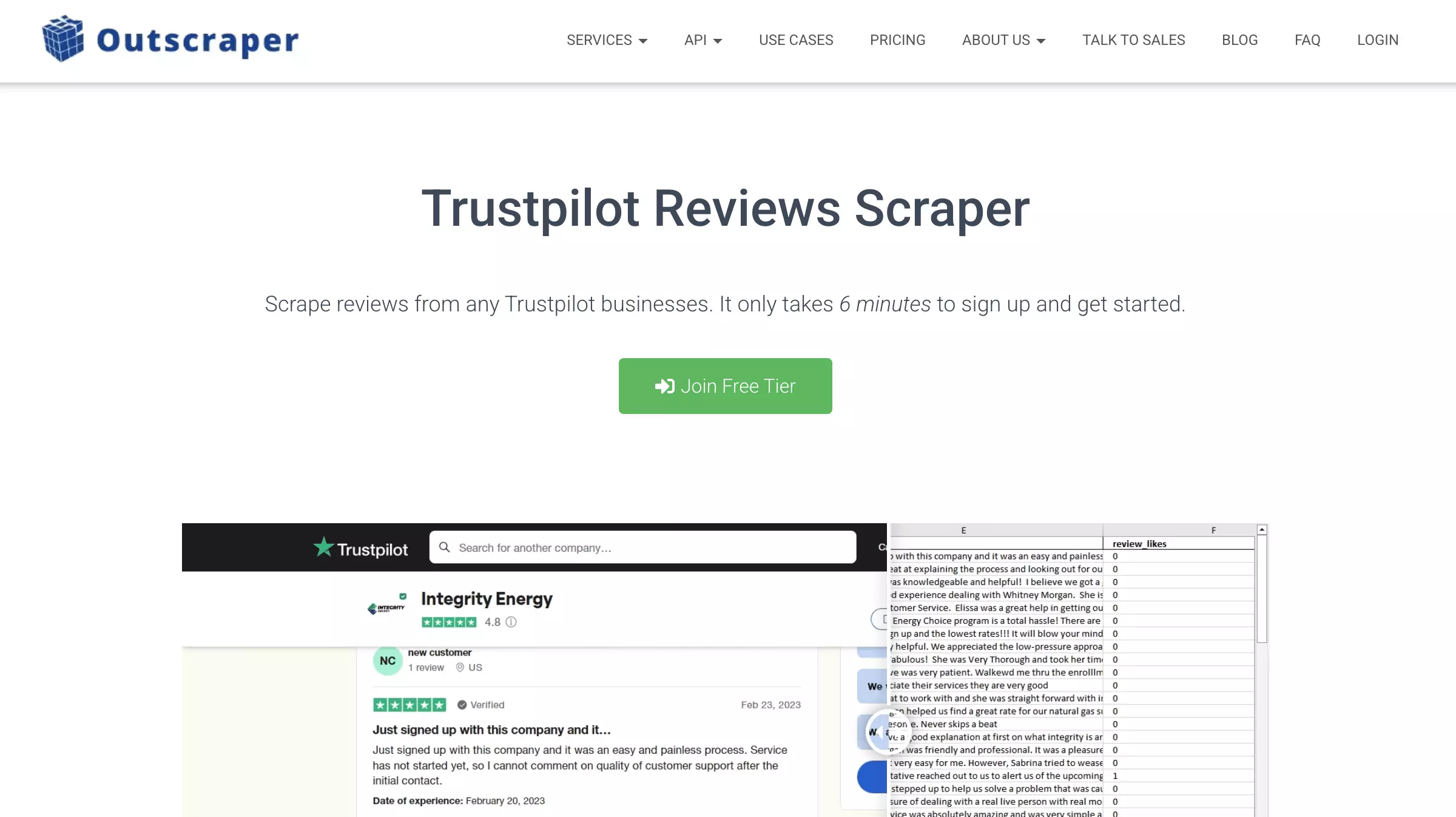
I asked for a month and got 200 reviews covering about 6 days, with no warning the run stopped short. Increasing the requested limit changed nothing, and pagination didn't get past those 200 reviews.
Its $3.00 per 1,000 entry price is also the highest here, so it isn't the cheap option either.
Worth knowing
The output is simple: 16 flat fields, all filled, and easy to drop into a spreadsheet. If a couple hundred recent reviews are enough, it does that job without much setup.
FAQ
Which Trustpilot scraper returned the most reviews?
Apify. It returned 924 reviews, then lobstr.io with 918. Bright Data returned 203, and Outscraper capped at 200.
Which scraper gives the most review data?
Apify. It returned 59 meaningful data points, including Trustpilot sentiment, topics, and review lifecycle data.
Which Trustpilot scraper is cheapest?
Apify at entry, lobstr.io at scale. Apify starts at $0.65 per 1,000. Both reach $0.50 at scale, but only lobstr.io gets there with no per-run fee.
Which Trustpilot scraper is fastest?
Apify. It returned 924 reviews in 1m 31s, versus lobstr.io's comparable 918 reviews in 2m 33s.
Which scraper is best for large-scale collection?
lobstr.io. It takes bulk input and runs up to 10 concurrent tasks with configurable Slots. Moving from 1 Slot to 10 returned 5,000 reviews across five companies 2.85× faster.
Conclusion
That's a wrap on the best Trustpilot review scrapers.
Who owns what:
- Apify owns data and speed. It gives you the richest review dataset and was the fastest scraper in testing.
- lobstr.io owns scale and support. You get configurable concurrency, $0.50 per 1,000 at scale with no per-run fee, and direct support from the company.