
Best Yelp Reviews Scrapers of 2026 [No Code Edition]
⚡ 30-Second Summary
- I tested the best Yelp reviews scrapers that actually work at scale in 2026, judged on data, usability, speed, cost, scalability, and customer support.
- lobstr.io is the best overall pick. 27 data fields, 400 reviews per minute (1.6x faster than the next-best), $0.5 per 1k at scale, and the only tool that pairs account age with friend count in the same row (the fake-review-detection combo), plus exclusive check-in and paid-through-Yelp fields.
- The honest trade-offs with lobstr.io: no owner-reply data, no language or date-range filters yet, unreliable reaction counts, and no Parquet export.
- Apify's Yelp Review Scraper is a solid second... the most popular Yelp reviews actor on Apify, Apify-maintained, fast at 250 reviews/min, and the cheapest option if you're scraping under 100k/month.
- But Apify is the most data-shallow tool on this list (17 fields), most filters are URL-based not UI-based, and technical support is the weakest in the category... live chat can't help with actor issues, you wait ~10 days on the developer.
- Outscraper is the specialty pick... the only tool that captures owner-reply data, for tracking how businesses respond to reviews.
- Outscraper's trade-offs: 6.7x slower than lobstr.io, the most expensive at scale ($1 per 1k at best), and capacity-bound past 1M reviews/month.
- This guide breaks down what each tool actually does, what each one quietly fails at, and which one makes sense for your job.
If you've gone looking for a way to pull Yelp reviews at scale, you've hit the same wall everyone does.
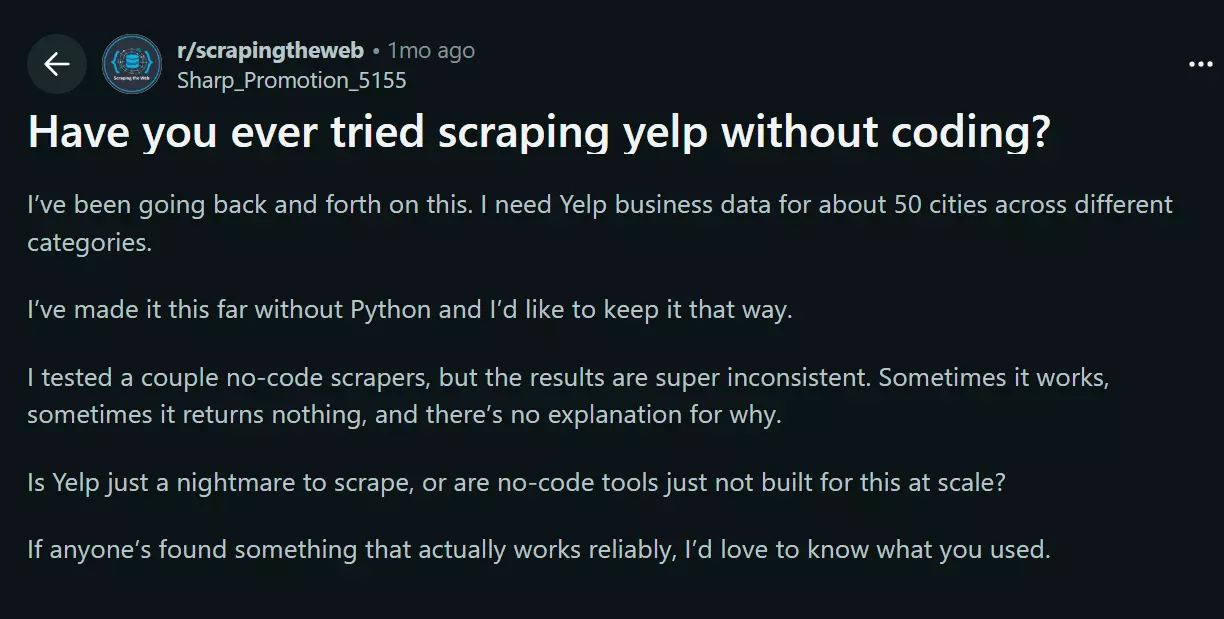
Most "best Yelp reviews scraper" lists are recycled marketing. Nobody runs the same job through every tool and counts what comes back.
So I did. I bought the paid plan of every tool and ran them through the same jobs... thousands of reviews, multiple runs each.
| Criteria | lobstr.io | Apify | Outscraper |
|---|---|---|---|
| Data points (per review) | 27 | 17 | 23 |
| Owner reply | ❌ | ❌ | ✅ |
| Account age (member since) | ✅ | ❌ | ❌ |
| Friend count | ✅ | ❌ | ✅ |
| Check-in count | ✅ | ❌ | ❌ |
| Business metadata | ✅ | ❌ | ❌ |
| Photo resolution | Full res | Full res | Thumbnail |
| Language field | ✅ | ✅ | ❌ |
| Filter: Sort by | ✅ | ⚠️ via URL | ✅ |
| Filter: Rating | ✅ | ⚠️ via URL | ⚠️ via URL |
| Filter: Keyword search | ✅ | ⚠️ via URL | ⚠️ via URL |
| Filter: Language | ❌ | ✅ | ❌ |
| Filter: Date range | ❌ | ✅ | ⚠️ from only |
| Filter: Max reviews/business | ✅ | ✅ | ✅ |
| Speed (reviews/min) | 400 | 250 | 60 |
| Max reviews/month (24/7, 1 slot) | ~17.3M | ~10.8M | ~2.6M |
| Concurrency | ✅ up to 100 slots | ⚠️ memory-driven | ❌ none |
| Free tier | 500/mo | ~5,000/mo | 500/mo |
| Cost /1k (entry → scale) | $2 → $0.5 | $0.8 → $0.5 | $3 → $1 |
| Export formats | CSV, JSON, Excel | CSV, JSON, Excel, XML, RSS, JSONL | CSV, JSON, Excel, Parquet |
| API access | ✅ API, MCP, SDK, CLI | ✅ API, MCP, SDK, CLI | ⚠️ via integrations |
| Customer support | 💯 Live chat + email | 👎 Issues tab ~10d | 👍 Live chat |
But before we get into the breakdown, let's address two questions first.
Why not just use Yelp's official API?
Sounds promising until you see what it actually gives you. You get up to 3 review excerpts per business. That's it. Three. And each one is truncated to roughly the first 160 characters.
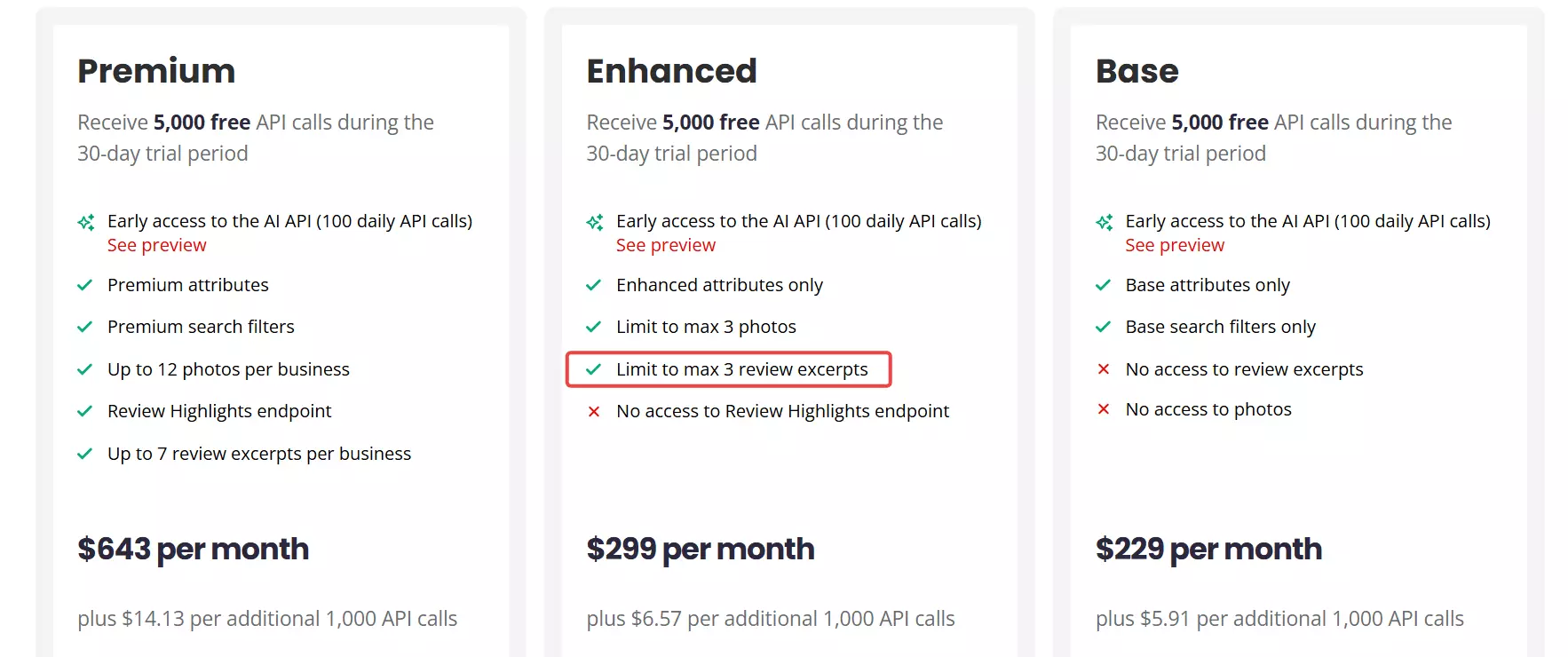
limit parameter that goes up to 50. Ignore it. Yelp's own FAQ confirms what you actually get: 3 excerpts, 160 characters each.A 3-star review that explains exactly why someone gave 3 stars? Cut off mid-sentence at character 161. The rest of the review you actually need? Gone.
And it gets worse:
- Reviews come back in Yelp's "default sort order" ... no filter for date, rating, language, or keyword.
- It's paid-only. The free Base plan returns zero reviews. You need the Enhanced plan (3 excerpts) at minimum.
- Rate limits everywhere. Daily quota + per-second throttling. 429 errors if you push.
- Up to 7 reviews per business on the Premium plan. Still no full text. Still capped at 160 characters per excerpt.
That's not a review dataset. That's a teaser.
So you need a scraper.
But before that... is scraping Yelp even legal?
Is scraping Yelp reviews legal?
Disclaimer: I'm not a lawyer. None of this is legal advice. If you're running a serious operation, talk to one. What follows is the general lay of the land based on public court rulings and Yelp's own documents.
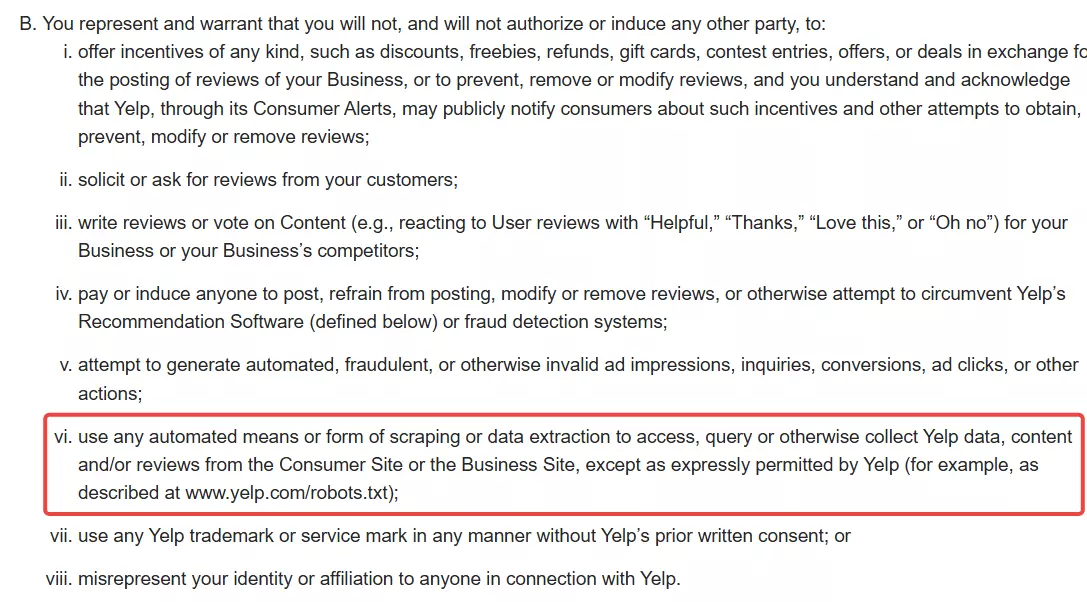
That's a private contract though. Breaking it can get your account banned. It doesn't make scraping criminal.
So is it legal? Generally, yes... for public review data, under US law.
The big precedent is hiQ Labs v. LinkedIn (9th Circuit, 2022) which established that scraping publicly accessible data is not a Computer Fraud and Abuse Act (CFAA) violation. Subsequent rulings have reinforced that.
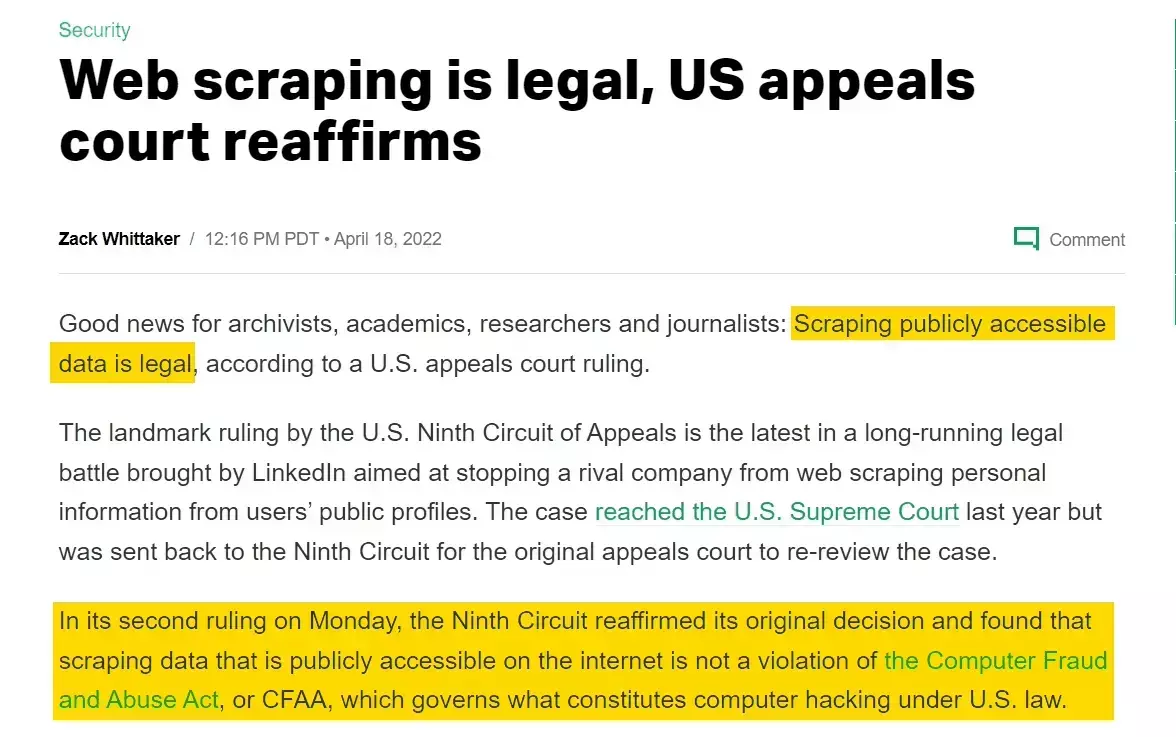
What that means in practice:
- ✅ Public review pages = generally legal to scrape.
- ❌ Anything behind a login = no. That's authorized access territory and changes the legal picture entirely.
- ❌ Don't republish copyrighted review text wholesale. Aggregate, analyze, summarize... but don't rebuild Yelp's review pages on your own domain.
- ❌ Don't abuse PII. Public profile data is different from collecting it to spam people.
- ❌ Don't scrape at DOS rates. Be reasonable. Hammering a site can trigger CFAA arguments even on public data.
OK, so scraping is on the table. The question is which tool. Let's get into it.
How did I choose the best Yelp reviews scrapers?
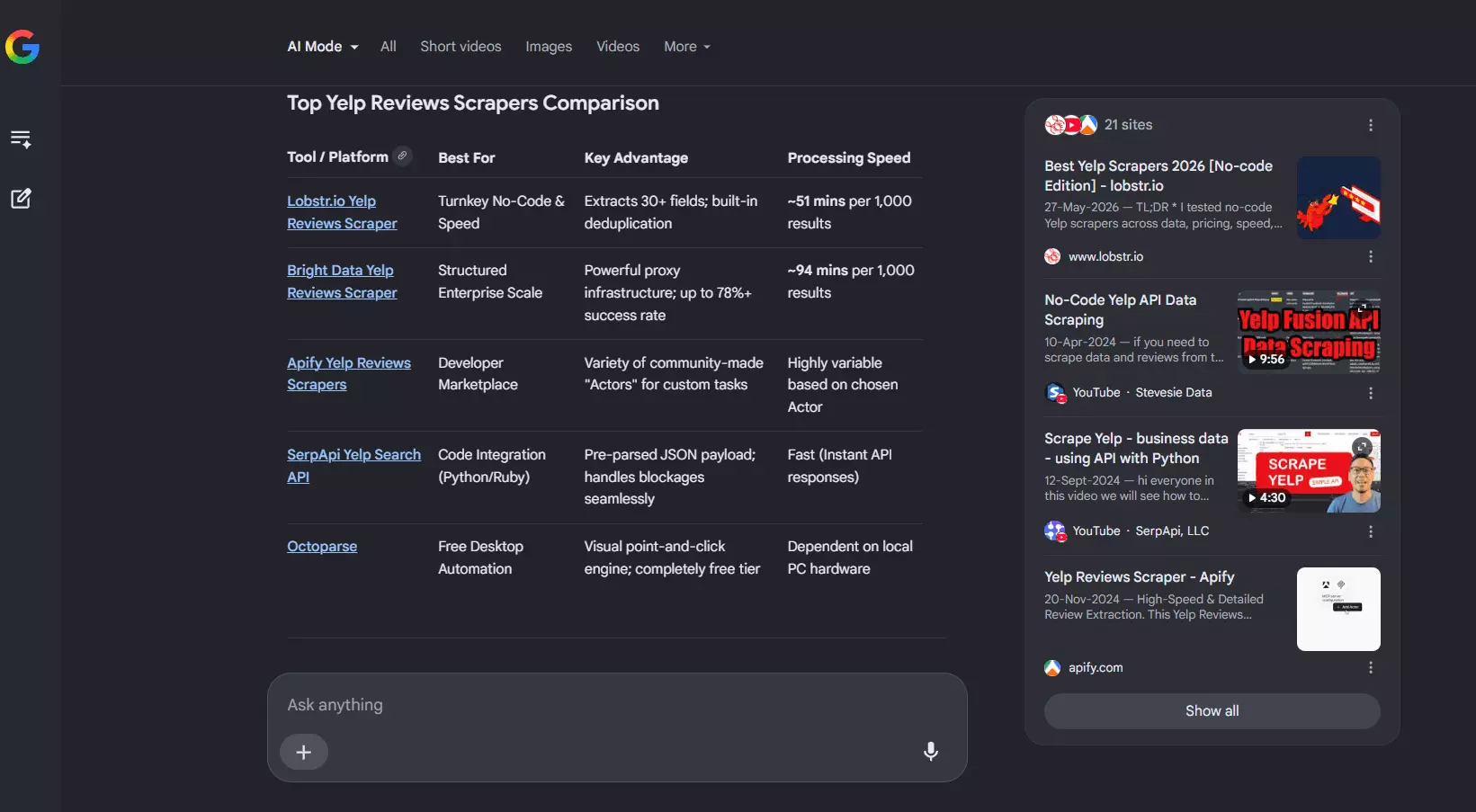
I read the Reddit threads, the Capterra reviews, and the actual user complaints first. People scraping Yelp keep landing on the same problems... tools that work for a week then stop, data that's shallow or inconsistent, pricing that pretends to be cheap until you hit volume, support that ghosts you when a scraper breaks because Yelp shipped a UI change overnight.

So I narrowed down to the tools that actually work at scale in 2026 and scored each on the same six things... the same six I break every tool down on below:
- Data ... quality, consistency, and how many real data points you get back per review. I only counted review-level fields here... I stripped the plumbing (internal IDs, task/run metadata, the search input echoed back) so no tool gets credit for noise. Star rating + review text alone is hobby-grade.
- Usability ... how fast you get from URL to data, and whether the filters are clean UI fields or hand-crafted URL parameters.
- Speed ... reviews pulled per minute, measured across multiple runs so it's a fair average, not one lucky run.
- Cost ... normalized to cost per 1,000 reviews, at entry and at scale, with hidden compute layers and overage traps folded in.
- Scalability ... how many reviews you could realistically pull in a month, concurrency included.
- Customer support ... what channels, who actually answers, and how long a fix takes when Yelp breaks something.
I paid for every tool's plan and ran them across thousands of reviews and multiple runs each.
And to compare them cleanly, field by field, I pointed all 3 at the same business... Sisterita in San Francisco... so the numbers you'll see below are the exact same reviews pulled by each tool, side by side.
What I excluded and why:
- Hobby GitHub scripts. They break the moment Yelp changes a CSS class. Not a real option for anyone running anything serious.
- Chrome extensions. They choke after 50-100 reviews. Useful for one-off curiosity, not for actual analysis.
- General-purpose web scrapers like Bright Data or Zyte. They work, but they're not Yelp-tuned. You're doing the parsing yourself.
Three tools made the cut. Here they are.
Best Yelp Reviews Scrapers of 2026
| Criteria | lobstr.io | Apify | Outscraper |
|---|---|---|---|
| Data points (per review) | 27 | 17 | 23 |
| Owner reply | ❌ | ❌ | ✅ |
| Account age (member since) | ✅ | ❌ | ❌ |
| Friend count | ✅ | ❌ | ✅ |
| Check-in count | ✅ | ❌ | ❌ |
| Business metadata | ✅ | ❌ | ❌ |
| Photo resolution | Full res | Full res | Thumbnail |
| Language field | ✅ | ✅ | ❌ |
| Filter: Sort by | ✅ | ⚠️ via URL | ✅ |
| Filter: Rating | ✅ | ⚠️ via URL | ❌ |
| Filter: Keyword search | ✅ | ⚠️ via URL | ❌ |
| Filter: Language | ❌ | ✅ | ❌ |
| Filter: Date range | ❌ | ✅ | ⚠️ from only |
| Filter: Max reviews/business | ✅ | ✅ | ✅ |
| Speed (reviews/min) | 400 | 250 | 60 |
| Max reviews/month (24/7, 1 slot) | ~17.3M | ~10.8M | ~2.6M |
| Concurrency | ✅ up to 100 slots | ⚠️ memory-driven | ❌ none |
| Free tier | 500/mo | ~5,000/mo | 500/mo |
| Cost /1k (entry → scale) | $2 → $0.5 | $0.8 → $0.5 | $3 → $1 |
| Export formats | CSV, JSON, Excel | CSV, JSON, Excel, XML, RSS, JSONL | CSV, JSON, Excel, Parquet |
| API access | ✅ API, MCP, SDK, CLI | ✅ API, MCP, SDK, CLI | ⚠️ via integrations |
| Customer support | 💯 Live chat + email | 👎 Issues tab ~10d | 👍 Live chat |
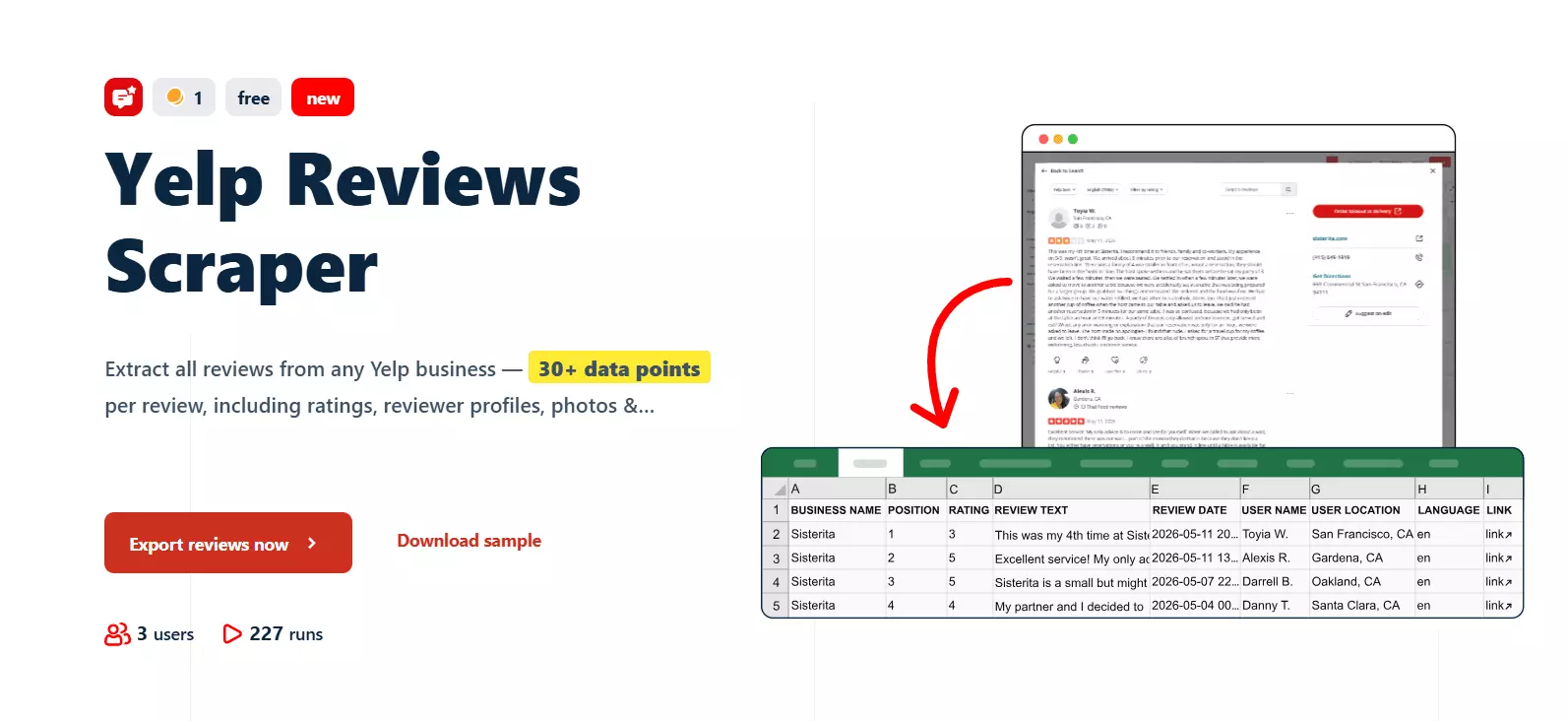
1. lobstr.io Yelp Reviews Scraper
| Pros | Cons |
|---|---|
| Deepest data of the three (27 fields) | No owner-reply data |
| Fastest by far (400 reviews/min) | No language or date filter |
| Only tool with account age + friend count together | Reaction counts are unreliable |
| Full-resolution photos + business metadata | |
| Cleanest billing, unlimited credit rollover | |
| Best customer support in the category |
Data
lobstr.io returns 27 useful fields per review... the deepest set I tested.
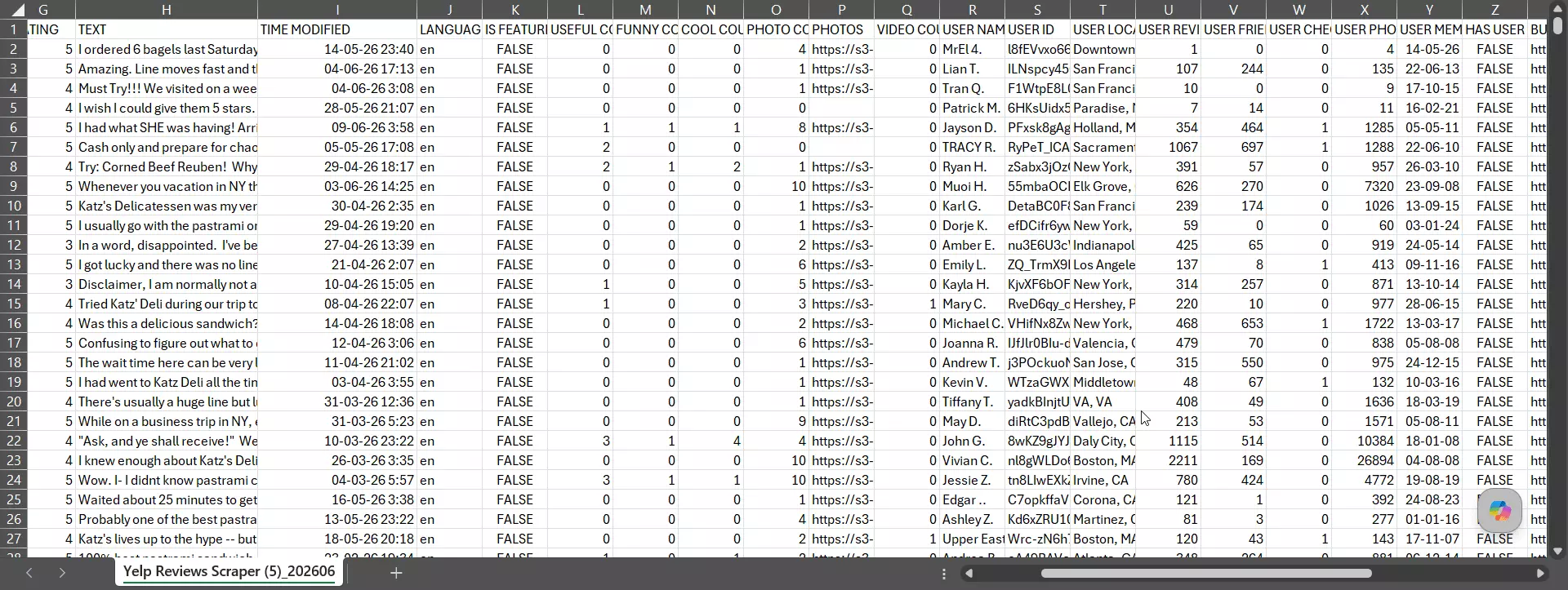
That's review content, full reviewer profile, the reactions, complete business metadata, and a set of reviewer trust signals nobody else captures. Here's the field set:
| Category | Data points |
|---|---|
| ✍️ Review content | review_id, rating, text, language, is_featured, time_modified, url |
| ❤️ Reactions | useful_count, funny_count, cool_count 🐛 |
| 📷 Media | photo_urls, photo_count, video_count |
| 👤 Reviewer | user_id, user_name, user_location, user_review_count, user_friend_count, user_photo_count |
| 🛡️ Trust signals | user_member_since, user_check_in_count, has_user_paid_through_yelp 🎁 |
| 🏪 Business | business_id, business_name, business_url, business_avg_rating, business_review_count, direct_review_permalink |
| ⚙️ Job metadata | collected_at, input_params, review_position |
o.jpg photos, a permalink to every review, and... uniquely... reviewer trust signals.user_member_since (account age) and user_friend_count fire on every review, and lobstr.io is the only tool that gives you both in the same row... the cleanest fake-review signal in the category. Apify has neither; Outscraper has friend count but no account age.user_check_in_count, has_user_paid_through_yelp) barely populate in practice, so treat them as bonus. And the reaction columns are buggy... mislabeled, Oh no missing, undercounted in my test. On the fix list.Usability
lobstr.io was the easiest of the three to drive. The whole flow is a simple wizard... Create Squid → add tasks → settings → launch.
Ways to feed it a job:
- A single Yelp business page URL
- Bulk-upload a list of business URLs (no cap)
It takes Yelp listing URLs only... it's a reviews scraper, not a listings scraper.
Pre-scrape filters:
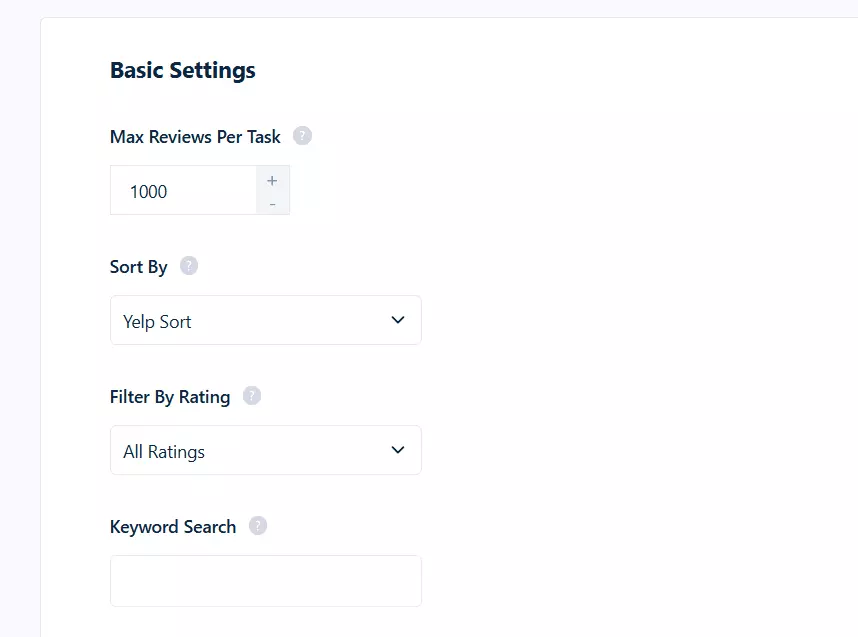
- Sort by (Yelp Sort, Newest, Oldest, Highest Rated, Lowest Rated, Elites)
- Rating
- Keyword search
- Max reviews per business
The gaps are language and date... neither is in the UI yet.
Where it pulls clear of the pack is the platform shell:
- Proper instance management... runs live inside their Squid
- A live progress tracker and console, plus per-run timestamps
- A daily credit cap, and runs that pause when credits run out (no overage)
- Abort anytime, plus webhook and email alerts
- Built-in scheduling for weekly monitoring
Speed
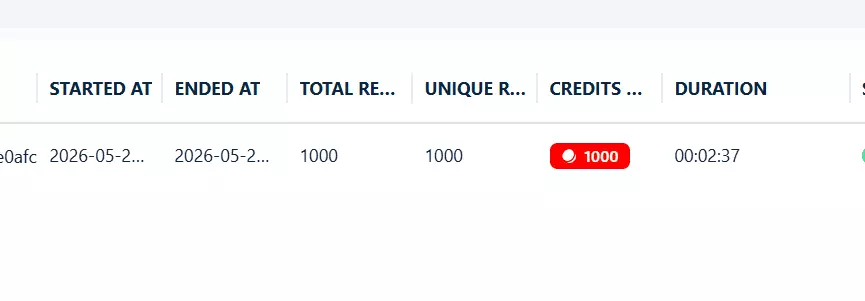
lobstr.io was the fastest tool I tested by a wide margin... 400 reviews per minute. That's 1.6x Apify and 6.7x Outscraper.
Cost
lobstr.io runs on a credit-based monthly subscription. 1 credit = 1 review, no overage, and credits never expire.
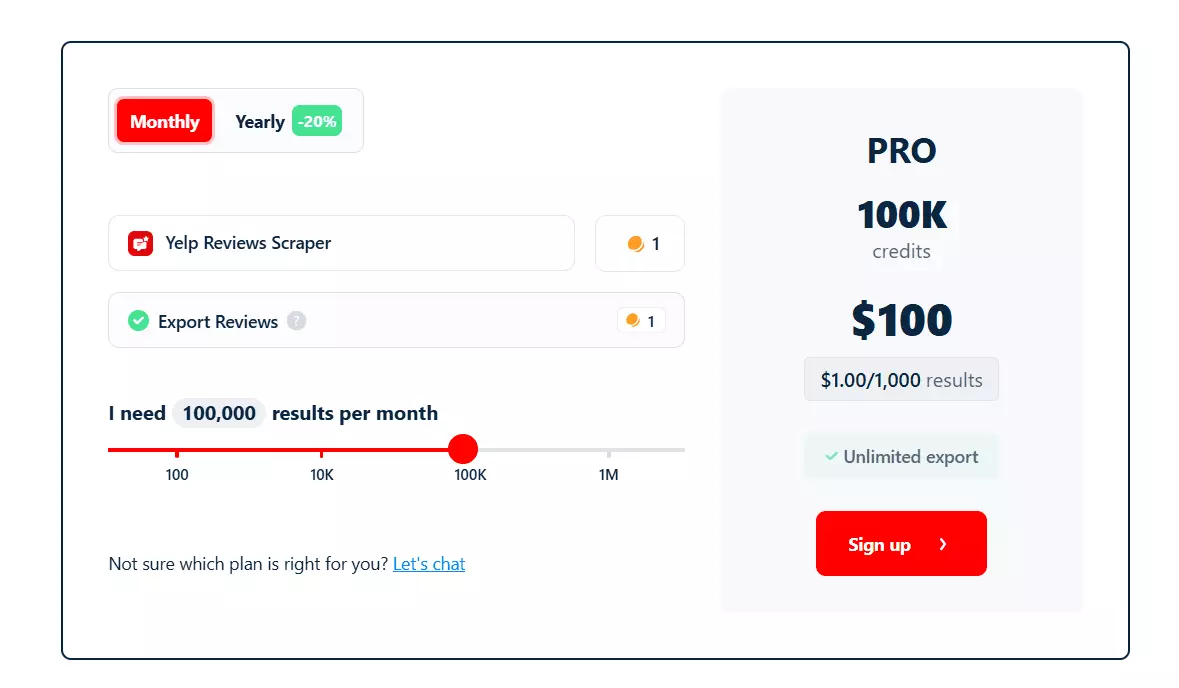
- Free tier: 500 reviews/mo
- Entry: $2 / 1K reviews
- At scale: $0.50 / 1K reviews
The cleanest billing of the three: unlimited rollover, no compute layer to budget separately, no overage surprises.
Scalability
This is lobstr.io's real moat. At ~400/min on a single slot, running 24/7, that's ~17.3M reviews/month on paper.
And you can even increase the speed using slots.
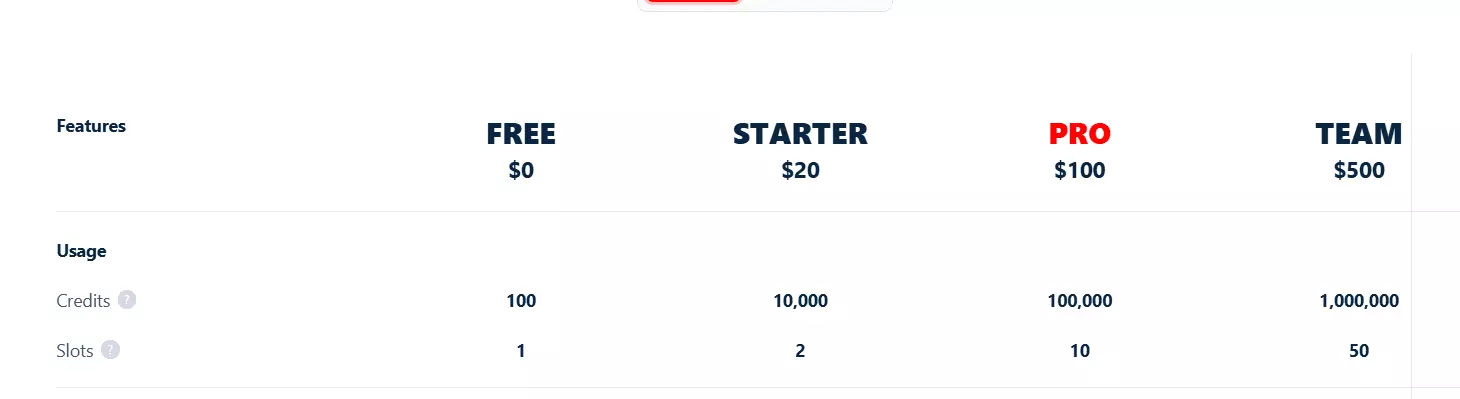
lobstr.io lets you add up to 100 slots, which makes your scraping 100x faster.
Customer support
This is genuinely lobstr.io's most-praised feature.
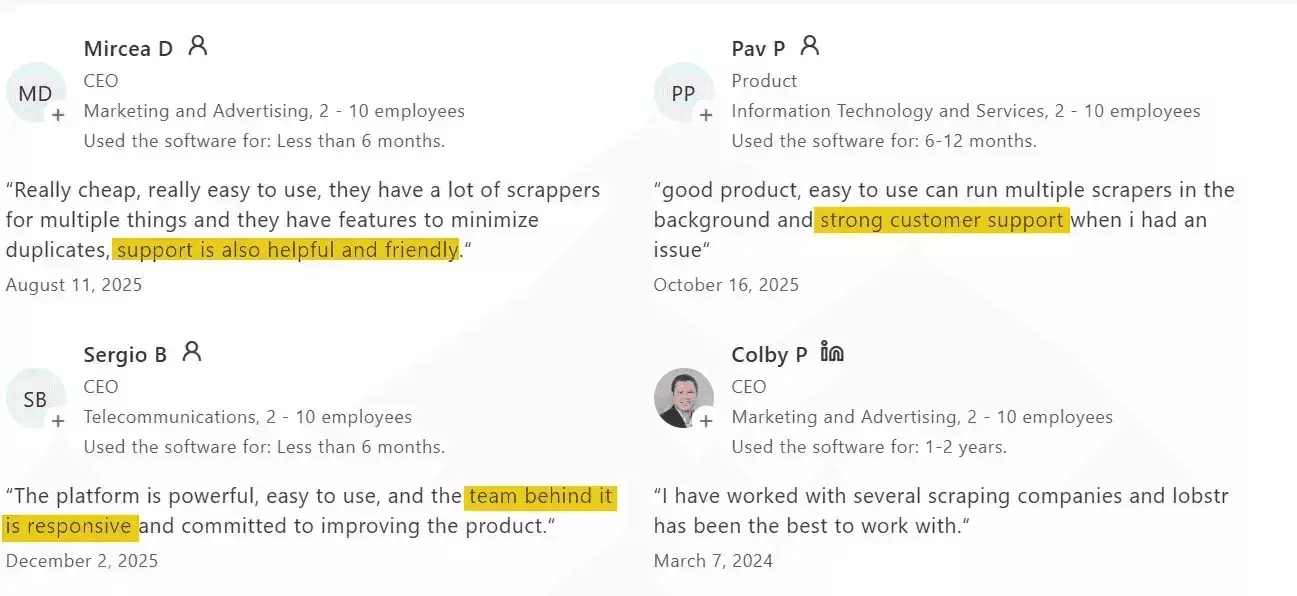
Support is via live chat and email, and users consistently praise the team's technical depth and responsiveness.
Best for: anyone running high-volume Yelp scraping, fraud and fake-review detection, or photo-heavy analysis who wants the deepest data, the fastest pulls, and predictable billing.
2. Apify
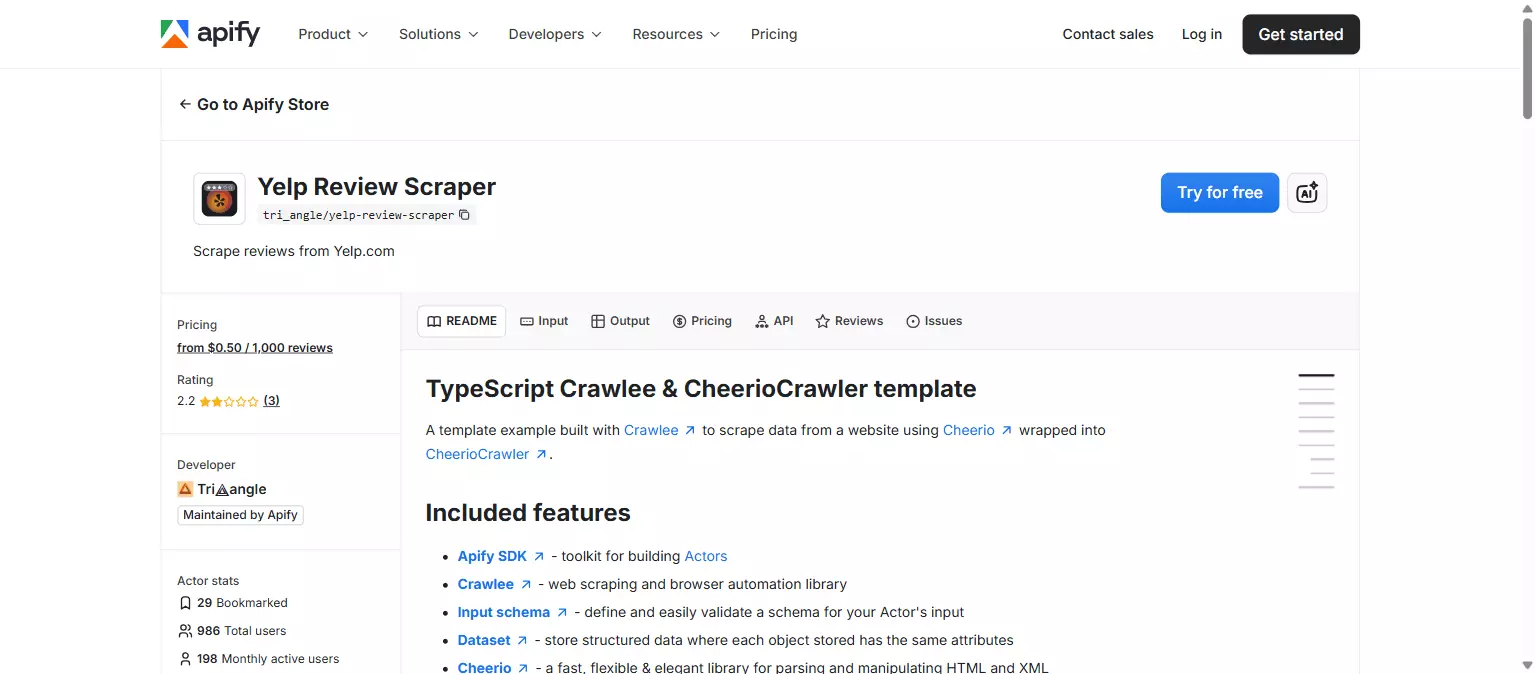
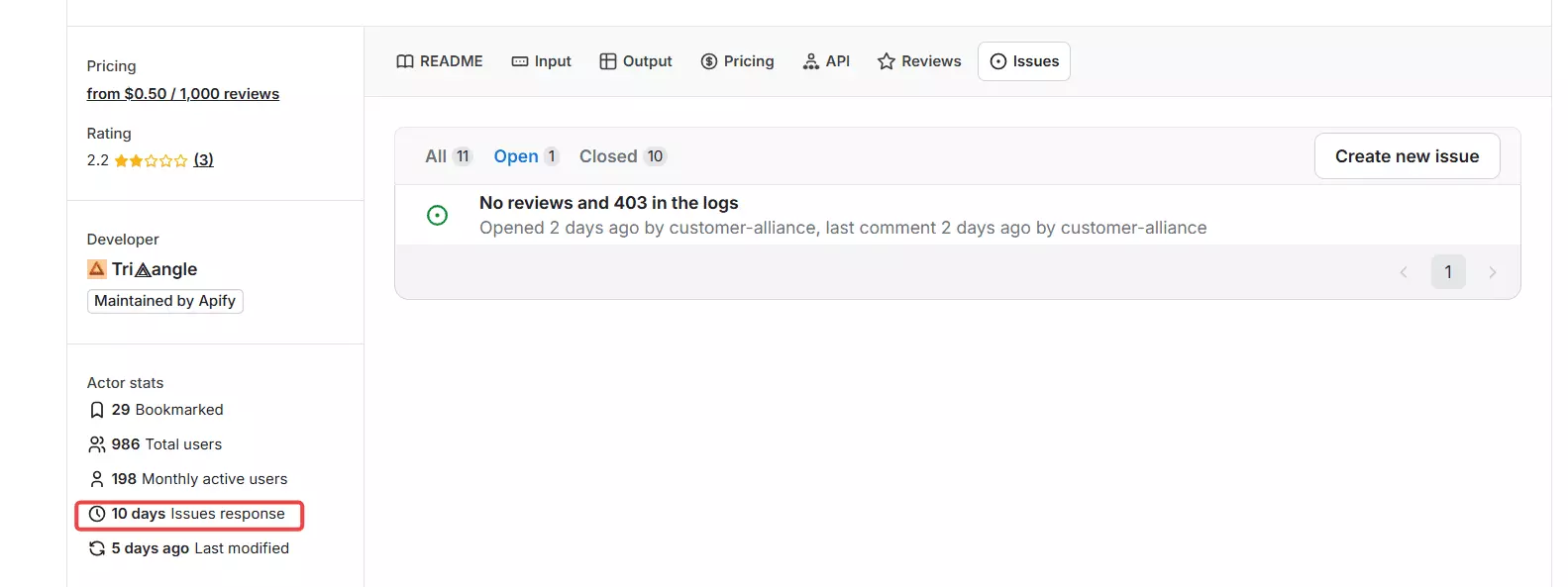
There are dozens of Yelp scrapers on it, so I'm covering the most-used one (986 total users, 198 monthly active), which Apify maintains... so it won't be abandoned tomorrow.
Pros & Cons
| Pros | Cons |
|---|---|
| Most popular Yelp reviews actor on Apify | Data-shallow: 17 fields |
| Apify-maintained, won't be abandoned | No business metadata, no trust signals |
| Fast: 250 reviews/min | No clean user_id (buried in reviewerUrl) |
| Clean ISO 8601 timestamps + full-res photos | Rating/keyword/sort filters are URL-based |
| Language + date-range filters in the UI | Support: actor issues wait ~10 days |
| 7 export formats + strong AI integrations | Apify's layered billing (compute + actor rate) |
Data
Apify returns 17 useful fields... the shallowest set in the test.
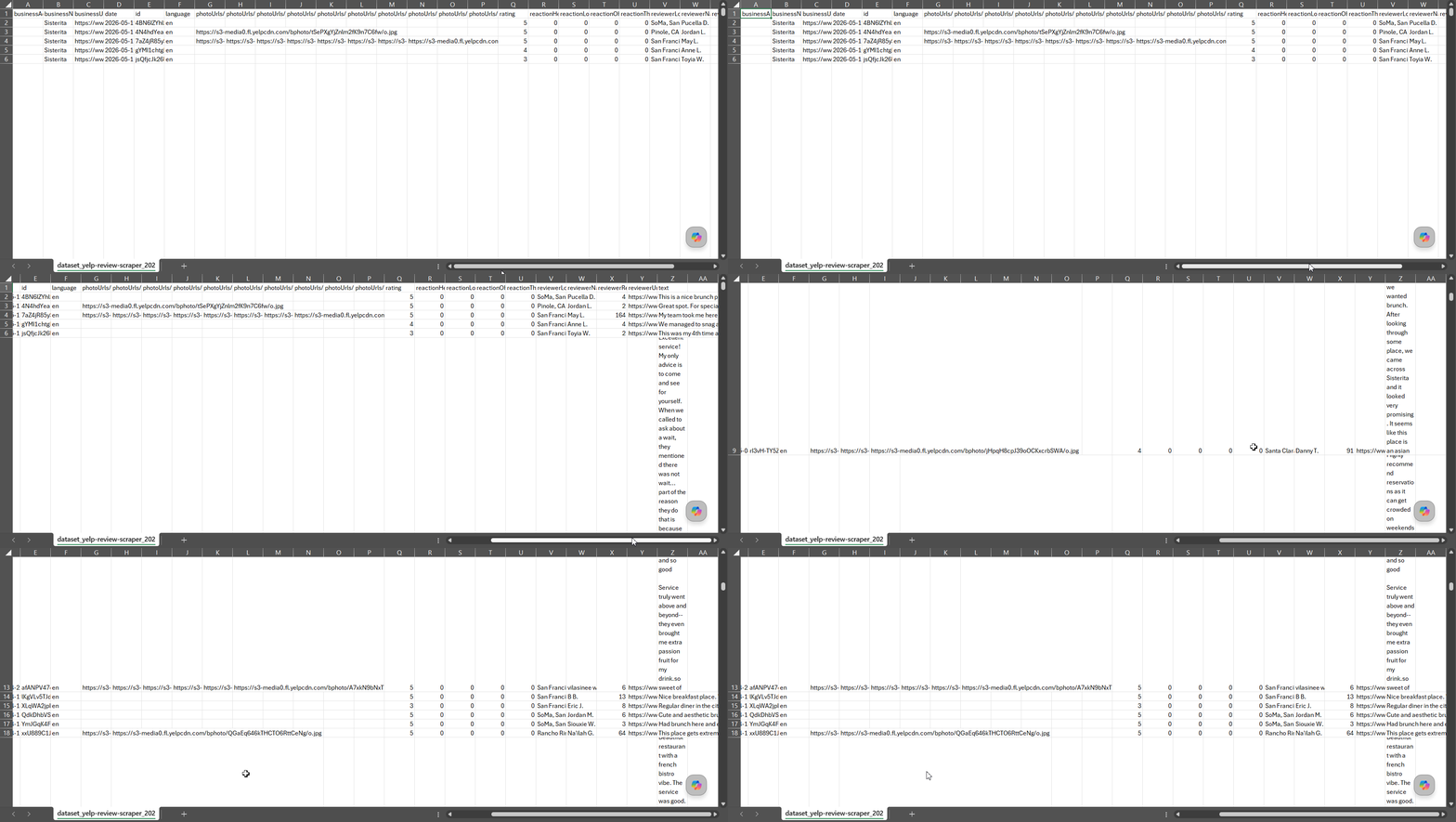
You get the core review, the four reactions, full-resolution photos, and a basic reviewer profile. That's it.
| Category | Data points |
|---|---|
| ✍️ Review content | id, businessName, businessUrl, businessAddress, date, rating, text, language |
| ❤️ Reactions | reactionHelpfulCount, reactionThanksCount, reactionLove_thisCount, reactionOh_noCount |
| 📷 Media | photoUrls |
| 👤 Reviewer | reviewerName, reviewerUrl, reviewerReviewCount, reviewerLocation |
businessAddress is there but empty for 100% of reviews... a dead field.If you only need the core review plus reactions and photos, it's enough. Anything more analytical and you'll feel the gaps.
Usability
Unlike Apify's busy general scrapers, this reviews actor is a simple single-page setup... all the inputs on one screen.
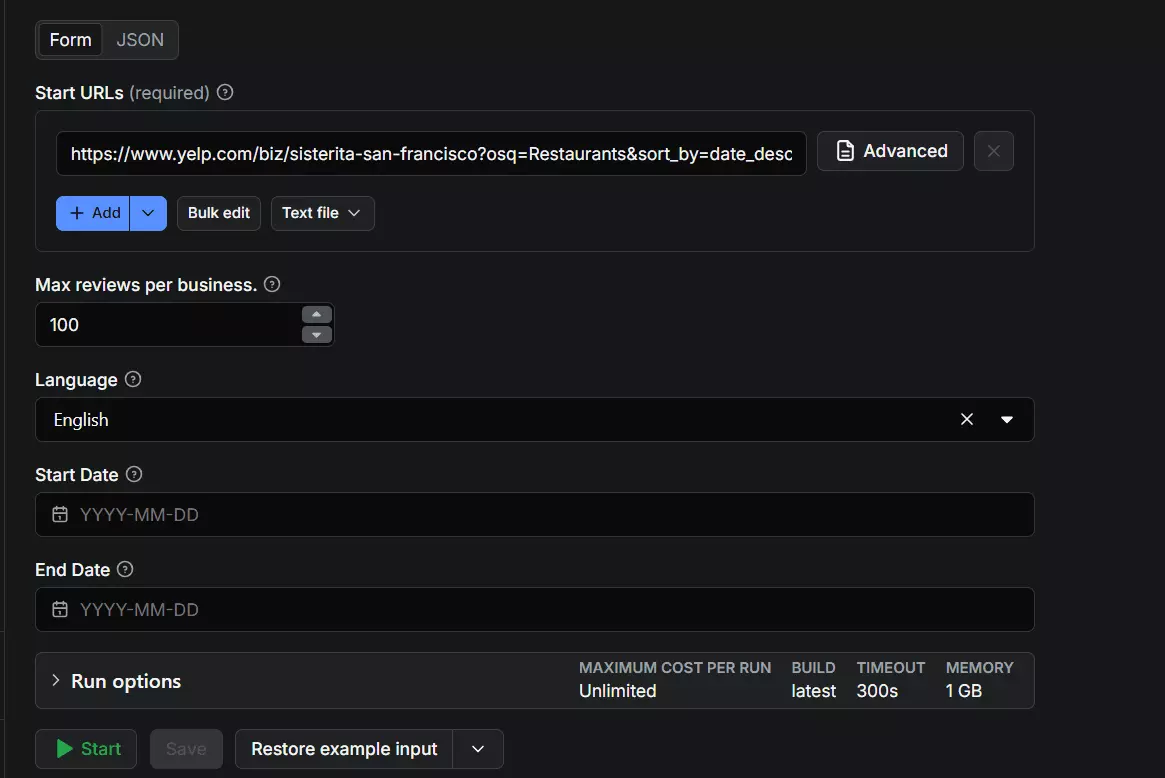
Ways to feed it a job:
- One or more Yelp business URLs in the Start URLs field
- Add them one at a time, paste a bulk list, or load a text file
- Form/JSON toggle for the technical folks
Pre-scrape filters:
- Language
- Start + end date window
- Max reviews per business
?osq=Restaurants&sort_by=date_desc) rather than clean form fields.The platform basics are thin too:
- No real instance management... reopen the actor and it loads your last inputs
- Scheduling isn't as clean as lobstr.io's
Speed

250 reviews per minute... faster than Outscraper, slower than lobstr.io. To pull 100,000 reviews takes 6.7 hours; 1M takes 2.8 days.
Cost
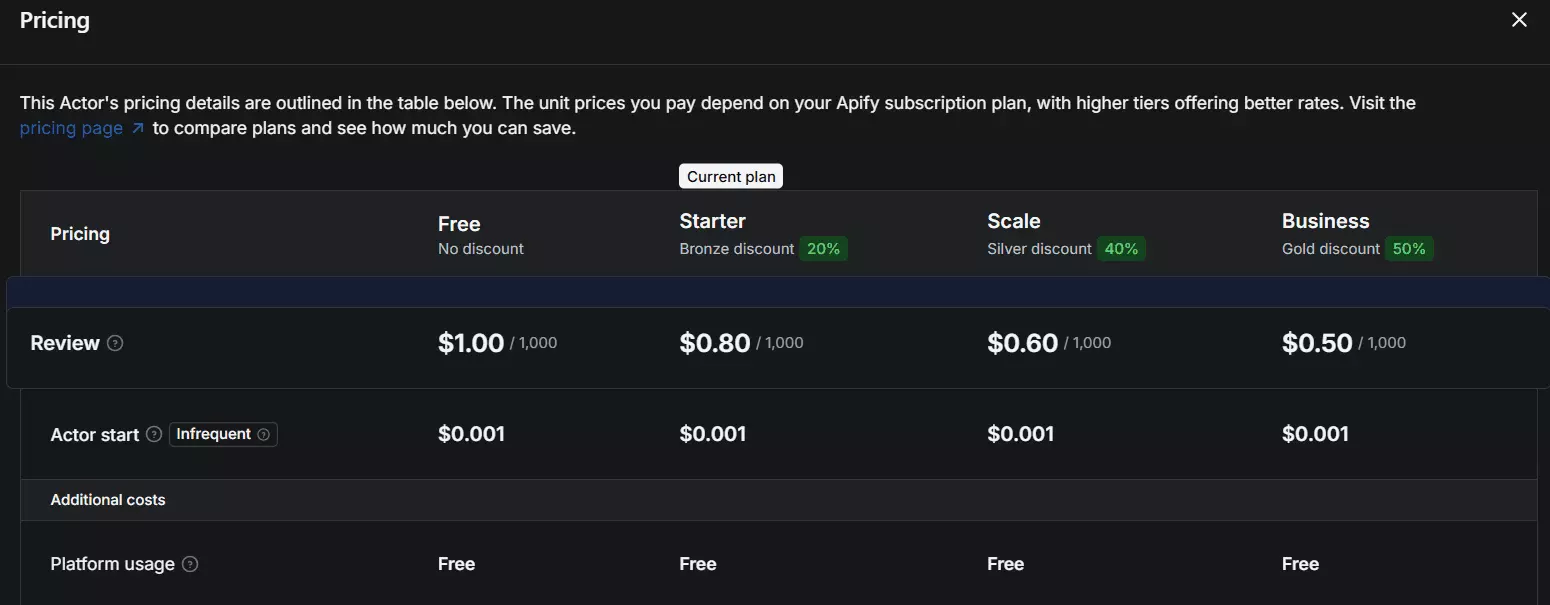
- Free tier: ~5,000 reviews/mo ($5 credit)
- Paid plans: from $0.80 / 1K reviews
- At scale: $0.50 / 1K... matches lobstr.io Team
The cheapest entry pricing on this list, but Apify's billing has more moving parts: platform compute credits on top of the per-1k rate, and they expire monthly.
Scalability
At 250/min running 24/7, that's ~10.8M reviews/month on the default config. But there's no concurrency slider... parallelism is tied to the memory you allocate, so you scale by paying for more compute, not by flipping a switch.
The head-to-head that matters: at 5M reviews/month Apify hits $2,500, identical to lobstr.io Team × 5. Same money... but Apify needs 14 days of continuous runtime where lobstr.io does it in 8.7.
Customer support
This is where Apify drops hard. It offers live chat plus a per-actor Issues tab, but the live chat agents are general platform support... they can't help with anything actor-specific.
So when the scraper breaks, the answer is "open an issue on the actor." The actor's Issues tab shows an average response time of about 11 days.
Best for: Apify-native users with platform credits who need a fast scraper, run pipelines into AI / LangChain / agent workflows, and don't need deep metadata. Also a solid budget pick for one-off jobs in the 10k-100k range.
3. Outscraper Yelp Reviews
| Pros | Cons |
|---|---|
| Only tool with full owner-reply data | Slowest in the category: 60 reviews/min |
| Parquet export (only tool that has it) | Most expensive at scale: $1/1k at best |
| Most flexible inputs (URL / ID / name + bulk) | Capacity-bound past 1M reviews/month |
| Pay-as-you-go, no subscription | Photos are thumbnails, not full res |
| Sentiment + summary add-ons | No language field, US-format dates |
| Responsive live-chat support | Missing most business metadata |
Data
Outscraper delivers 23 useful fields... mid-pack on depth, but with one thing no one else has. Here's the field set:
| Category | Data points |
|---|---|
| ✍️ Review content | review_id, query, business_name, review_rating, review_text, review_photos |
| ❤️ Reactions | review_tags_helpful, review_tags_thanks, review_tags_love_this, review_tags_oh_no |
| 👤 Reviewer | author_id, author_title, author_image, author_friend_count, author_photo_count, author_reviews_count, author_location, author_link |
| 💬 Owner reply | owner_reply, owner_reply_title, owner_reply_datetime_utc, owner_reply_timestamp 🎁 |
| 🕐 Timestamps | datetime_utc, timestamp |
The 🎁 owner-reply fields are the moat. If your job is reputation management... tracking how businesses respond to negative reviews, measuring response time, analyzing reply tone... Outscraper is the only option that delivers this out of the box.
The rest is fine but unremarkable... solid author metadata, partial avatars (~64% in the test). It misses the language field and most business metadata, and photos come back as 348px thumbnails in a comma-separated string, not full resolution.
Usability
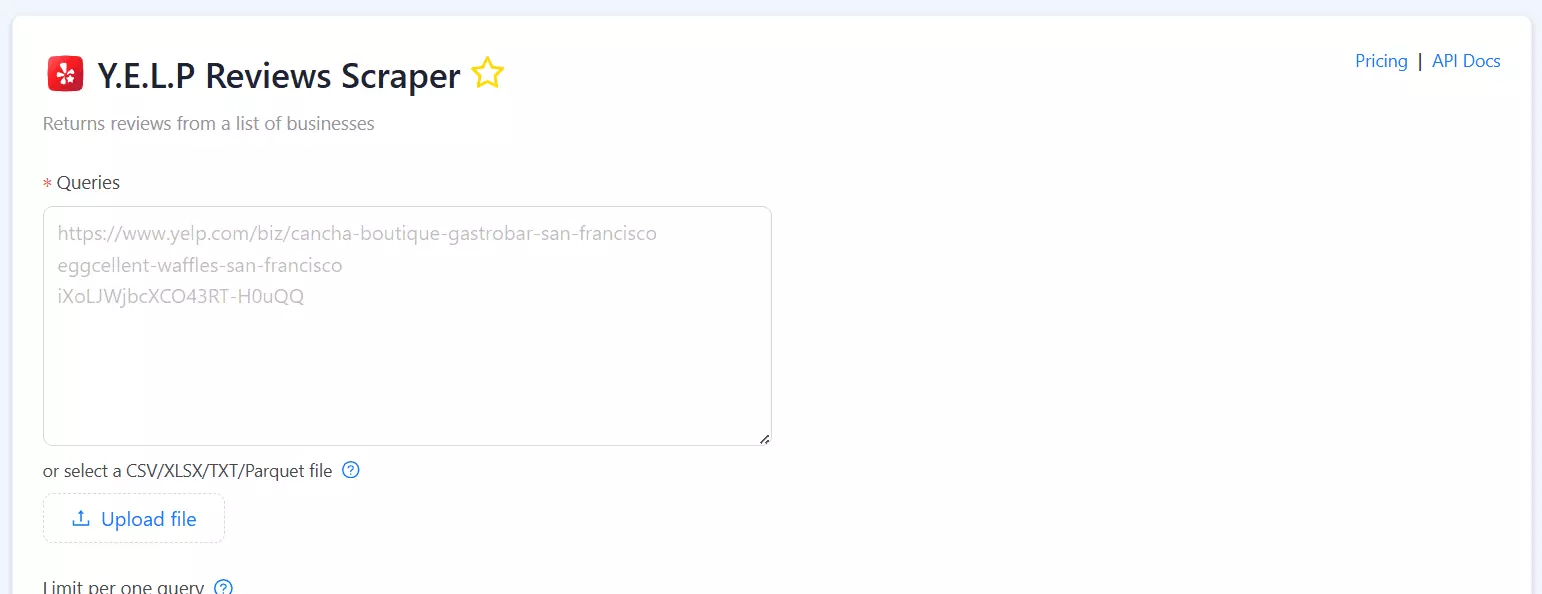
Outscraper has a clean one-page setup... queries → enrichment → sorting → export, all on one screen.
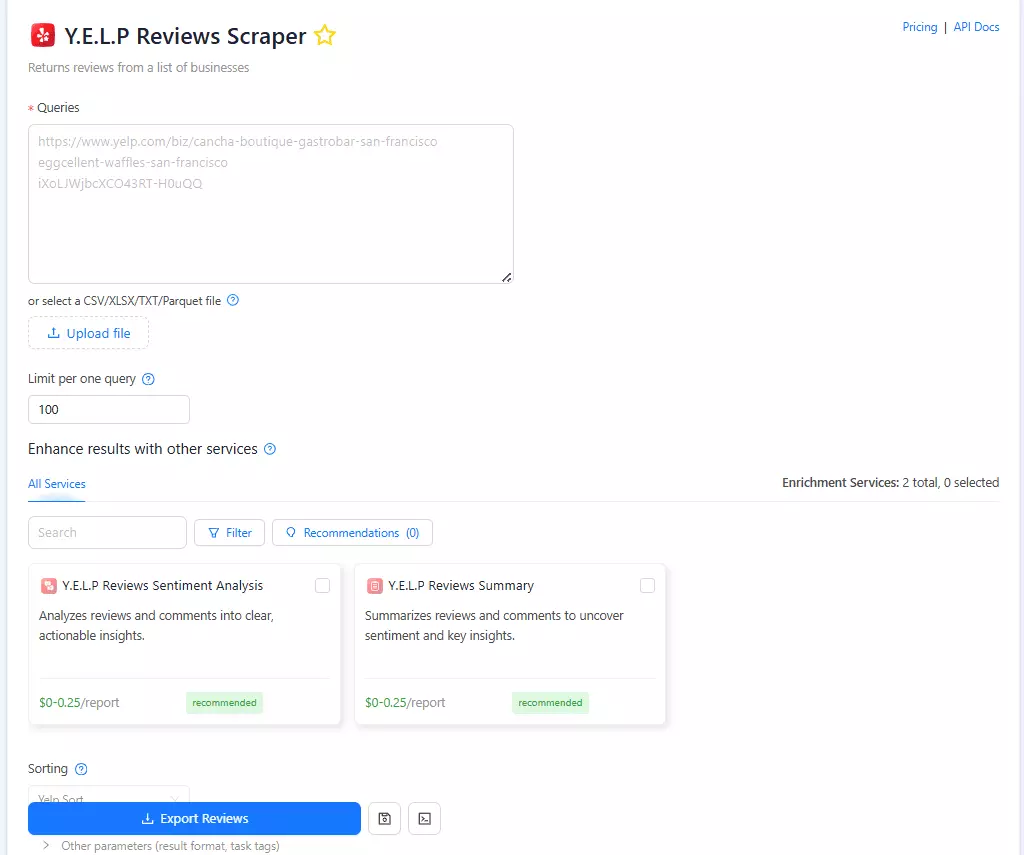
Ways to feed it a job: the most flexible inputs of the three.
- Yelp business URLs, business IDs, or plain business-name queries (one per line)
- Bulk-upload a CSV, XLSX, TXT, or Parquet file
Pre-scrape filters:
- Sort
- "From" date... newer-than, with an optional Relative mode like "last 30 days" (lower bound only, no end-date cap)
- Paid Sentiment Analysis and Review Summary add-ons baked into the run
No rating, keyword, or language filter though... the set is thin.
Where it gets rough: once you hit Export, you're flying blind.
- No live console
- No progress tracker
- No run timestamps
You fire it off and check back later. For a 60-reviews-per-minute tool, that's a long wait with no visibility.
Speed
This is where Outscraper hurts. 60 reviews per minute... the slowest by a wide margin. To pull 100,000 reviews takes 27.8 hours of continuous runtime; 1M takes 11.6 days.
Cost
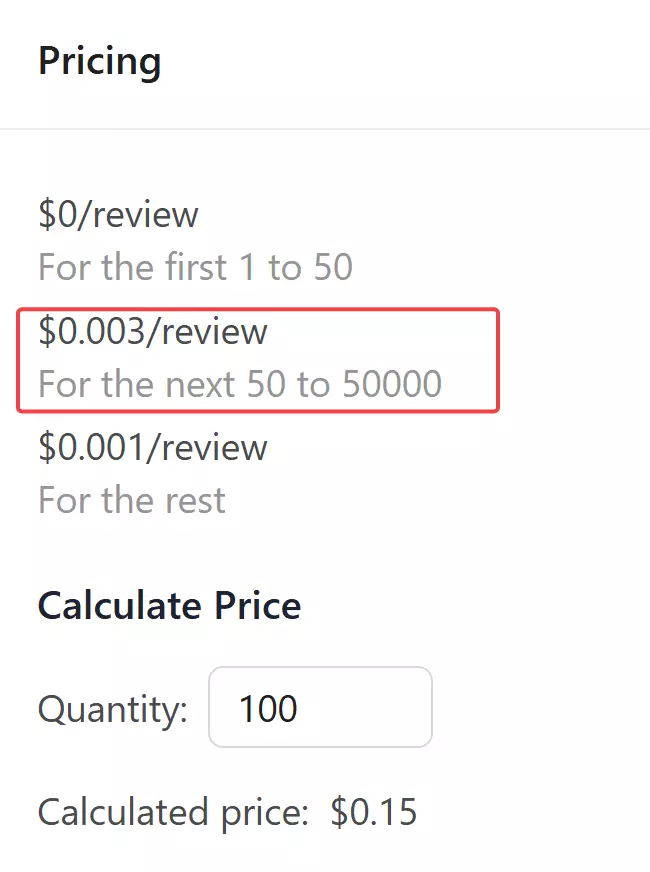
- Pay-as-you-go: no subscription, no commitment
- Entry: $3 / 1K reviews
- At scale: $1 / 1K reviews
The priciest of the three... 2-5x the cheapest at every tier. PAYG suits genuine one-offs, but at volume it stings: 1M reviews = $1,000 vs $500 on lobstr.io or Apify.
Scalability
At 60/min with no concurrency, the 24/7 ceiling is about 2.6M reviews/month.
At 1M/month Outscraper already eats 39% of that for a single customer... run it for two clients at that scale and you're over capacity.
Constrain to business hours and effective capacity drops to roughly 633k/month, so it physically can't deliver 1M during work hours. Sub-100k, none of this matters. Above it, it matters a lot.
Customer support
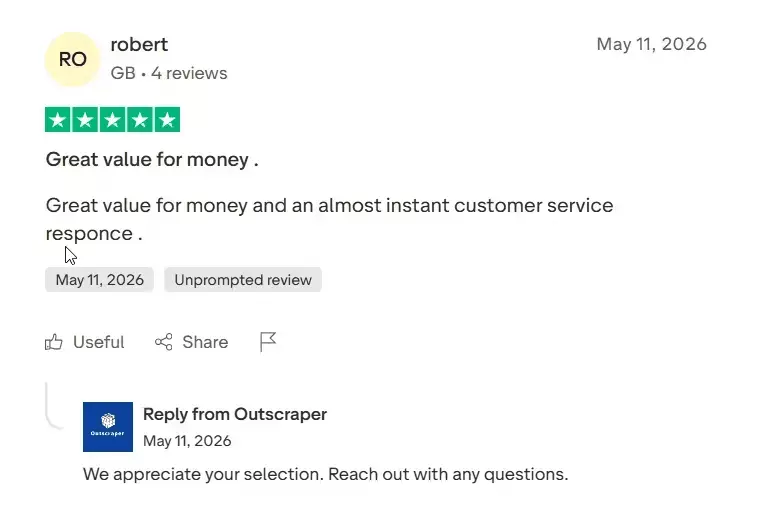
Outscraper offers live chat and it's responsive. A solid story... not at lobstr.io's level (no email channel, less technically deep), but materially better than Apify's wait-for-the-developer model.
Best for: reputation-management workflows that need owner-reply data, data engineers who want Parquet exports, and one-off jobs where pay-as-you-go beats committing to a subscription.
FAQ
Which Yelp scraper has the most data?
member_since, check_in_count, paid_through_yelp) that no competitor delivers.What's the cheapest Yelp scraper?
Apify at $0.50 per 1,000 reviews at scale (and $0.80 at entry). lobstr.io matches that $0.50 rate from the Team plan up with cleaner billing (no platform compute layer to budget separately, no overage surprises, unlimited credit rollover).
Can I scrape Yelp reviews legally?
Yes for public data, under US law (hiQ Labs v. LinkedIn precedent). Yelp's ToS prohibits it on their end, but breaking the ToS is a private contract issue, not a criminal one. Don't scrape behind logins. Don't republish full review text wholesale. Don't abuse PII. Don't hammer the site at DOS rates.
Does Yelp have an official API for reviews?
Which scraper is best for tracking how businesses respond to reviews?
Outscraper. The only tool on this list that captures owner reply text, title, and timestamp. The other two have zero owner-reply data.
Which scraper is best for AI agent / LangChain workflows?
Apify. Full developer surface (API, MCP, SDK, CLI) plus native integrations with Langchain, Haystack, n8n, Make, Zapier, and JSONL exports for LLM training. lobstr.io has the API + Make.com path; Outscraper works through integration tools.
Can I scrape Yelp at 1M+ reviews/month?
Comfortably on lobstr.io and Apify. On a single slot running 24/7, lobstr.io can theoretically pull ~17.3M reviews/month and Apify ~10.8M, so 1M is a small fraction of either (and lobstr.io adds up to 100 slots on top). Outscraper tops out around 2.6M/month and gets capacity-bound past 1M, especially if you only run during business hours.
Conclusion
That's a wrap on the best Yelp reviews scrapers for 2026.
Quick recap of who owns what:
- lobstr.io owns speed, data depth, fake-account trust signals, enterprise scale, the cleanest billing in the category, and the best customer support. The default pick for anyone serious about Yelp at volume.
- Apify owns the cheap entry tier and the AI / agent integration story. Solid if you're under 100k/month and don't need deep metadata... just be ready for the slow support model when something breaks.
- Outscraper owns owner-reply data. The specialty pick. Slow and expensive, but the only option for what it's good at.
This list will keep evolving as these tools ship updates... lobstr.io has filter and export improvements queued, Apify's actor improves over time, Outscraper keeps expanding its catalog. I'll keep this updated.