
Best Google Maps Reviews Scrapers of 2026 [No Code]
(updated)
lobstr.io is the best Google reviews scraper in 2026 (9.5/10) across data, speed, cost, scale, and support. It's the fastest of the three, the cheapest at every tier, the only one with true horizontal scaling, and it captures review data the others drop... owner replies, edit tracking, and the fullest review-context set.
Apify is the runner-up (6.8/10), bundling the full business listing into every review row, and Outscraper (5.7/10) is the no-subscription pay-as-you-go option.
⚡ 30-Second Summary
- I bought the paid plan of every Google reviews scraper people actually recommend and ran the same job through each one... the same listing, 1,000 reviews, multiple runs, then counted exactly what came back on data, usability, speed, cost, scalability, and support
- lobstr.io is the best overall pick (9.5/10). It's the fastest (~273 reviews/min), the cheapest ($0.40/1K entry, $0.10/1K at scale), the only tool with real horizontal scaling (Slots), and the only one that tracks edited reviews. Pick it for high-volume review monitoring, sentiment work, and multi-location reputation tracking. Trade-off: it lacks a keyword-search filter and an owner-reply-date field
- Apify is the runner-up (6.8/10). Solid, clean review data with the full business listing baked into every row, the cleanest JSON of the three, and the broadest review-context tags. Pick it for pulling reviews plus business metadata in one run. Trade-off: priciest at scale ($0.30/1K), no edit tracking, no sort or rating filter
- Outscraper is the pay-as-you-go third place (5.7/10). No subscription, a keyword-search filter the others lack, and a from/to date window. Pick it for a quick one-time pull. Trade-off: the thinnest data (no translation, no Local Guide flag, empty likes), and no live progress tracking
- This guide breaks down what each tool actually returns, where each one quietly falls short, and which one fits your job
- Didn't make the cut: Bright Data, ScrapeHero, and Livescraper. Reasons at the end
If you've gone looking for a way to pull Google reviews at scale, you've hit the same wall everyone does.
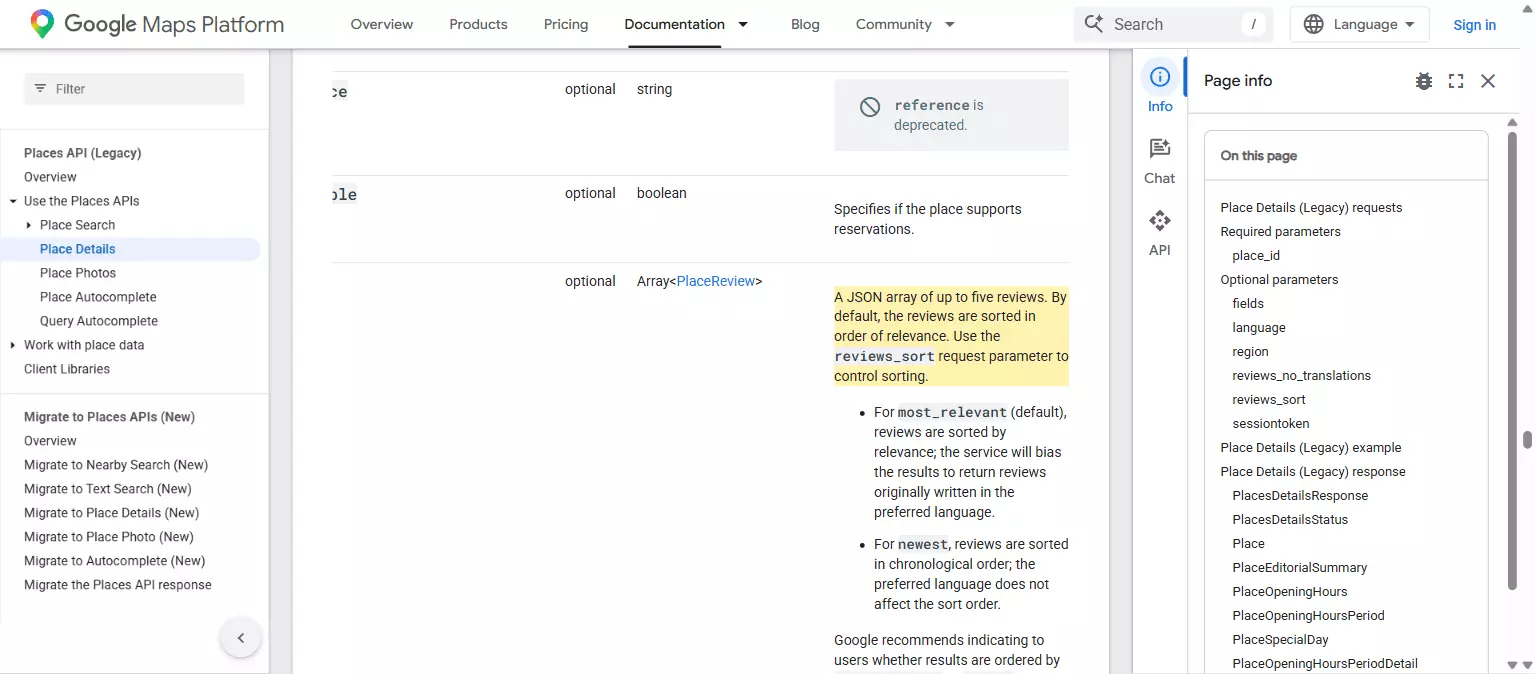
The official Places API hands you 5 reviews per place. Five. 🙃 The DIY scripts die every other week. And half the "scrapers" you find return 20 reviews and call it a day.
Most "best Google reviews scraper" lists online are recycled marketing. Nobody runs the same job through every tool and counts what comes back.
So I did. I bought the paid plans and ran every tool through the same 1,000 reviews from the same listing, multiple runs each, then measured them field by field.
Just tell me which one
| Criteria | Winner | Why |
|---|---|---|
| Data quality | lobstr.io | Highest fill rate + the only edit tracking (tie with Apify on depth) |
| Data breadth | Apify | Most distinct fields, incl. place/neighborhood context tags |
| Speed | lobstr.io | ~273 reviews/min, fastest of the three |
| Cost | lobstr.io | $0.10/1K at scale, cheapest at every tier |
| Scalability | lobstr.io | Only tool with Slots... ~11.8M/month on one, up to ~1.18B account-wide |
| Filters | Outscraper | Only tool with keyword search + an upper date bound |
| Support | lobstr.io | Live chat, fast and technical, Capterra 5.0 |
| Overall | lobstr.io | Highest aggregate at 9.5/10 |
That's the snapshot. Here's the full scorecard it's built on, with every criteria and every measured number side by side.
| Criteria | lobstr.io | Apify | Outscraper |
|---|---|---|---|
| Overall score (/10) | 9.5 | 6.8 | 5.7 |
| Meaningful data points (per review) | 29 | 38 | 21 |
| Owner reply text | ✅ | ✅ | ✅ |
| Owner reply date | ❌ | ✅ | ✅ |
| Edit tracking (modified flag + date) 🎁 | ✅ | ❌ | ❌ |
| Local Guide flag | ✅ | ✅ | ❌ |
| Language + original/translated text | ✅ | ✅ | ❌ |
| Review likes | ✅ | ✅ | ❌ empty |
| Detailed sub-ratings (Rooms/Service/Location...) | ✅ | ✅ | ❌ |
| Review-context tags (trip type, travel group...) | ✅ | ✅ broadest | ❌ |
| Place/neighborhood context (safety, walkability...) | ❌ | ✅ | ❌ |
| Reviewer profile (name, id, photo, count) | ✅ | ✅ | ✅ |
| Photos delivered as | ⚠️ joined string | ✅ array | ⚠️ single url |
| Clean JSON (ISO dates, typed values) | ⚠️ | ✅ cleanest | ⚠️ non-ISO dates |
| Filter: Sort by (newest/relevant/high/low) | ✅ | ❌ | ✅ |
| Filter: Newer than | ✅ to the second + timezone | ✅ (day-level) | ✅ |
| Filter: To date / before (upper bound) | ❌ | ❌ | ✅ |
| Filter: Rating (min/max) | ✅ | ❌ | ✅ (one at a time) |
| Filter: Skip reviews without text | ✅ | ❌ | ✅ |
| Filter: Skip reviews without image | ✅ | ❌ | ❌ |
| Filter: Review origin (Google / all sources) | ✅ | ✅ | ✅ |
| Filter: Keyword search in reviews | ❌ | ❌ | ✅ |
| Filter: Language | ✅ | ✅ | ✅ |
| Filter: Personal-data toggle | ❌ | ✅ | ❌ |
| Speed (reviews/min) | ~273 | ~156 | ~137 |
| Cost /1K reviews (entry → scale) | $0.40 → $0.10 | $0.45 → $0.30 | $3 → $1 |
| Free tier | 500 reviews/month | ~8,300/month ($5 credit) | 500/scrape (free under 500/mo) |
| Max reviews/month (24/7, 1 Slot) | ~11.8M | ~6.7M | ~5.9M |
| Horizontal scaling | ✅ 20 Slots/Squid, up to 100/account | ⚠️ memory-driven | ❌ none |
| Interface | No-code dashboard + API/SDK/CLI/MCP | Actor UI + API/SDK/CLI/MCP | Dashboard + API |
| Export formats | CSV, JSON, Excel, Sheets, S3, email | CSV, JSON, Excel, XML, HTML | CSV, JSON, Excel |
| Support | 💯 Live chat, fast + technical | 👍 Live chat + Discord (~1.3d) | 👍 Live chat, responsive |
| User rating | Capterra 5.0 (33) | Apify store 4.8 (185) | Trustpilot 4.5 (279) |
How the scores work: each pillar is rated 0-10 from the tests below, and a tool's overall is the average of the six, with Data counted at its quality score (for a scraper, clean, usable data beats raw field count). For lobstr.io that's (9 + 9 + 9 + 10 + 10 + 10) / 6 = 9.5.
If you just want the quick answer, here it is.
| If you want... | Go with |
|---|---|
| The deepest, best-filled review data | lobstr.io |
| Edit tracking (was a review changed after posting) | lobstr.io |
| The fastest pull and the highest ceiling | lobstr.io |
| The cheapest price at any volume | lobstr.io |
| Reviews plus full business-listing context in one run | Apify |
| The broadest field set and cleanest JSON | Apify |
| Keyword search inside reviews, no subscription | Outscraper |
Want the receipts behind every pick? Keep reading. But first, the question worth settling before you scrape anything... is it even legal?
Is it legal to scrape Google reviews?
⚠️ Disclaimer
The information in this section is for general informational purposes only. It reflects publicly available sources and my own interpretation of them.
It does not constitute legal advice and should not be treated as such. Laws vary by jurisdiction and can change.
If you need guidance on compliance, data use, contracts, or platform-specific risks, consult a qualified legal professional who can evaluate your situation in detail.
Does Google allow it? No.
But does that make scraping public reviews illegal? Not necessarily.
The reviews are already public. Anyone with a browser can open a listing and read every review without logging in. No paywall, no auth, no private content.
So if the content's public, you're not bypassing technical barriers, and you use the data responsibly, you're usually on safe ground:
- Respect rate limits
- Comply with GDPR and similar laws
- Don't republish reviews as your own content
- Don't use reviewer data to harass or impersonate
- Respect takedown requests
OK, with the rules on the table, let's get into how I picked.
How did I choose the best Google reviews scrapers?
Before testing anything, I went where the complaints live... Reddit threads, community discussions, and review sites... to find the pain points that actually matter.
The pattern repeats. Someone grabs a cheap tool and the data comes back shallow, or the "scraper" caps out at 20 reviews, or a run finishes but half the fields are empty.
Based on that research, here are the six criteria I scored every tool on, the same six I break each one down on below.
- Data ... quality, consistency, and which real review data points come back per listing. I stripped the plumbing (internal IDs, run metadata, and the business listing copied onto every review row) so no tool gets credit for noise, and I collapsed duplicate field representations so a renamed field doesn't get counted twice. Then I cross-checked disputed fields value-by-value across all three datasets
- Usability ... input options, whether filters are clean UI fields or hand-crafted URL params, and how fast you get from a URL to a clean export without an expensive mistake
- Speed ... reviews pulled per minute, measured across multiple runs of the same 1,000-review job
- Cost ... normalized to cost per 1,000 reviews, at entry and at scale, with add-ons, filter costs, and free tiers folded in
- Scalability ... how far each tool scales with concurrency, and how many reviews you could realistically pull running 24/7 for a month
- Customer support ... what channels exist, who actually answers, and how fast
To compare them cleanly, field by field, I pointed all three at the same listing and the same 1,000 reviews, aligned every review by its native Google review ID, and measured each tool on the shared set.
One honest caveat on the counts: the tools returned slightly different windows of that listing... lobstr.io and Outscraper overlapped on 998 reviews, and Apify's window overlapped on 868. I report fill rates on the shared set and field coverage on each tool's own schema.
What I left out and why:
- DIY GitHub scripts. They die the moment Google ships a layout change, and none handle pagination or filtering at scale
- Chrome extensions. They choke after a few dozen reviews and can't run unattended
- General-purpose scrapers. They work, but they're not Google-reviews-tuned, so you build the parser and the filtering yourself
- The 5-review Places API. It's not a scraper, and it caps at 5 reviews per place with no full pagination or sort
Then I bought the paid plan of every tool that made the shortlist and ran them all against the same reviews, multiple runs each.
Three tools made the cut. Here they are.
Best Google Reviews Scrapers of 2026
| Criteria | lobstr.io | Apify | Outscraper |
|---|---|---|---|
| Overall score (/10) | 9.5 | 6.8 | 5.7 |
| Meaningful data points (per review) | 29 | 38 | 21 |
| Owner reply text | ✅ | ✅ | ✅ |
| Owner reply date | ❌ | ✅ | ✅ |
| Edit tracking (modified flag + date) 🎁 | ✅ | ❌ | ❌ |
| Local Guide flag | ✅ | ✅ | ❌ |
| Language + original/translated text | ✅ | ✅ | ❌ |
| Review likes | ✅ | ✅ | ❌ empty |
| Detailed sub-ratings (Rooms/Service/Location...) | ✅ | ✅ | ❌ |
| Review-context tags (trip type, travel group...) | ✅ | ✅ broadest | ❌ |
| Place/neighborhood context (safety, walkability...) | ❌ | ✅ | ❌ |
| Reviewer profile (name, id, photo, count) | ✅ | ✅ | ✅ |
| Photos delivered as | ⚠️ joined string | ✅ array | ⚠️ single url |
| Clean JSON (ISO dates, typed values) | ⚠️ | ✅ cleanest | ⚠️ non-ISO dates |
| Filter: Sort by (newest/relevant/high/low) | ✅ | ❌ | ✅ |
| Filter: Newer than | ✅ to the second + timezone | ✅ (day-level) | ✅ |
| Filter: To date / before (upper bound) | ❌ | ❌ | ✅ |
| Filter: Rating (min/max) | ✅ | ❌ | ✅ (one at a time) |
| Filter: Skip reviews without text | ✅ | ❌ | ✅ |
| Filter: Skip reviews without image | ✅ | ❌ | ❌ |
| Filter: Review origin (Google / all sources) | ✅ | ✅ | ✅ |
| Filter: Keyword search in reviews | ❌ | ❌ | ✅ |
| Filter: Language | ✅ | ✅ | ✅ |
| Filter: Personal-data toggle | ❌ | ✅ | ❌ |
| Speed (reviews/min) | ~273 | ~156 | ~137 |
| Cost /1K reviews (entry → scale) | $0.40 → $0.10 | $0.45 → $0.30 | $3 → $1 |
| Free tier | 500 reviews/month | ~8,300/month ($5 credit) | 500/scrape (free under 500/mo) |
| Max reviews/month (24/7, 1 Slot) | ~11.8M | ~6.7M | ~5.9M |
| Horizontal scaling | ✅ 20 Slots/Squid, up to 100/account | ⚠️ memory-driven | ❌ none |
| Interface | No-code dashboard + API/SDK/CLI/MCP | Actor UI + API/SDK/CLI/MCP | Dashboard + API |
| Export formats | CSV, JSON, Excel, Sheets, S3, email | CSV, JSON, Excel, XML, HTML | CSV, JSON, Excel |
| Support | 💯 Live chat, fast + technical | 👍 Live chat + Discord (~1.3d) | 👍 Live chat, responsive |
| User rating | Capterra 5.0 (33) | Apify store 4.8 (185) | Trustpilot 4.5 (279) |
You've seen the scorecard. Here's the story behind the numbers, tool by tool.
1. lobstr.io
User rating: ⭐ Capterra 5.0 (33 reviews, as of July 2026)
| Criteria | Score (/10) |
|---|---|
| Usability | 9 |
| Speed | 9 |
| Cost | 10 |
| Scalability | 10 |
| Data (richness / quality) | 8 / 9 |
| Support | 10 |
| Overall | 9.5 |
| Pros | Cons |
|---|---|
| Highest fill rate of the three (captures the review context others leave empty) | No keyword-search filter |
| Only tool that tracks edited reviews (modified flag + date) | No upper date bound (only "newer than") |
| Fastest of the three (~273 reviews/min) | |
| Cheapest at entry and at scale ($0.40 → $0.10 / 1K) | |
| Only tool with true horizontal scaling (Slots) | |
| Cleanest no-code billing, daily cap, no overage |
Data
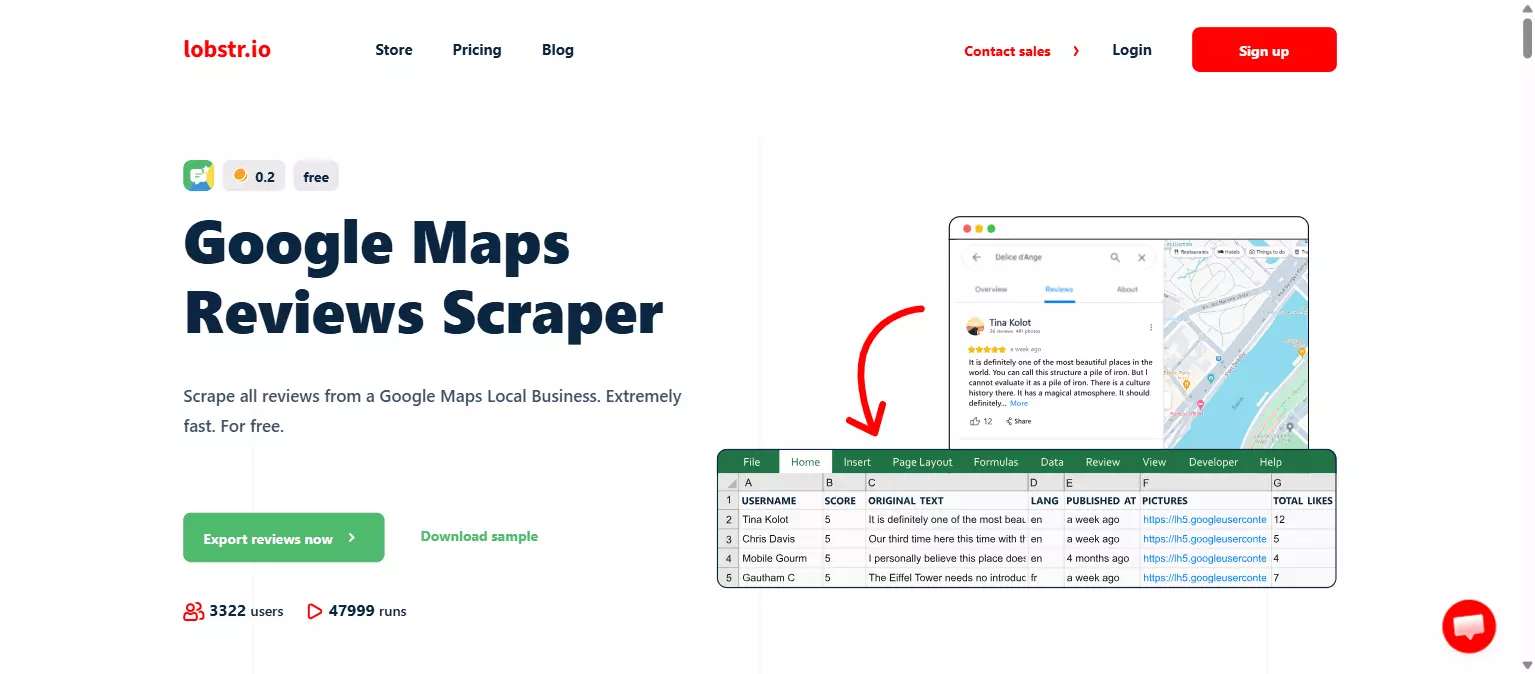
lobstr.io returns ~29 meaningful review data points per review... place info stripped out, just the review-level fields that matter.
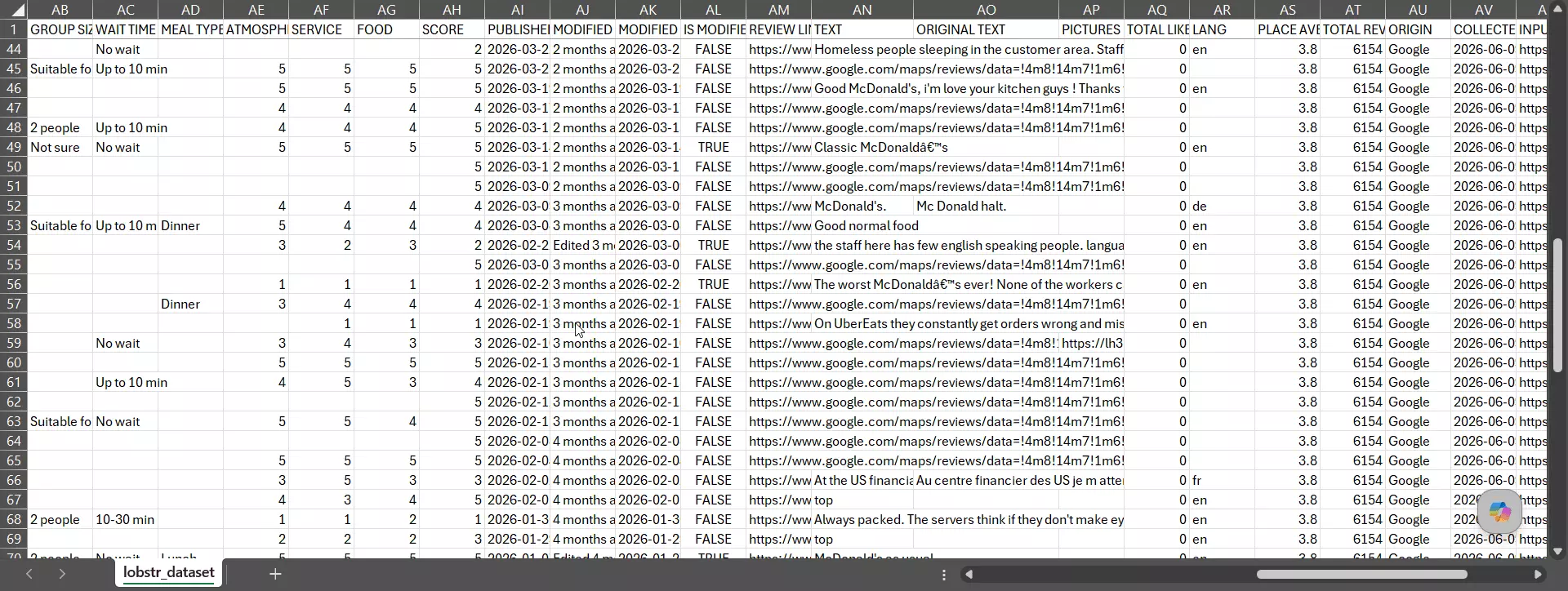
Here's the field set:
| Category | Data points |
|---|---|
| ✍️ Review content | text, original_text, lang, score, pictures, published_at_datetime, review_link, internal_review_id, origin |
| 👤 Reviewer | user_name, user_link, user_internal_id, user_image_url, user_reviews_count, is_user_local_guide |
| ❤️ Engagement & owner | total_likes, response_from_owner |
| 🛠️ Edit tracking 🎁 | is_modified, modified_at_datetime, modified_at |
| ⭐ Detailed sub-ratings | Rooms, Service, Location (or Food, Service, Atmosphere for restaurants) |
| 🧳 Review-context tags | Trip type, Travel group, Hotel highlights, Bed comfort, Room view, Breakfast type, Kid friendliness |
The raw count isn't lobstr.io's edge... on distinct fields it's actually a touch leaner than Apify. Its edge is fill and uniqueness.
It fills the review context others leave empty. Across the shared 868-review set, lobstr.io returned sub-ratings and review-context tags on more reviews than Apify... detailed ratings on ~806 reviews vs Apify's ~708, trip type on 573 vs 509, travel group on 559 vs 494. Same fields, more of them populated.
is_modified plus a modified-at datetime tells you whether a review was changed after posting. Neither Apify nor Outscraper capture that at all... it's genuinely unique to lobstr.io.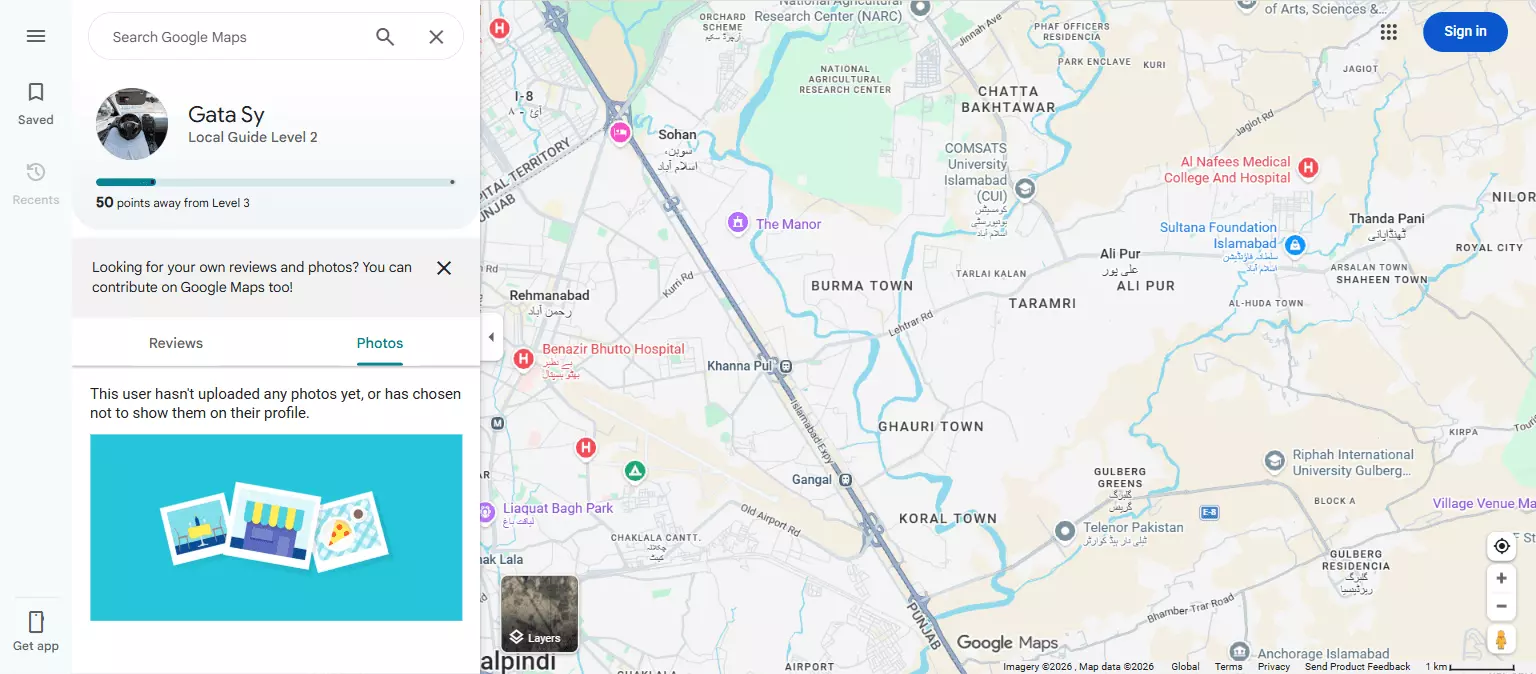
On accuracy, all three tools agree field-for-field on the data they share... rating, reviewer identity, review text, owner replies. I cross-checked the disputed values against Google directly and lobstr.io held up every time.
The honest gaps:
- No owner-reply date. lobstr.io captures the owner's reply text but not when it was posted... Apify and Outscraper both include the timestamp
- It doesn't break out the place/neighborhood context tags Apify does (safety, walkability, nearby activities), though those show up on well under 10% of reviews
- Photos come back as a comma-joined string rather than a clean array, so you split them yourself. It's on the fix list
Usability
lobstr.io was the easiest tool to use. The whole flow is a simple wizard: Create a Squid, add tasks, settings, launch.
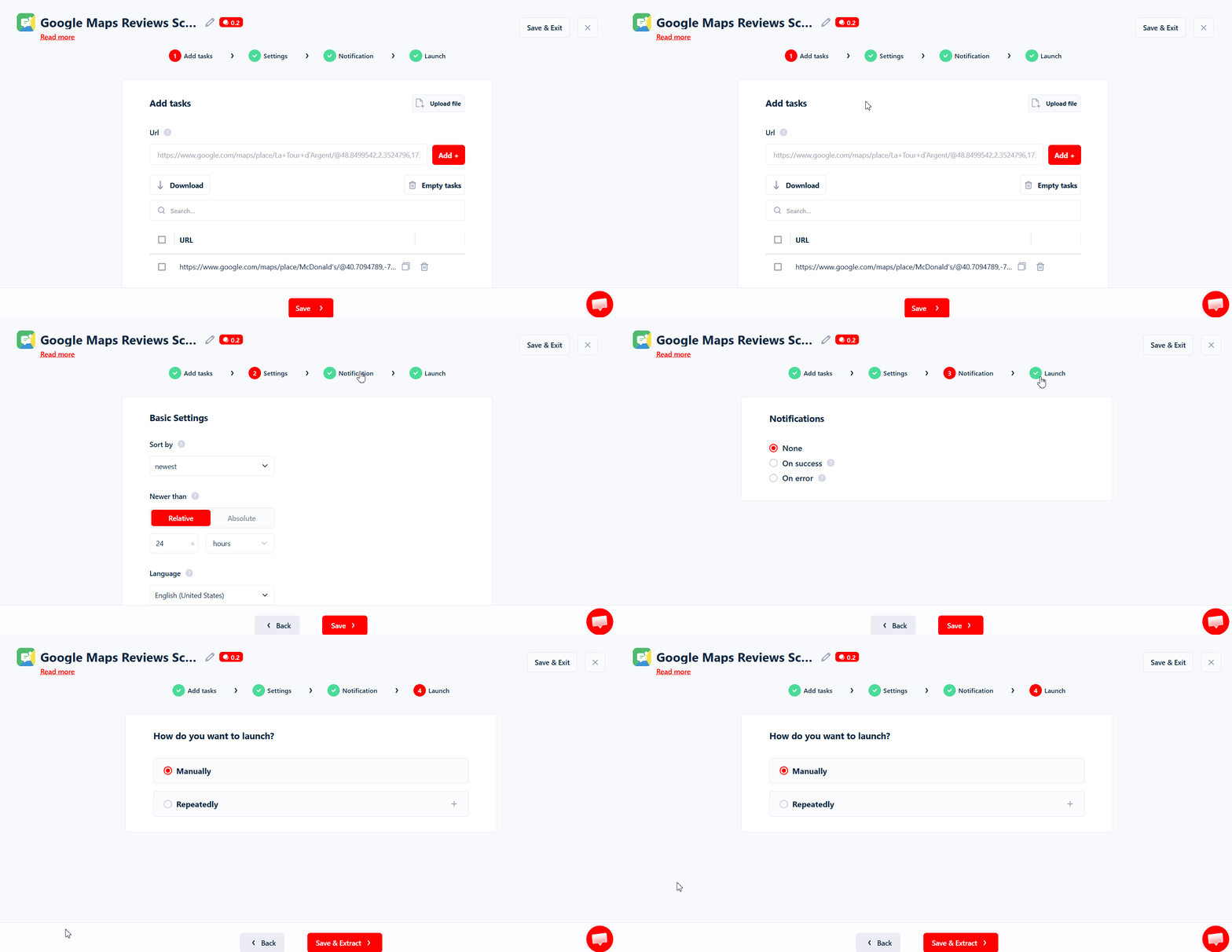
Ways to feed it a job:
- A Google Maps place URL
- A Place ID (e.g.
ChIJaZUyZj6-3zgR0Xw7zvtDDj8) - Bulk upload a CSV or TXT... up to 10,000 place URLs per run
Pre-scrape filters (narrow reviews before you pay):
- Sort by (newest, most relevant, highest, lowest)
- Newer than (a specific date, to the second with a timezone, or a relative window like 7 days)
- Review origin (Google only vs all sources)... newly added, so it now matches Apify and Outscraper here
- Language
- Skip reviews without text, skip reviews without image
- Rating filter (minimum or maximum)
Where it pulls clear of the pack:
- Proper instance management... runs live inside their Squid
- A live progress tracker and console, plus per-run timestamps
- A daily credit cap so you don't overspend, with runs that pause when credits run out... no overage, no half-finished exports
- Abort anytime, plus webhook and email alerts
- Built-in scheduling, which makes weekly review monitoring trivial
The two filters it's still missing: an upper date bound (a from/to window) and keyword search inside review text. Both live on Outscraper.
Speed
lobstr.io was the fastest tool I tested. Across my runs it averaged ~273 reviews per minute... it cleared the 1,000-review job in 3 minutes 40 seconds, ahead of Apify's ~156/min and Outscraper's ~137/min.
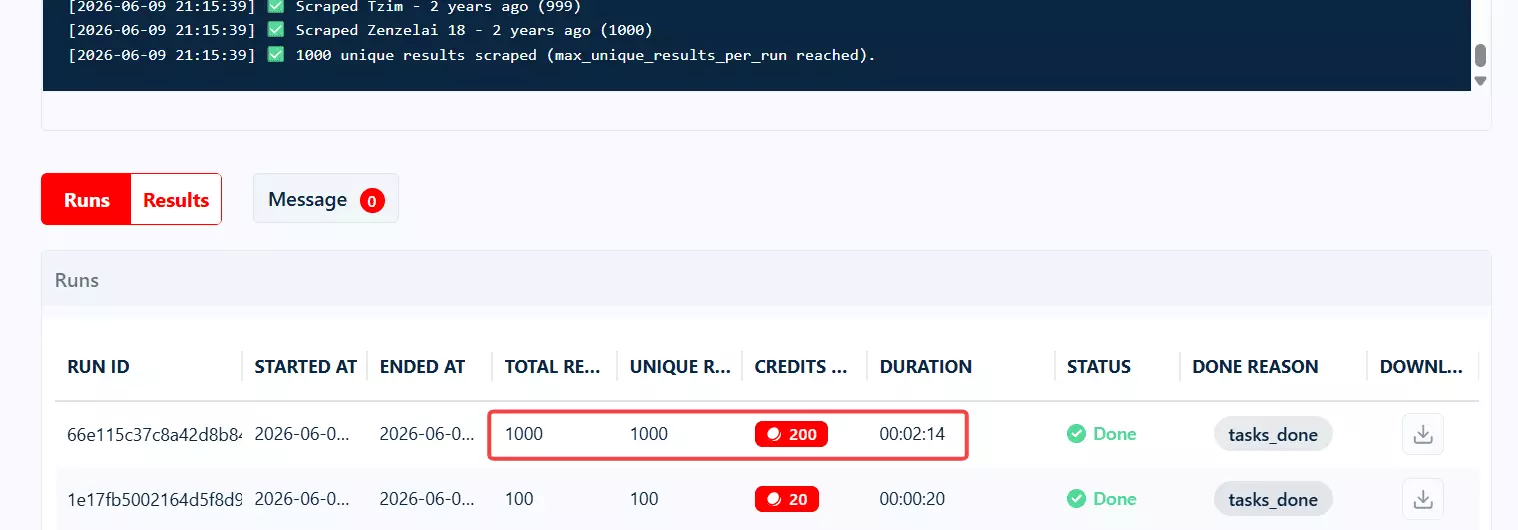
And that's on a single Slot. There's a lever to go much faster, but I'll get to that under scalability.
Cost
lobstr.io runs on a credit-based monthly subscription. Reviews are cheap... each review is just 0.2 credits, with no overage charges.
- Free tier: 500 reviews/month
- Entry: $0.40 / 1K reviews
- At scale: $0.10 / 1K reviews
Scalability
This is lobstr.io's real moat. At ~273/min on a single Slot, running 24/7, that's about ~11.8M reviews/month. I keep the headline at one Slot on purpose, to give you the most conservative number.
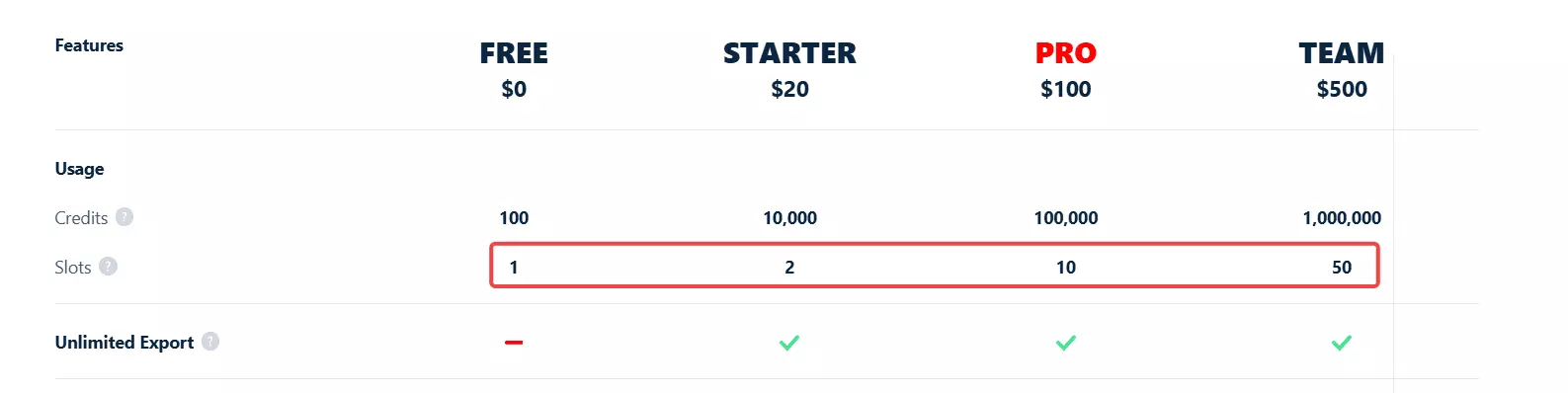
Then you scale it with Slots. Each Slot is another bot pulling in parallel:
- 1 Slot: ~11.8M reviews/month
- 20 Slots (one Squid): ~236M reviews/month
- 100 Slots (top plan, spread across Squids): ~1.18B reviews/month
So the fastest single worker on the list also has by far the highest ceiling once you add Slots. No other tool here has a concurrency model to match it.
Customer support
Support is via live chat, and it's one of the few things users praise consistently... quick, technically competent, actually helpful.
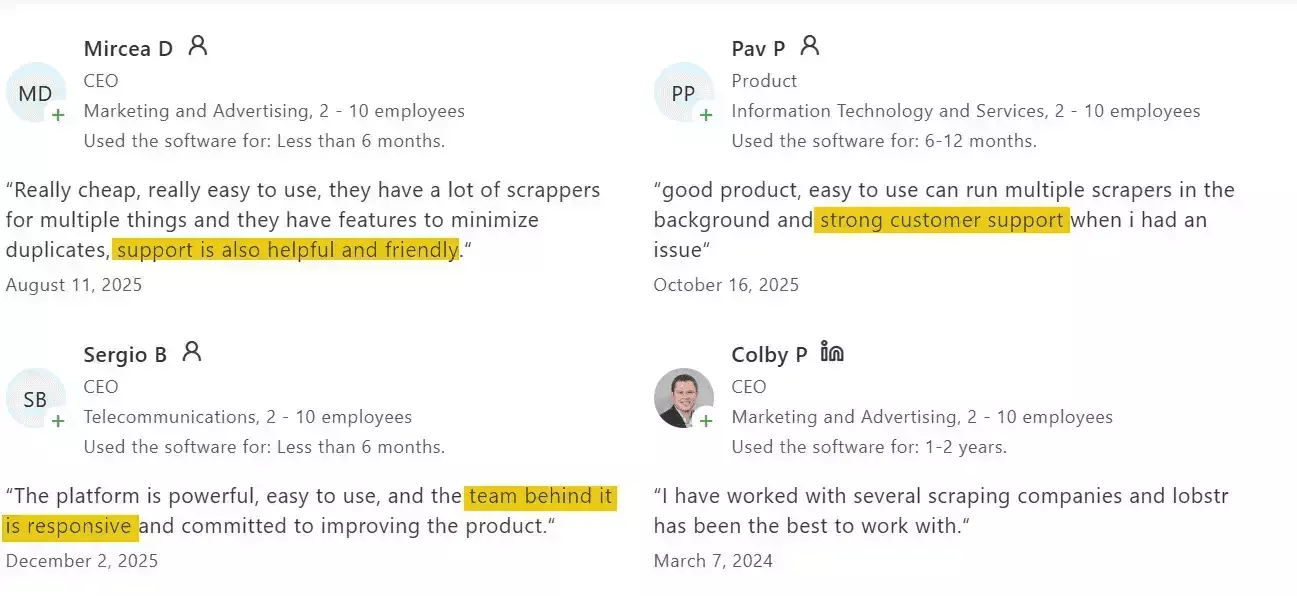
It carries a 5.0 rating on Capterra across 33 reviews... the strongest score in this comparison.
Best for: anyone doing high-volume review monitoring, sentiment analysis, or multi-location reputation work who wants the best-filled data at the lowest price and the highest ceiling.
2. Apify
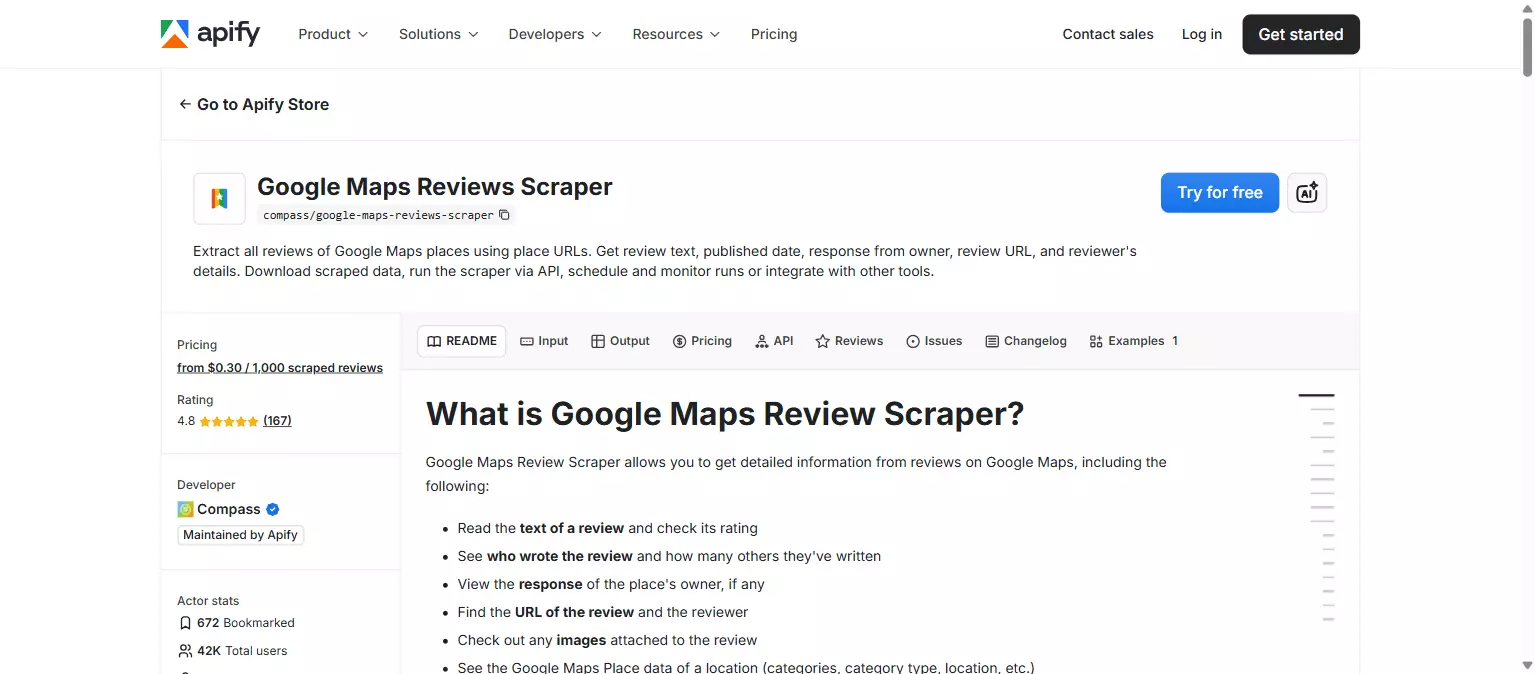
User rating: ⭐ Apify store 4.8 (185 reviews, as of July 2026)
| Criteria | Score (/10) |
|---|---|
| Usability | 7 |
| Speed | 6 |
| Cost | 7 |
| Scalability | 5 |
| Data (richness / quality) | 8 / 9 |
| Support | 7 |
| Overall | 6.8 |
| Pros | Cons |
|---|---|
| Most distinct fields of the three, plus full business listing in every row | Priciest at scale ($0.30/1K) |
| Cleanest JSON... photos as an array, HTML stripped, ISO dates | No edit tracking |
| Uniquely breaks out place/neighborhood context tags | No sort or rating filter on reviews |
| Includes the owner-reply date | No horizontal scaling (memory-driven) |
| Strong exports (CSV, JSON, Excel, XML, HTML) | Slower than lobstr.io (~156/min) |
Data
Apify returns the most columns... 69 of them. But ~30 are the business listing copied onto every review row (address, categories, city, lat/lng, and so on). Strip those and you're left with ~38 genuinely review-level fields... the most distinct data points of the three.
| Category | Data points |
|---|---|
| ✍️ Review content | text, textTranslated, originalLanguage, translatedLanguage, stars, publishAt, publishedAtDate, reviewId, reviewUrl, reviewOrigin, reviewImageUrls[] |
| 👤 Reviewer | name, reviewerId, reviewerUrl, reviewerPhotoUrl, reviewerNumberOfReviews, isLocalGuide |
| ❤️ Engagement & owner | likesCount, responseFromOwnerText, responseFromOwnerDate |
| ⭐ Sub-ratings | reviewDetailedRating.Rooms, .Service, .Location |
| 🧳 Review-context tags | reviewContext.Trip type, .Travel group, .Hotel highlights, .Safety 🎁, .Walkability 🎁, .Nearby activities 🎁, .Food & drinks 🎁, .Noteworthy details 🎁 |
| 🏪 Business (repeated on every row) | title, address, categoryName, city, state, lat, lng, placeId, totalScore, reviewsCount... |
Apify's real strengths are breadth and format. It returns the most distinct review fields, its JSON is the cleanest of the three... photos as a proper array, HTML stripped from text, ISO 8601 dates, properly typed values... and it uniquely breaks out place and neighborhood context tags (safety, walkability, nearby activities, food & drinks) that lobstr.io doesn't, plus the owner-reply date lobstr.io leaves out.
On depth it's genuinely neck-and-neck with lobstr.io. The two agree field-for-field on the shared data, and Apify's Local Guide flag now matches lobstr.io's exactly... a change from my earlier testing, where it under-flagged them.
Two things hold it back on data. It doesn't track edited reviews (no modified flag). And while it lists more fields, several of its context tags are sparse... populated on well under 10% of reviews... so on a typical review, its lead over lobstr.io is narrower than the raw count suggests.
Usability
Good news here: unlike Apify's busy Google Maps actor, the reviews actor is simple. All the input options sit on a single page.
Ways to feed it a job: place URLs, Place IDs, search terms.
Filters: newer than (day-level), language, review origin (Google only vs all sources), and a personal-data toggle to include or exclude reviewer info... the one filter no one else has. Notably missing: a sort-order control and a rating filter on reviews.
The catch is the platform basics. No instance management... reopen the actor and it loads your last inputs, so it's easy to fire off a run you didn't mean to. And no scheduling as clean as lobstr.io's. Where it recovers is the integration catalog... Make, n8n, Zapier, and the deepest set of connectors here.
Speed
Apify averaged ~156 reviews per minute across my runs... it cleared the 1,000-review job in 6 minutes 25 seconds. Middle of the pack.

There's no concurrency slider either... parallelism is tied to the memory you allocate, so to go faster you pay for more compute.
Cost
Usage-based, and the most expensive of the three at scale.
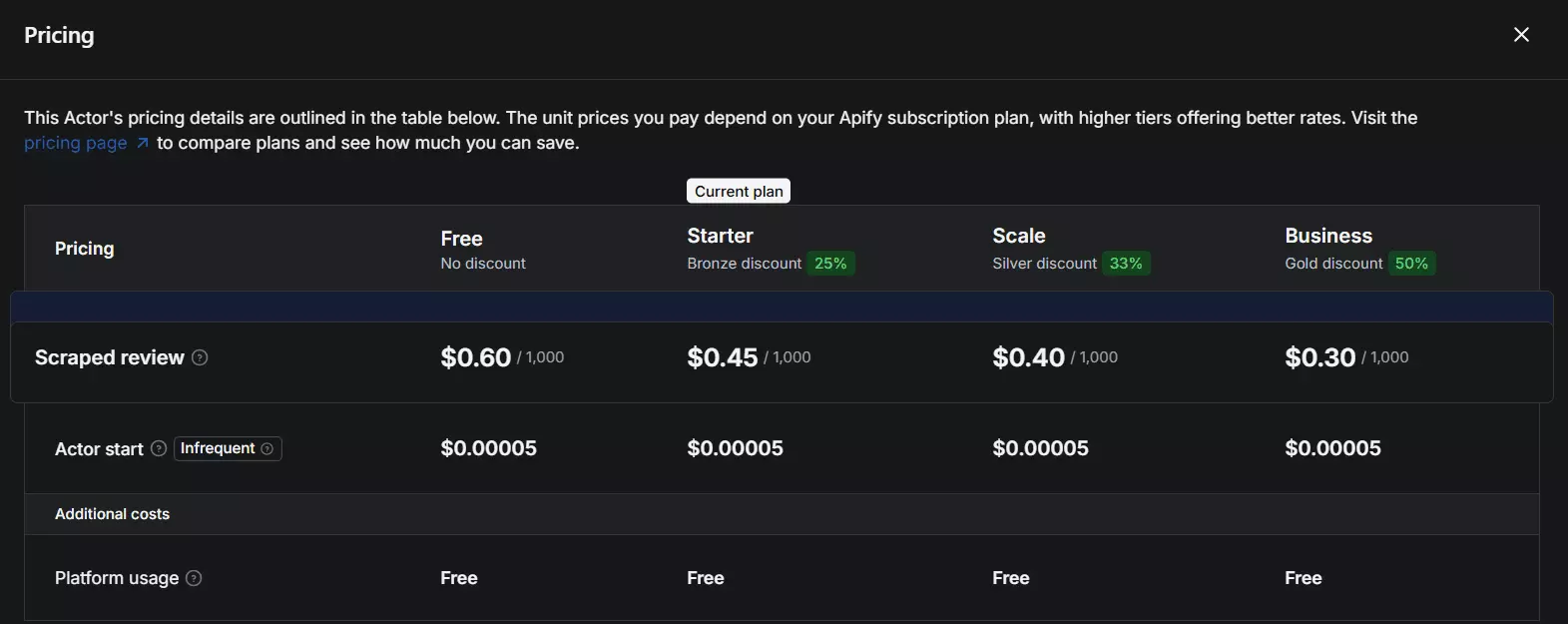
- Free tier: $5 credit/month... and since free-tier reviews bill at the no-discount $0.60/1K, that's about 8,300 reviews
- Entry (paid plans): $0.45 / 1K reviews
- At scale: $0.30 / 1K reviews
That $0.30 floor is 3x lobstr.io's $0.10. A million reviews runs about $300 versus lobstr.io's $100.
Scalability
At ~156/min, 24/7, that's about ~6.7M reviews/month on the default config.
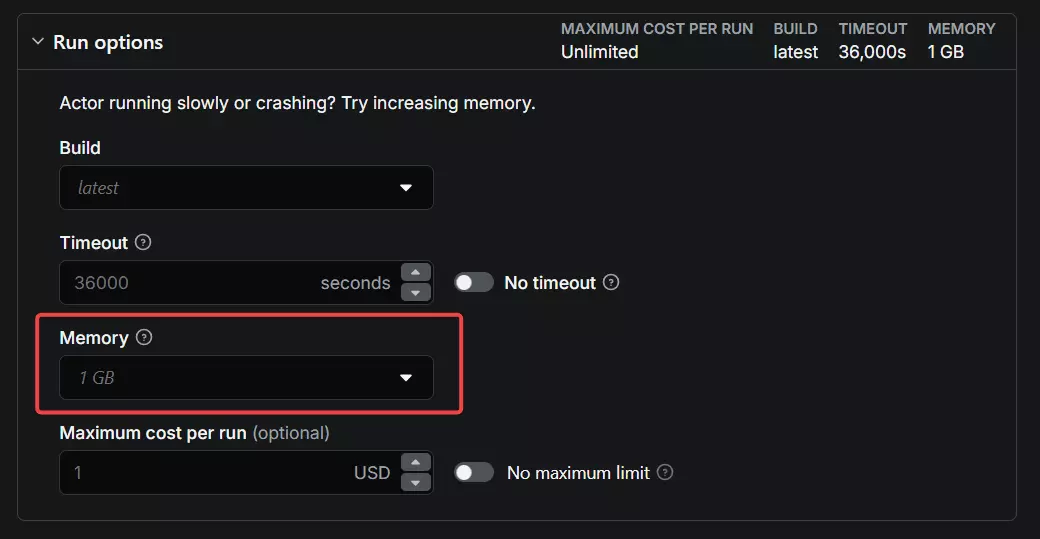
You can push higher by paying for more memory and running more concurrent actors... but you scale by spending on compute, not by flipping a switch. There's no Slot-style concurrency to lean on.
Customer support
Live chat, a ticketing system, and a Discord community. Each actor has its own issue tab, with a listed response time around 1.3 days. Reasonable, not instant.
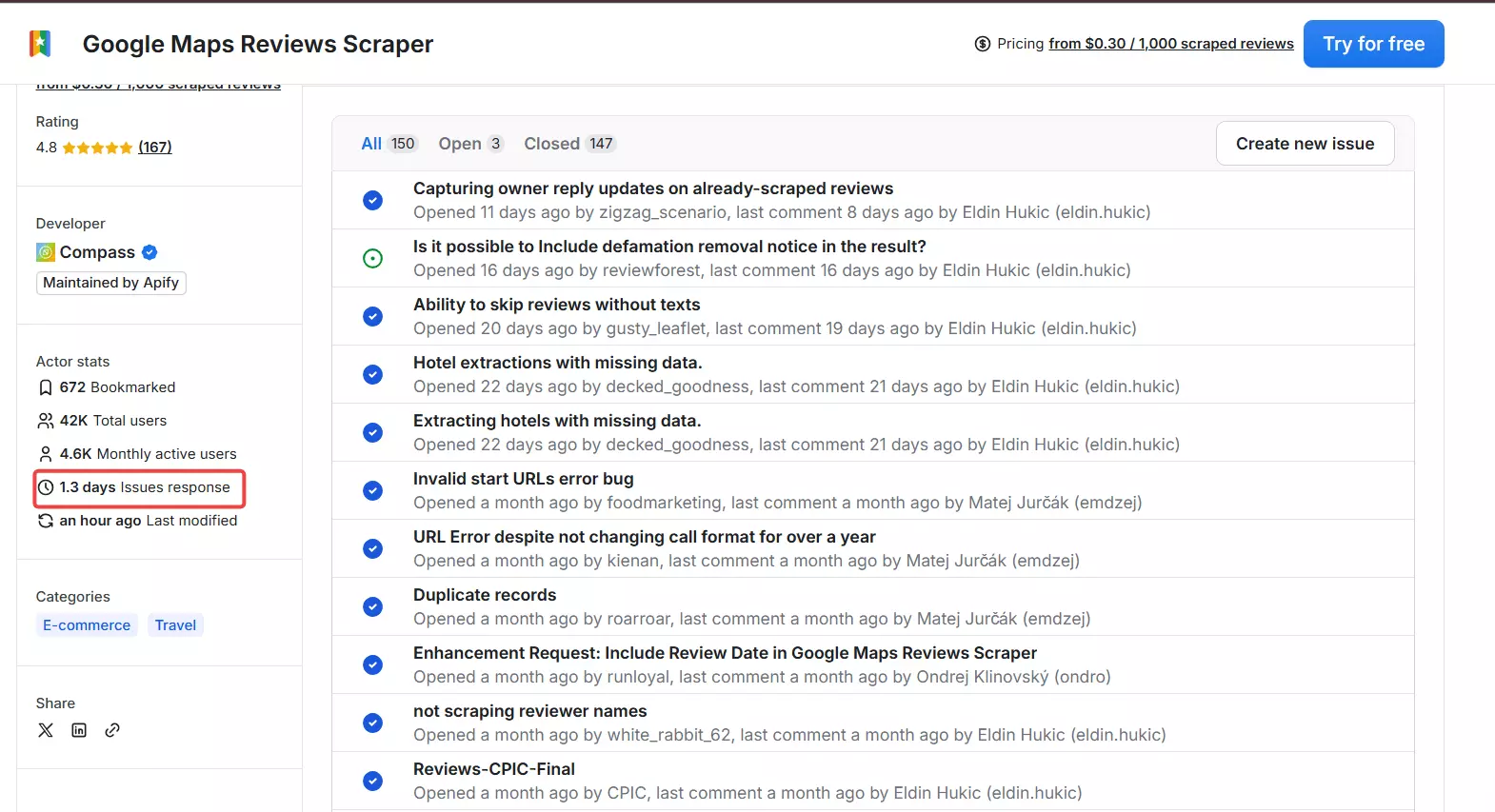
The actor carries a 4.8 rating across 185 reviews on the Apify store... a solid, credible track record.
Best for: anyone who wants reviews and the full business-listing context in a single run, the cleanest JSON to pipe into a warehouse, and doesn't mind paying more for it.
3. Outscraper
User rating: ⭐ Trustpilot 4.5 (279 reviews, as of July 2026)
| Criteria | Score (/10) |
|---|---|
| Usability | 7 |
| Speed | 5 |
| Cost | 4 |
| Scalability | 4 |
| Data (richness / quality) | 5 / 7 |
| Support | 7 |
| Overall | 5.7 |
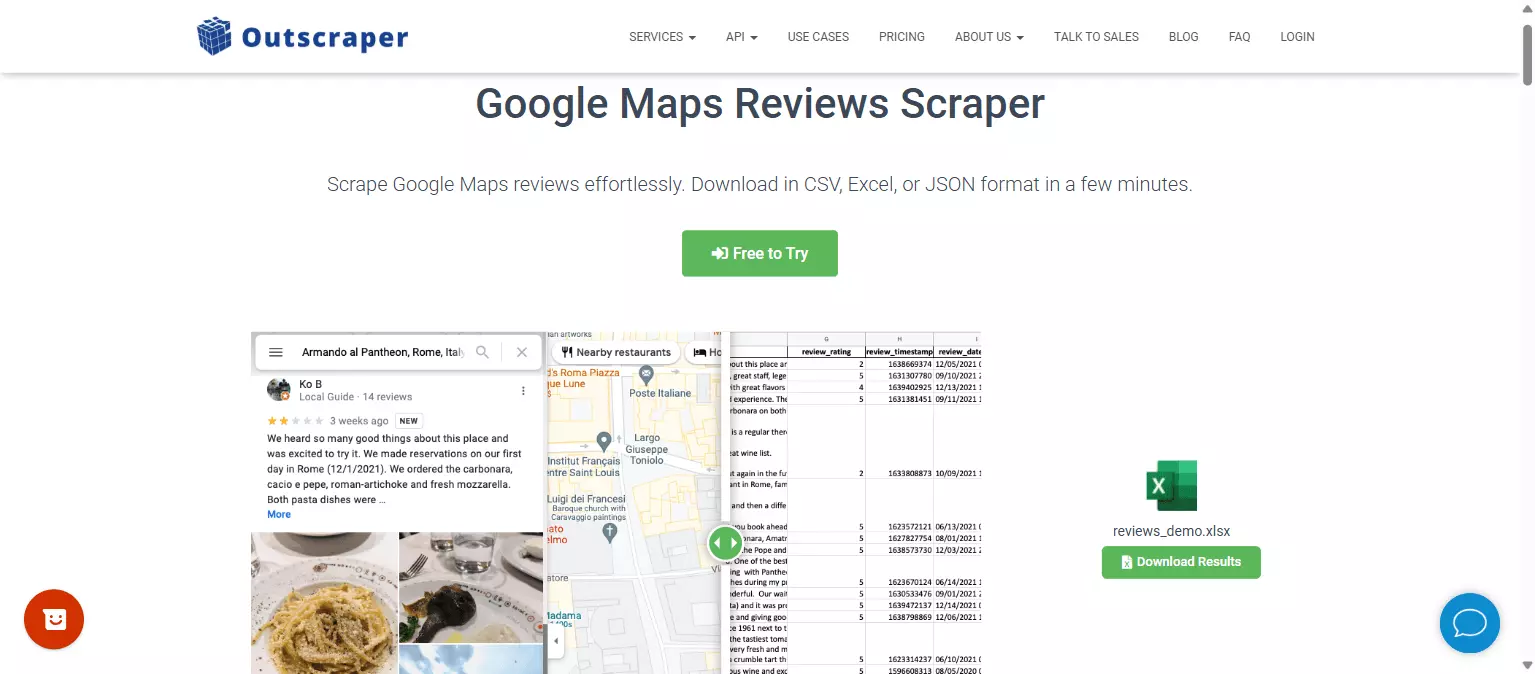
| Pros | Cons |
|---|---|
| No subscription, pure pay-as-you-go | Thinnest data (no translation, no language) |
| Keyword search inside reviews | No Local Guide flag |
| Free pre-scrape filters + a from/to date window | Likes column comes back empty |
| Clean one-page setup | No live progress tracking |
Data
Outscraper returns ~21 meaningful review data points... the thinnest set in the test.
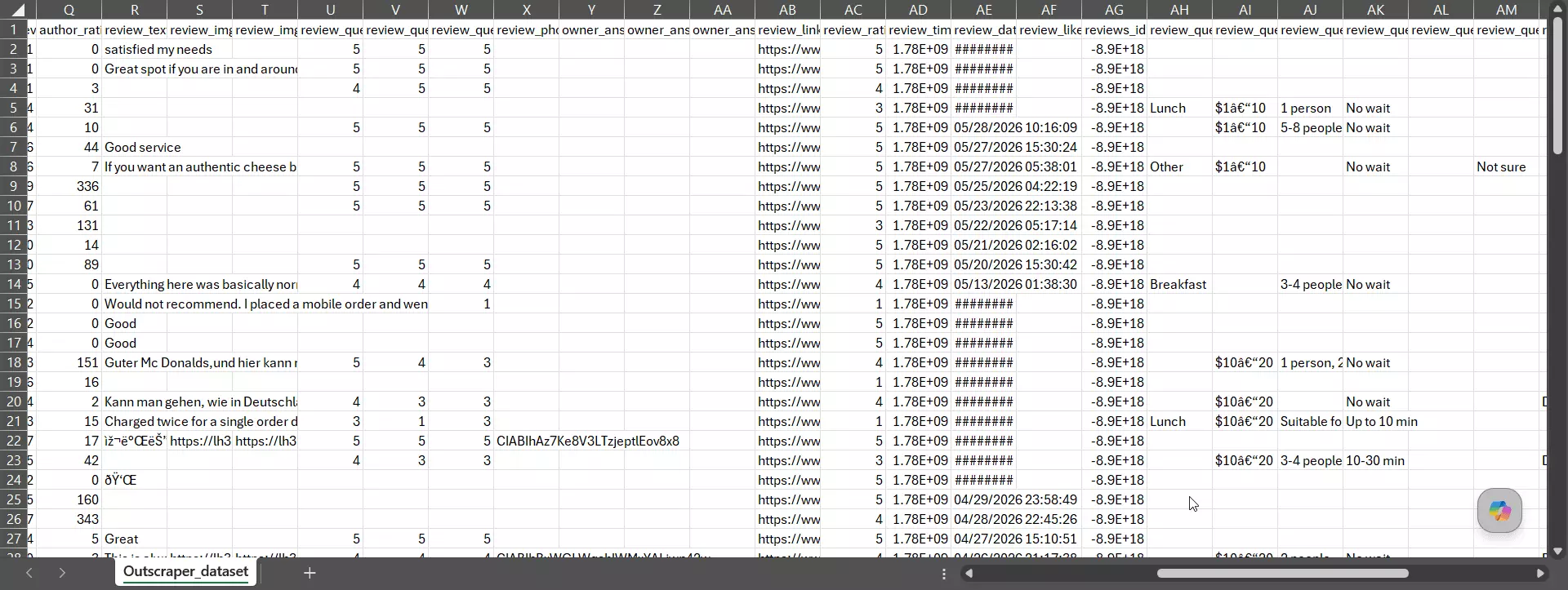
| Category | Data points |
|---|---|
| ✍️ Review content | review_text, review_rating, review_img_url, review_link, review_id, review_datetime_utc |
| 👤 Reviewer | author_title, author_link, author_id, author_image, author_reviews_count, author_photos_count |
| ❤️ Engagement & owner | owner_answer, owner_answer_timestamp_datetime_utc |
| 🏪 Place (repeated on every row) | name, google_id, place_id, rating, reviews... |
It covers the basics... review text, rating, reviewer profile, owner reply (with a timestamp, which lobstr.io lacks), and review images. It's accurate on what it returns.
But it's the thinnest on the review data that matters:
- No translation. Just
review_text... no original-language text, no translated version, not even a language field. For non-English reviews, that's a real hole - No Local Guide flag at all
- No detailed sub-ratings and no review-context tags
- Likes came back empty across the board, and so did a couple of fields it nominally supports (
author_ratings_count,review_photo_ids)... they exist in the schema but returned nothing on my run
So if your reviews are multilingual or you care about reviewer credibility signals, Outscraper leaves you short.
Usability
Clean one-page setup... input, data, filters, export, laid out in order.
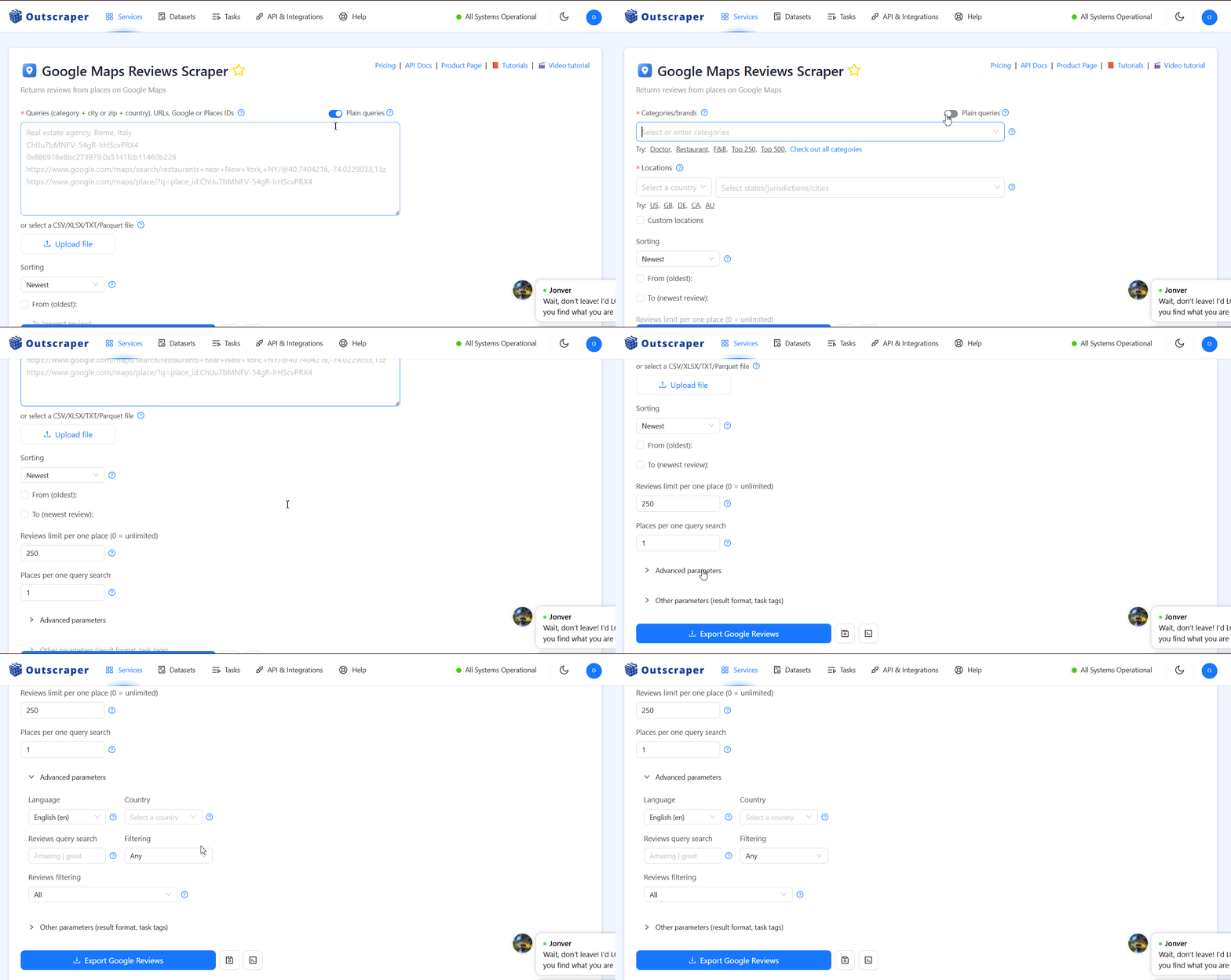
Ways to feed it a job: search queries, Place IDs, place URLs, bulk upload (CSV, XLSX, TXT, Parquet).
Filters (all free): sort by, a from→to date window (the only tool that lets you cap the end date), rating (min or max, one at a time), review origin, review content (all / with text / without text), language, and... the one filter lobstr.io and Apify don't have... keyword search inside review text.
Where it gets rough: once you hit Get Data, you're flying blind. No live console, no progress tracker, no run timestamps. You launch and check back later.
Speed
Outscraper cleared the 1,000-review job in 7 minutes 19 seconds... about ~137 reviews per minute. That's a big jump from my earlier testing, and it lands it roughly level with Apify rather than trailing far behind.
There's still no completion timer in the dashboard, so I had to clock the runs myself.
Cost
Pay-as-you-go, no subscription.
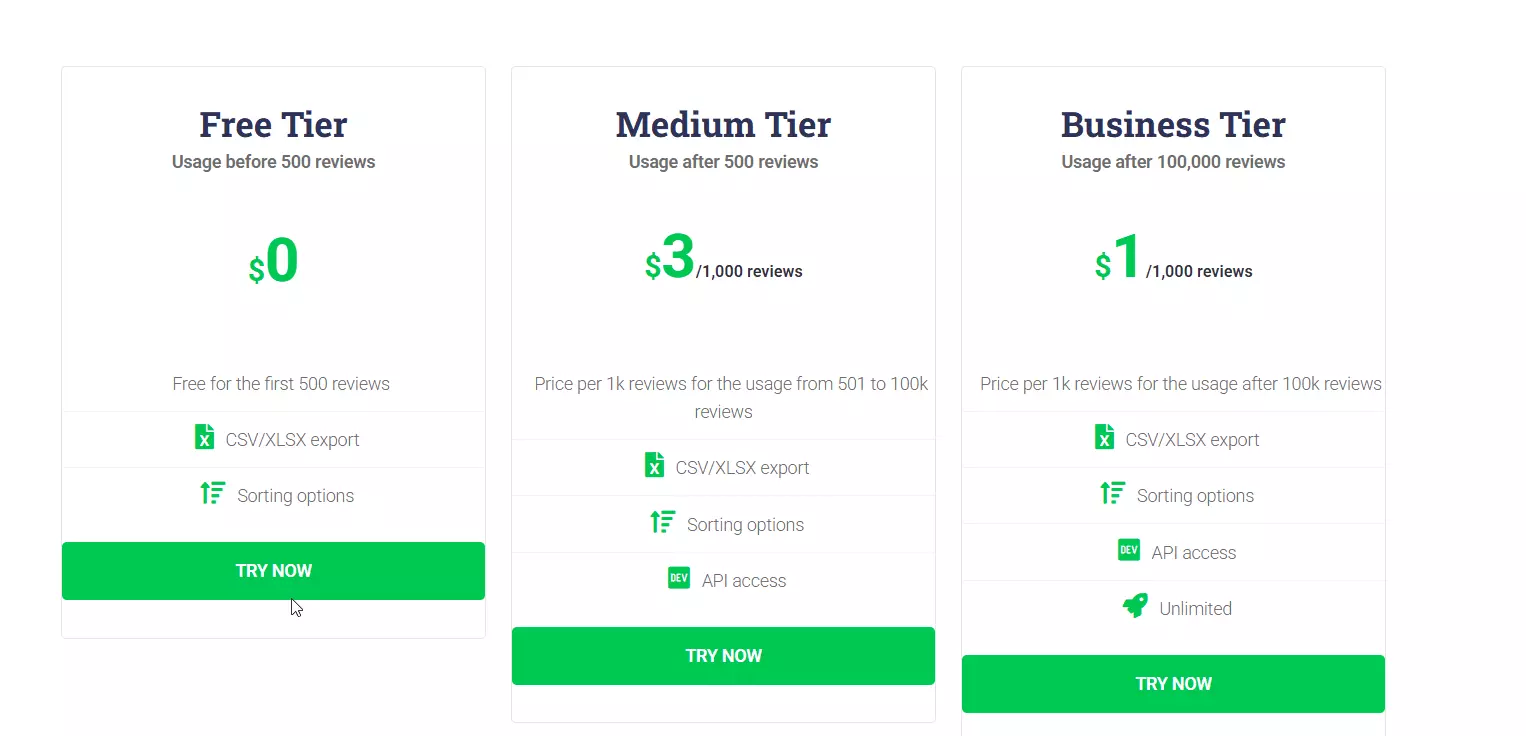
- Free tier: first 500 reviews of every scrape (and free entirely if you stay under 500/month)
- Entry: $3 / 1K reviews
- At scale: $1 / 1K reviews
That's the priciest entry point by a mile ($3 vs $0.40-0.45), and even at scale its $1/1K is 10x lobstr.io's floor. The no-subscription model suits genuine one-offs, but it adds up fast at volume.
Scalability
At ~137/min with no concurrency, the 24/7 ceiling is about ~5.9M reviews/month. Predictable, and much healthier than it used to be thanks to the speed bump... but it won't scale past that. There's no Slot or worker model to add parallelism.
Customer support
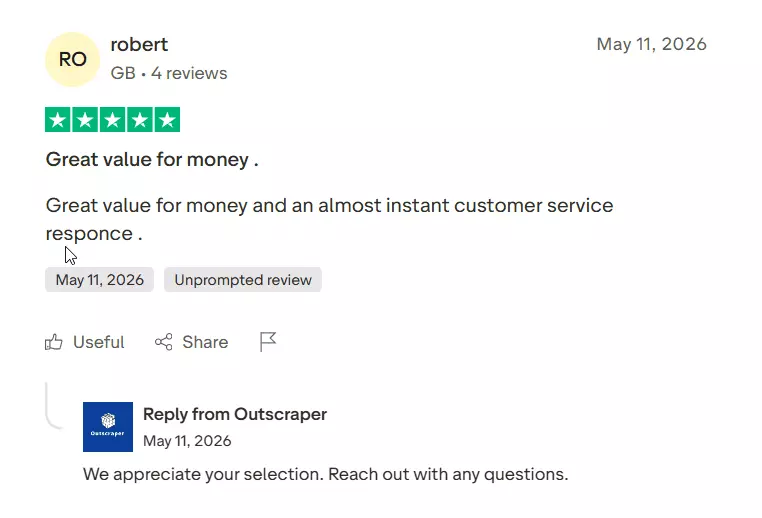
Live chat, and responses are fast and pretty responsive. It holds a 4.5 rating on Trustpilot across 279 reviews. I've had the odd issue getting deep technical questions answered in the past, but overall it's good.
Best for: a no-subscription, one-time pull... especially if you need keyword search inside reviews or an upper date bound, and your reviews are mostly English.
The scrapers that didn't make the list
These aren't bad tools. They just lost on the thing that decides a review scrape... filtering. When you can't narrow reviews before you pull them (by date, rating, language, content), you pay to scrape everything and clean up after. And a couple are thin on data too.
| Criteria | Bright Data | ScrapeHero | Livescraper |
|---|---|---|---|
| Input | Place URL / Place ID | Place URL | Queries, IDs, URLs, bulk |
| Built-in filters | ❌ None | Sort-by only | Sort-by only |
| Owner reply | ✅ | ✅ | ✅ |
| Local Guide flag | ✅ | ✅ | ❌ |
| Translated text | ❌ | ✅ | ❌ |
| Speed | ~83/min | ~67/min | ~100/min |
| Cost /1K (entry → scale) | $1.50 → $1.00 | ~$2.22 → $0.50 | $2.00 (flat) |
Bright Data
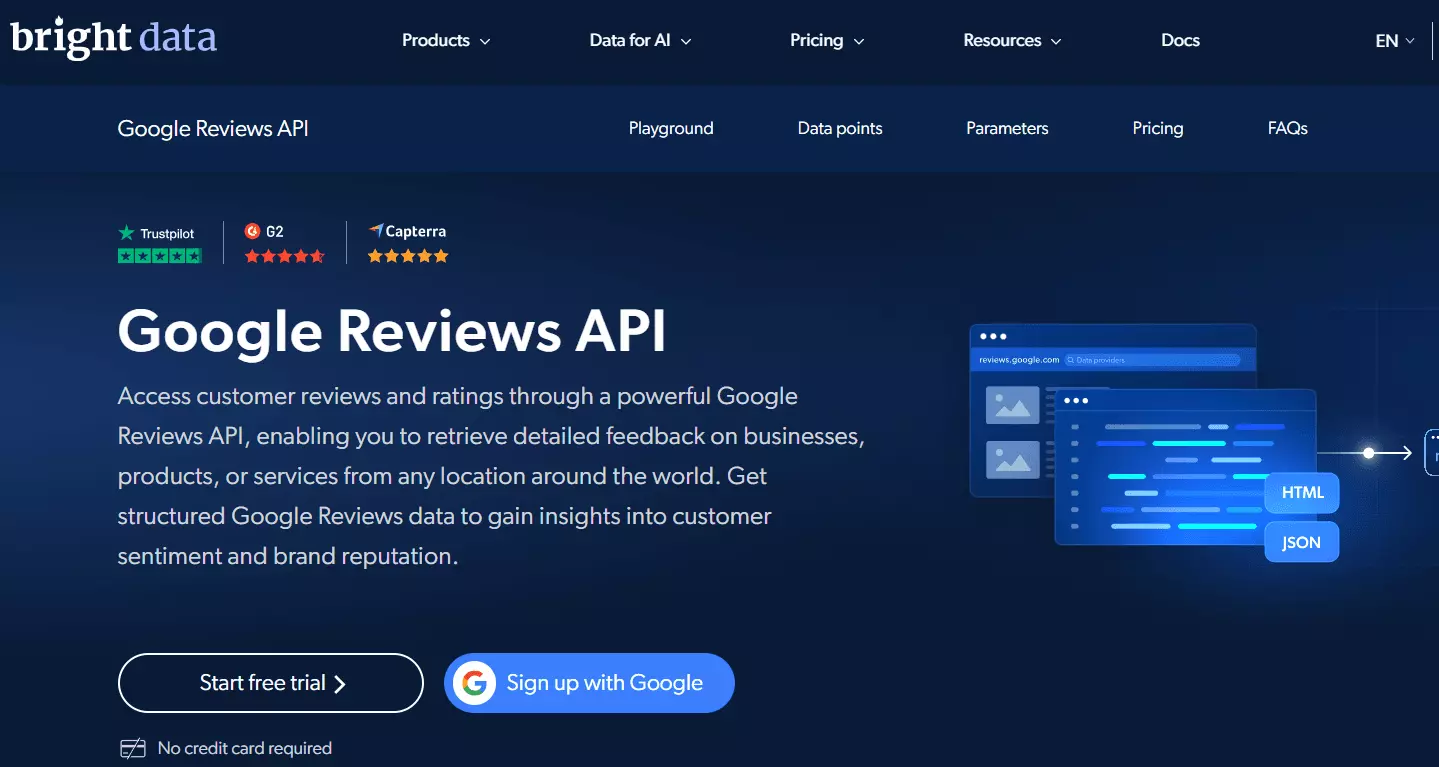
Its Google reviews collector is genuinely data-rich... owner replies, Local Guide status, likes, even the listing's Q&As. So why isn't it in the top 3?
No built-in filters... at all. No date, rating, language, or sort control. The workaround is to apply filters on the Google Maps listing page yourself, copy the final URL, and hand it over. For monitoring "only reviews from the last 7 days" across hundreds of places, that manual URL-building doesn't scale.
It's a powerful collector for developers, but the wrong shape for filtered, no-code review work.
ScrapeHero
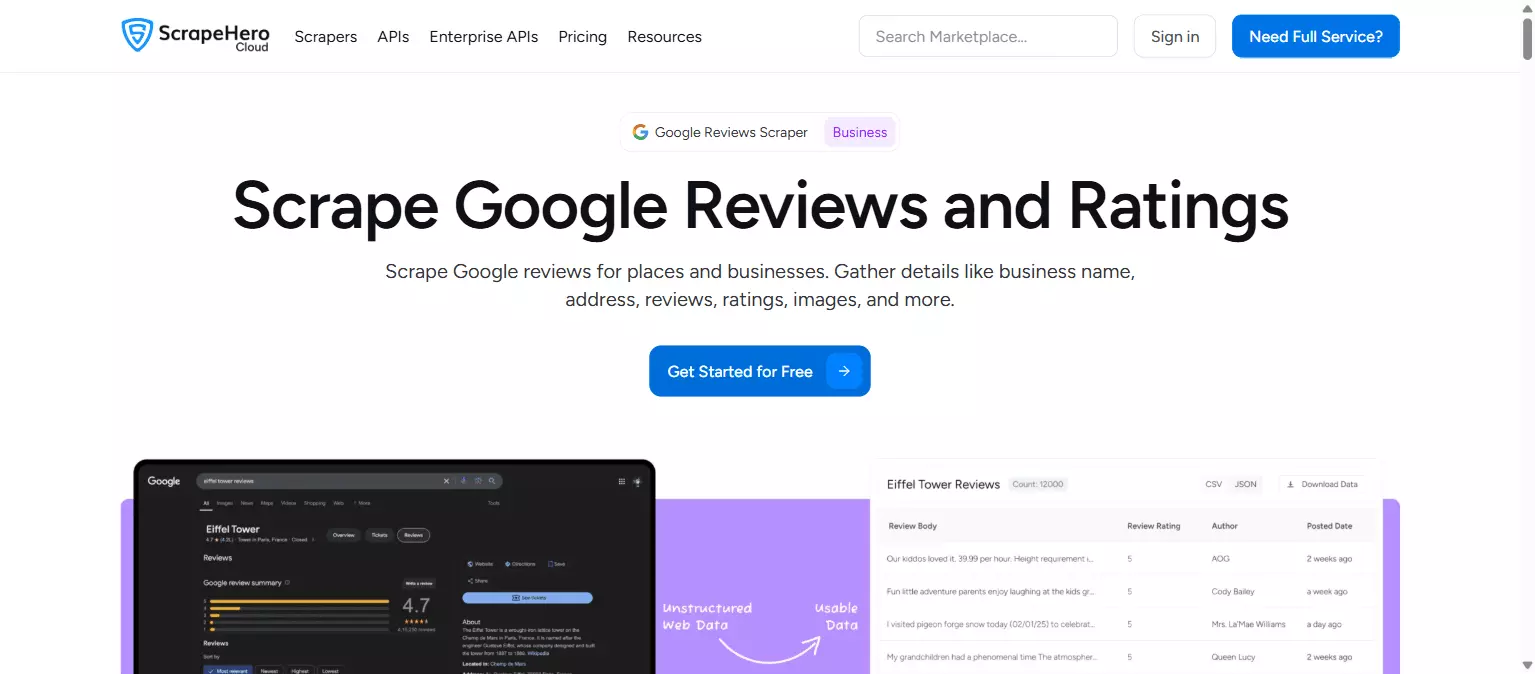
It takes a place URL and returns a clean, lightweight record, and to its credit it keeps original/translated text, Local Guide status, and owner replies.
Why it didn't make it: the fewest data points of anything I tested (~20 fields, no likes), and only a sort-by filter. No date filter, no rating filter, no language filter. Its credit math also lands awkwardly... about $2.22/1K at entry, dropping to $0.50/1K only at serious scale.
Fine for a quick pull, light for everything else.
Livescraper
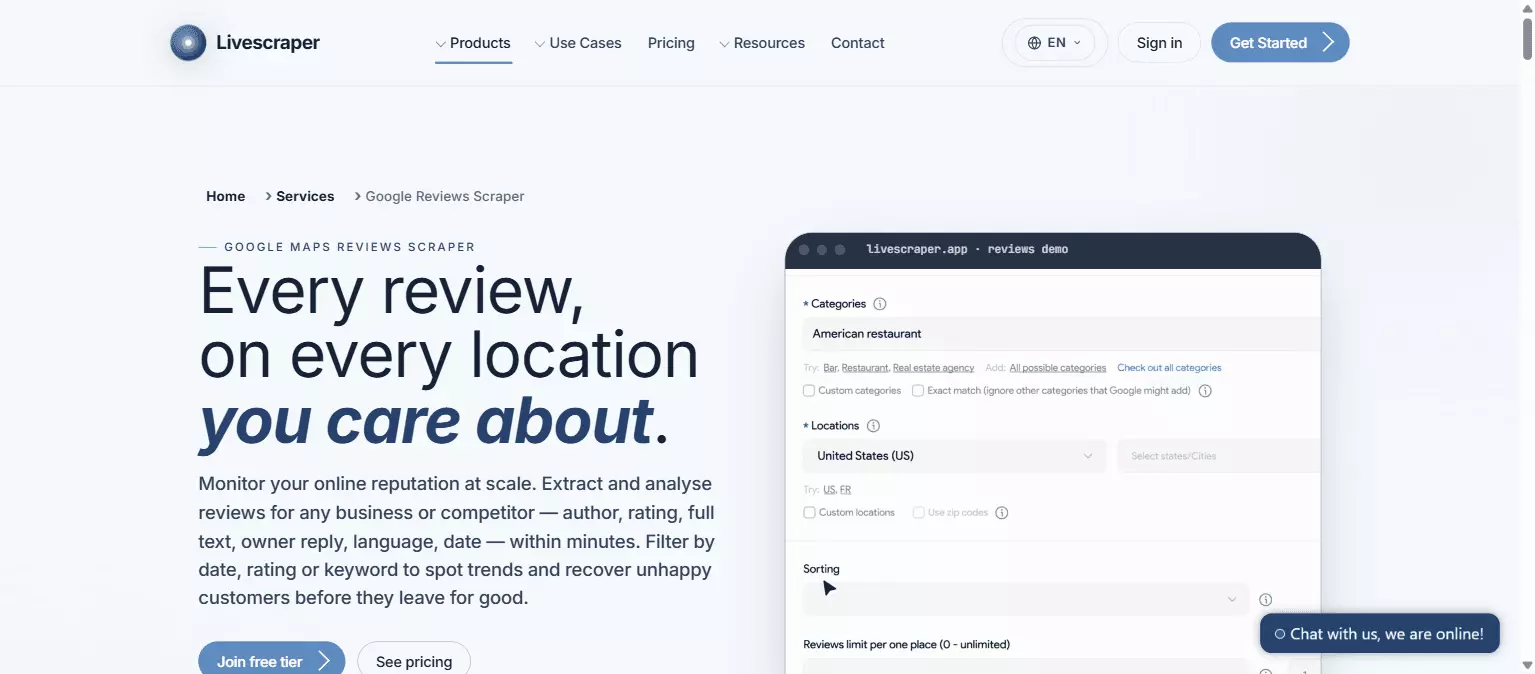
Why it didn't make it: only a sort-by filter, no translation, no Local Guide flag, and a glitchy export in my testing. Flat pricing at $0.002/review ($2/1K, no scale discount) means it never gets cheaper as you grow.
It's quick (~100 reviews/min), but quick doesn't help when the export trips over itself and you can't filter what you pull.
FAQ
Which Google reviews scraper returns the most data?
Apify returns the most distinct fields, but lobstr.io fills them best. The two are neck-and-neck on review depth. Apify lists ~38 review-level fields to lobstr.io's ~29 (it uniquely breaks out place/neighborhood context tags), but lobstr.io populates the shared fields on more reviews and is the only one that tracks edited reviews. Outscraper trails both... no translation, no Local Guide, empty likes.
Which is the cheapest?
lobstr.io. $0.40/1K at entry, dropping to $0.10/1K at scale... the lowest of the three at both ends. Apify is $0.45 → $0.30, and Outscraper is $3 → $1.
Which is the fastest?
lobstr.io. Across my runs it averaged ~273 reviews/min, ahead of Apify's ~156/min and Outscraper's ~137/min. The gaps are tighter than they used to be, but lobstr.io still leads, and its Slots push the monthly ceiling far past the others.
Can I scrape owner responses to reviews?
Yes... all three capture the business's reply to a review. Apify and Outscraper also include the date the owner replied; lobstr.io captures the reply text but not the timestamp.
How many reviews can I scrape per place?
All of them. None of these three is capped at the official API's 5-review limit. If a business has 12,000 reviews, you can pull all 12,000. (Google's spam filter hides 5 to 20% of reviews from everyone, so counts can look slightly off... that's Google, not the scraper.)
Can I scrape only recent reviews?
Yes. All three support a "newer than" date filter. Only Outscraper also lets you set an end date (a from→to window). Pair the date filter with "sort by newest" for a clean monitoring setup.
Can I scrape Google reviews at scale (millions/month)?
Comfortably on lobstr.io. A single Slot running 24/7 does ~11.8M reviews/month, a full Squid of 20 Slots does ~236M, and the top plan reaches ~1.18B account-wide. Apify tops out near ~6.7M and Outscraper near ~5.9M, both scaling only by adding memory or waiting, with no clean concurrency control.
Conclusion
That's a wrap on the best Google reviews scrapers for 2026.
Quick recap of who owns what:
- lobstr.io owns fill rate, edit tracking, speed, the cheapest price, and by far the highest ceiling once you add Slots. The default pick for high-volume monitoring, sentiment work, and anyone serious about Google reviews at scale. It pays for that with no keyword filter and no owner-reply-date
- Apify owns the broadest field set, the cleanest JSON, and reviews bundled with full business-listing context in one run. The pick when you want everything in a single actor and don't mind paying more
- Outscraper owns keyword search, an upper date bound, and a no-subscription model. A fine pick for a quick one-off, as long as your reviews are English and you don't need translation or Local Guide data
This list will keep evolving as these tools ship updates. I'll keep it current.