How Decathlon Tracks 30,000+ Sport Listings a Week with lobstr.io
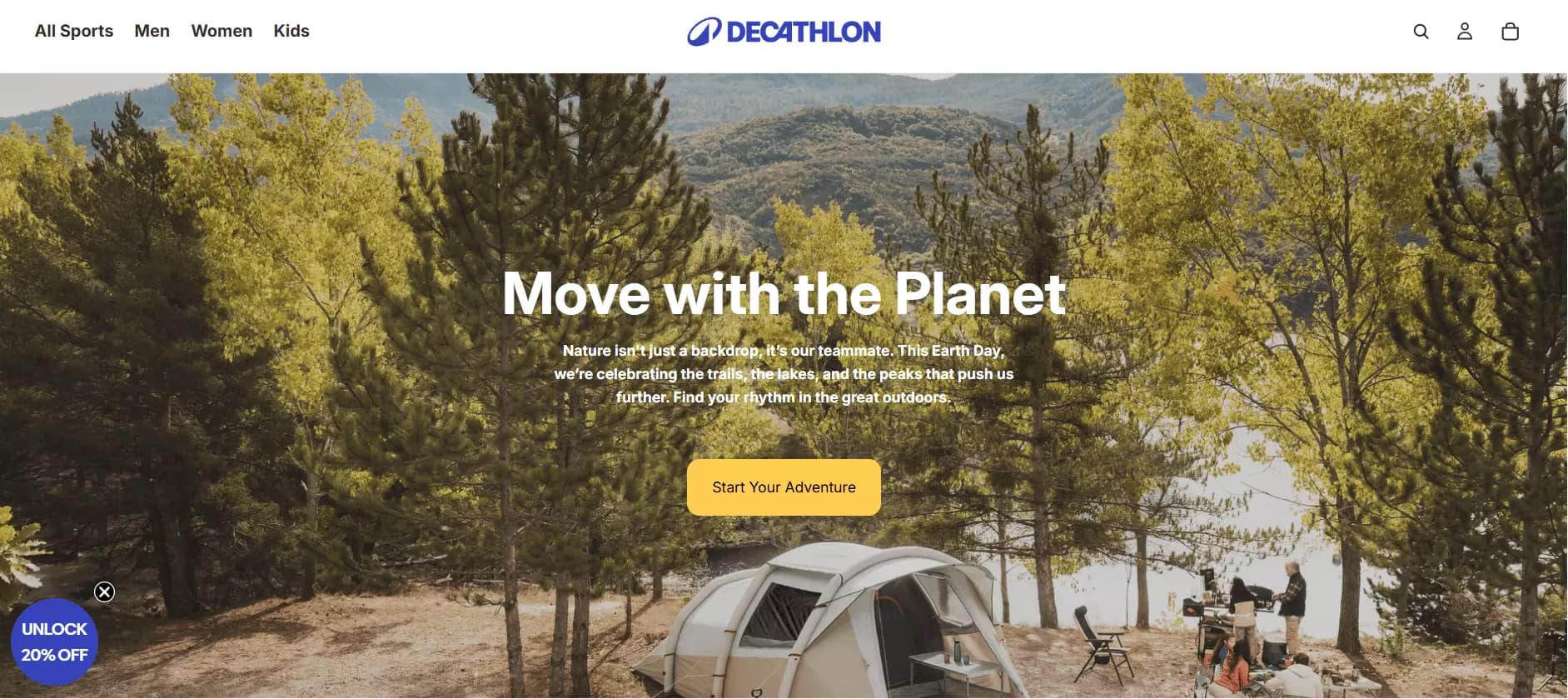
The company is also one of the largest second-hand sports retailers on the planet.
Through Decathlon Seconde Vie and the Decathlon Occasions program, Decathlon resold 1.6 million second-hand sports products in 2025 across 43 markets.
The second-hand business has been doubling year-over-year since 2019.
That second-hand presence isn't a sustainability gesture. It's a business line operated at the same scale and rigor as Decathlon's new-product retail... which means it needs the same kind of analytical infrastructure underneath.
When Decathlon's data analysts go to inform pricing, demand, or range decisions for their sport categories, the secondhand market is one of the strongest signals available. And on the French market, that means Leboncoin and Vinted.
Miss a chunk of either, and the pricing call that lands on the design team's desk is biased before the analyst opens the file.
The problem with existing tools at this scale
Decathlon Digital's product analysts sit inside the design and commercial teams for each sport category... Hiking, Camping, Climbing on the outdoor side, plus parallel teams for fitness, team sports, and the rest of the portfolio.
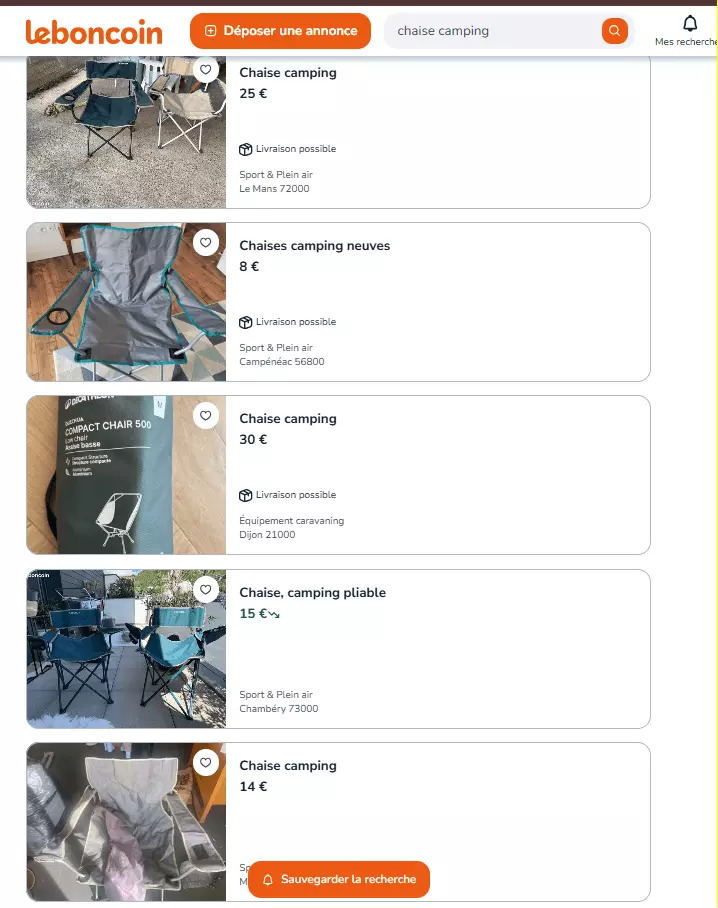
Each analyst's job is to identify and deliver high-impact data work for their vertical. Pricing benchmarks. Demand signals. Range planning.
Competitive view across category specialist brands. Inputs to the buyback and resale pricing for Decathlon Seconde Vie.
Almost all of those questions live inside the same dataset: every active listing for the relevant category, on every major French marketplace, refreshed weekly.
That's a hard dataset to acquire reliably.
Before standardizing on lobstr.io, Decathlon's data team tested several approaches.
A mix of marketplace APIs (where they existed) and off-the-shelf scraping tools across different pricing tiers.
Each option broke at one of three places.
- Stability. Off-the-shelf scrapers failed mid-run, returned partial data, or quietly degraded over weeks as the source platforms changed. Every broken run cost an analyst half a day of rerunning and stitching. Done weekly, that's a chronic tax on the team.
- Scale. Recurring weekly monitoring across multiple sport categories runs into hard usage ceilings on tools that weren't built for it. Several competing tools the team evaluated cap monthly usage at around 150,000 results — Decathlon's current workflow alone would sit at ~80% of that ceiling, leaving no headroom for new verticals, re-runs, or cadence increases.
- Cost. Per-listing pricing on the alternatives that did handle scale made weekly category-level monitoring uneconomic. Multiply weekly runs by every sport category the team supports, and the budget collapses before the analyses are useful.


The team needed a setup designed for recurring, high-volume secondhand market monitoring... not one-off research projects.
Three specific capabilities mapped directly to the three walls:
- Search-URL input with native typo tolerance — captures the long-tail listings single-keyword scrapes miss (the 5-10% of supply posted by sellers who don't take time over titles).
- Per-result pricing — makes 30,000+ listings per week economically viable, every week, across every sport category.
- Production-grade reliability — clusters complete cleanly on a weekly cadence without an engineer babysitting them.
The next section shows how the team puts the first of those... the search-URL strategy... to work.
Building search-URL strategies for French marketplaces
Both scrapers take search URLs as input.
The analyst constructs a search URL on Leboncoin or Vinted with the right category, keyword, and region filters. Feeds the URL to lobstr.io. Gets back the full set of matching listings.
That's the simple version.
The way Decathlon's data team actually does it is more deliberate.
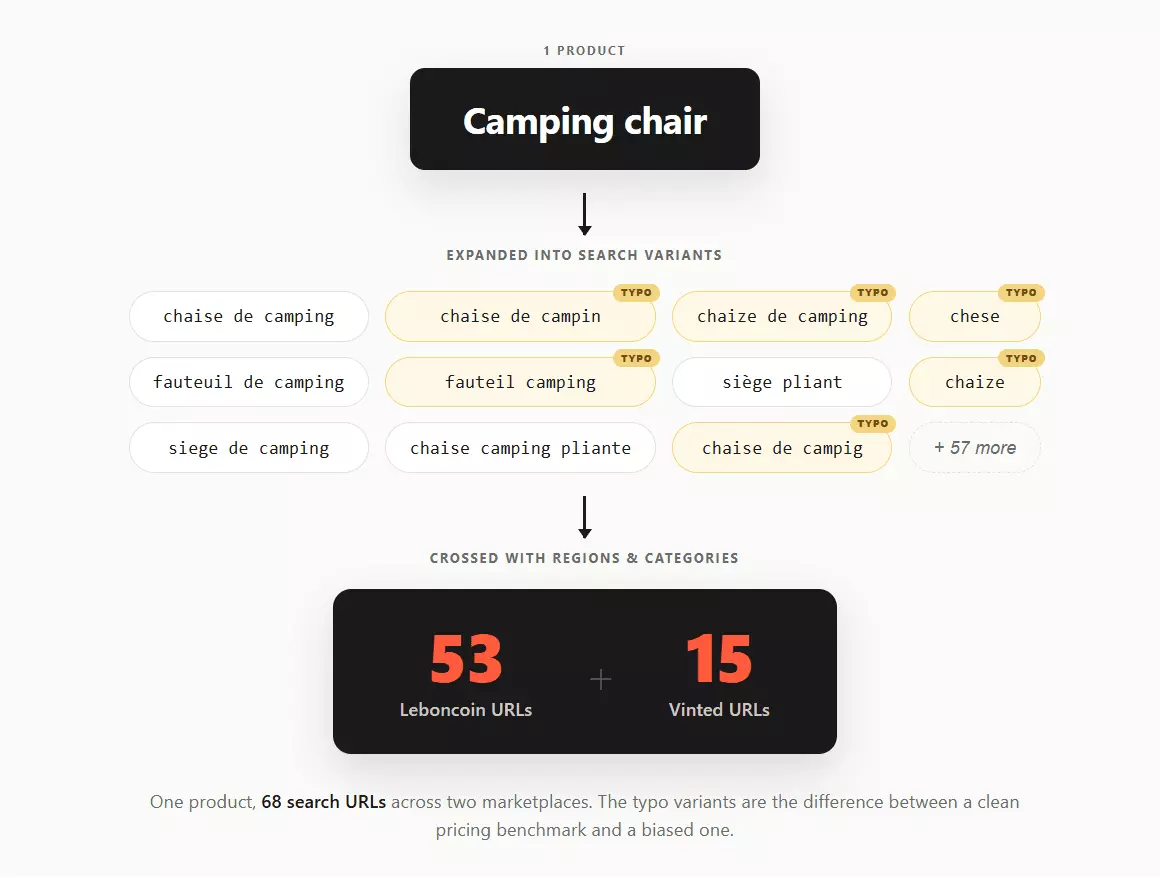
For a single product category like camping chairs, the analyst doesn't run one search URL.
They run dozens.
Each one a different combination of typo variant, region, and category filter... all targeting the same underlying product.
A real camping cluster from Baptiste's workspace runs 53 distinct Leboncoin search URLs and 15 Vinted search URLs. The keyword variants captured in just one product line:
chaise de camping,chaise de campin,chaise de campigchaise camping,chaise camping pliante,chese,chaize,chaize de campingfauteuil de camping,fauteil camping,fauteuille,fauteulsiege de camping,siege camping pliant,siège pliant...
Plus the same set crossed against multiple French regions for geographic coverage, plus the same again on Vinted with its own URL structure.
The point of running every spelling variant isn't pedantry.
It's bias correction.
A pricing benchmark on "chaise de camping" alone systematically excludes the cheaper end of the market. Listings posted by sellers who don't take time over their titles... which often means the most price-elastic supply.
Capturing them keeps the analysis honest.
The two scrapers run on a parallel weekly cadence.
Leboncoin clusters are refreshed every six to seven days.
Vinted clusters typically run the morning after the corresponding Leboncoin run. So the analyst gets parallel snapshots of the same product universe across both platforms within a 24-hour window.
The Vinted run feeds a different demographic of buyer and seller than Leboncoin... younger, more clothing-and-accessories oriented.
The side-by-side comparison is a signal in itself.
What the data looks like
Both scrapers return rich structured data. The Leboncoin scraper exposes about 50 fields per listing, and the Vinted scraper around 30.
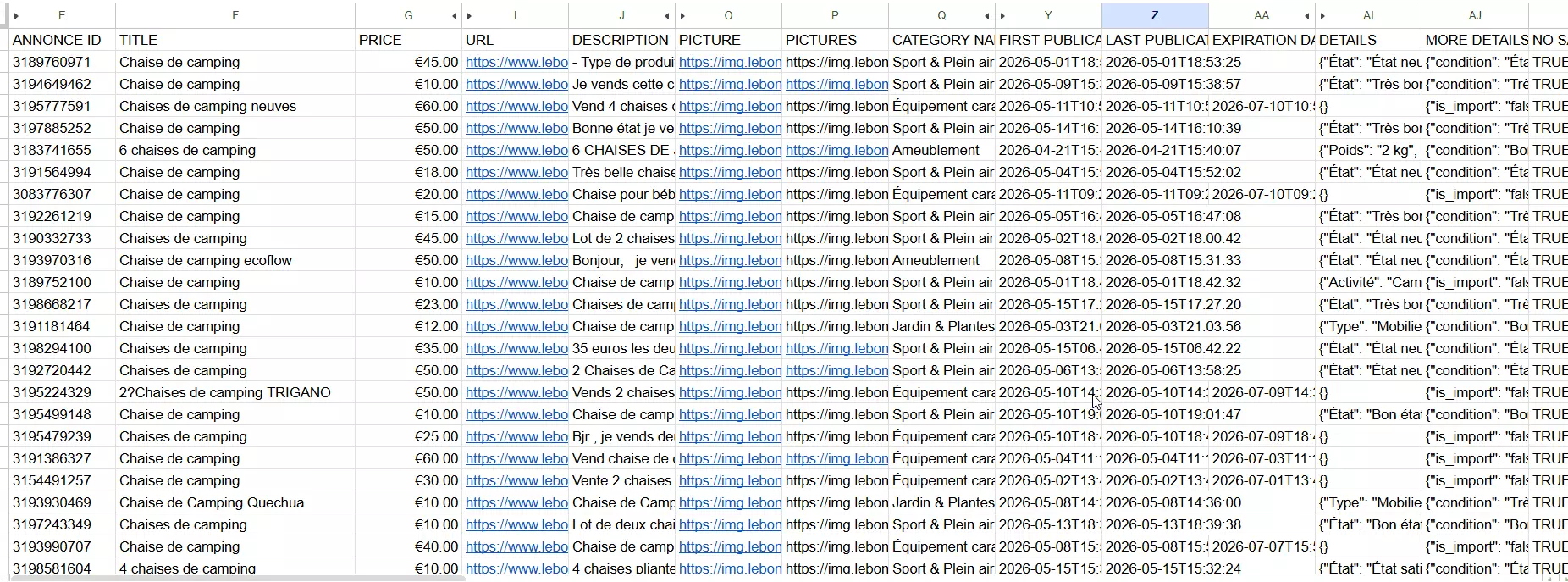
The fields the data team actually uses for analysis are a focused subset of each. A real Leboncoin record from one of the team's recent camping runs.
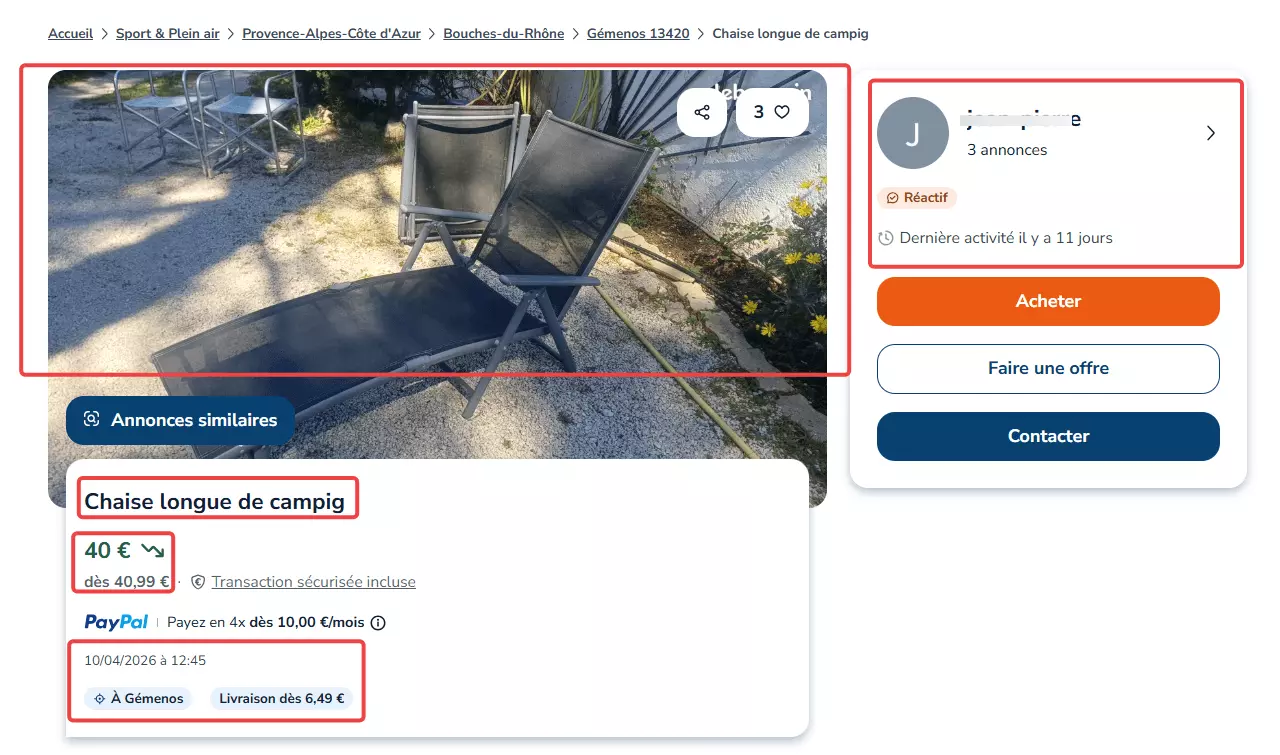
Notice the title... Chaise longue de *campig*** (misspelled), a real-world example of exactly the typo problem the search-URL strategy is built to catch:
{
  "title": "Chaise longue de campig",
  "category_name": "Sport & Plein air",
  "price": 40,
  "old_price": 60,
  "city": "Gémenos",
  "department": "Bouches-du-Rhône",
  "region": "Provence-Alpes-Côte d'Azur",
  "postal_code": "13420",
  "lat": "43.29308",
  "lng": "5.63396",
  "first_publication_date": "2026-04-10T13:45:23Z",
  "last_publication_date": "2026-04-10T13:45:23Z",
  "status": "active",
  "owner_type": "0",
  "owner_siren": null,
  "more_details": {
    "condition": "Bon état",
    "shippable": "true",
    "shipping_type": "mondial_relay",
    "estimated_parcel_weight": "2297",
    "sports_hobbies_activity": "Camping et randonnée"
  },
  "scraping_time": "2026-05-21T15:25:50.721Z"
}f
The fields doing real work for the analyst:
priceandold_price— the second one tracks price drops. This listing dropped from €60 to €40... a ~33% markdown that a static price benchmark would miss completely.first_publication_dateandlast_publication_date— listing age and time-to-sell signals.region,department,lat/lng— geographic distribution of supply, demand, and pricing.owner_typeandowner_siren— distinguishes individual sellers from professional resellers (set whenowner_typeis1). Crucial for separating casual second-hand activity from wholesale clearance and destockage operations.category_name— Leboncoin's own category structure (Sport & Plein air,Équipement caravaning, etc.), which the analyst uses to cross-validate keyword filters.
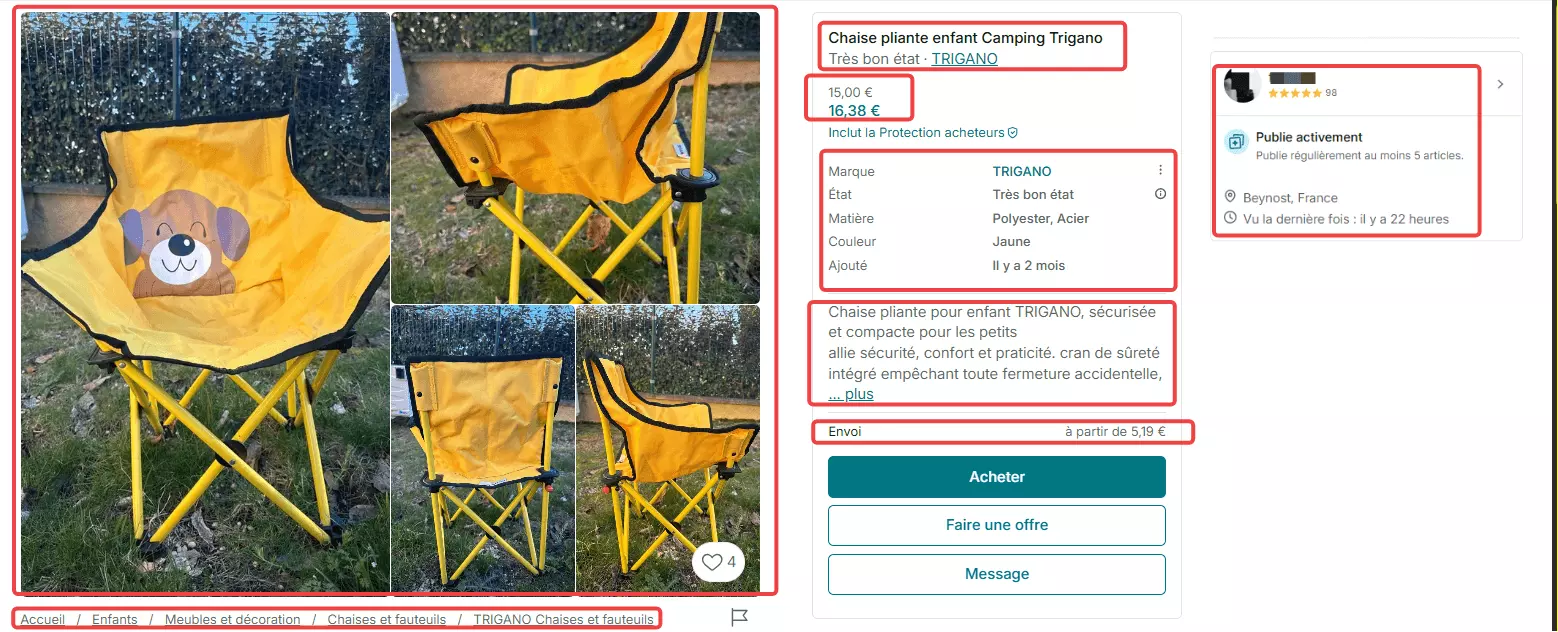
The Vinted side adds engagement-layer signals that Leboncoin doesn't expose:
{
  "title": "Chaise pliante enfant Camping Trigano",
  "brand_title": "TRIGANO",
  "price": 15,
  "service_fee": 1.45,
  "total_item_price": 16.45,
  "currency": "EUR",
  "status": "Très bon état",
  "favourite_count": 4,
  "view_count": 0,
  "user_business": false,
  "url": "https://www.vinted.fr/items/8290278491-chaise-pliante-enfant-camping-trigano",
  "scraping_time": "2026-05-18T07:00:47.662Z"
}f
favourite_count is a soft demand signal that surfaces interest before sale.This listing has 4 favourites at €15. A comparable listing with 40 favourites at the same price tells a very different demand story.
brand_title lets the analyst aggregate by brand directly.That matters because the dataset surfaces both Decathlon's own category-specialist brands (Quechua, Domyos, Kipsta) and competitor brands like Intersport's McKinley, TRIGANO, EcoFlow... plus the long tail of niche players.
What the workflow feeds
The same dataset feeds several analyses inside Decathlon's design and commercial teams.
Pricing benchmarks are the foundation.
What does a two-season-old Quechua tent fetch on Leboncoin? How does that compare to a McKinley equivalent on Vinted?
Those numbers calibrate retail pricing and the buyback / resale pricing on Decathlon Seconde Vie.
A business line that resold 1.6 million products in 2025 needs market-true reference prices to operate.
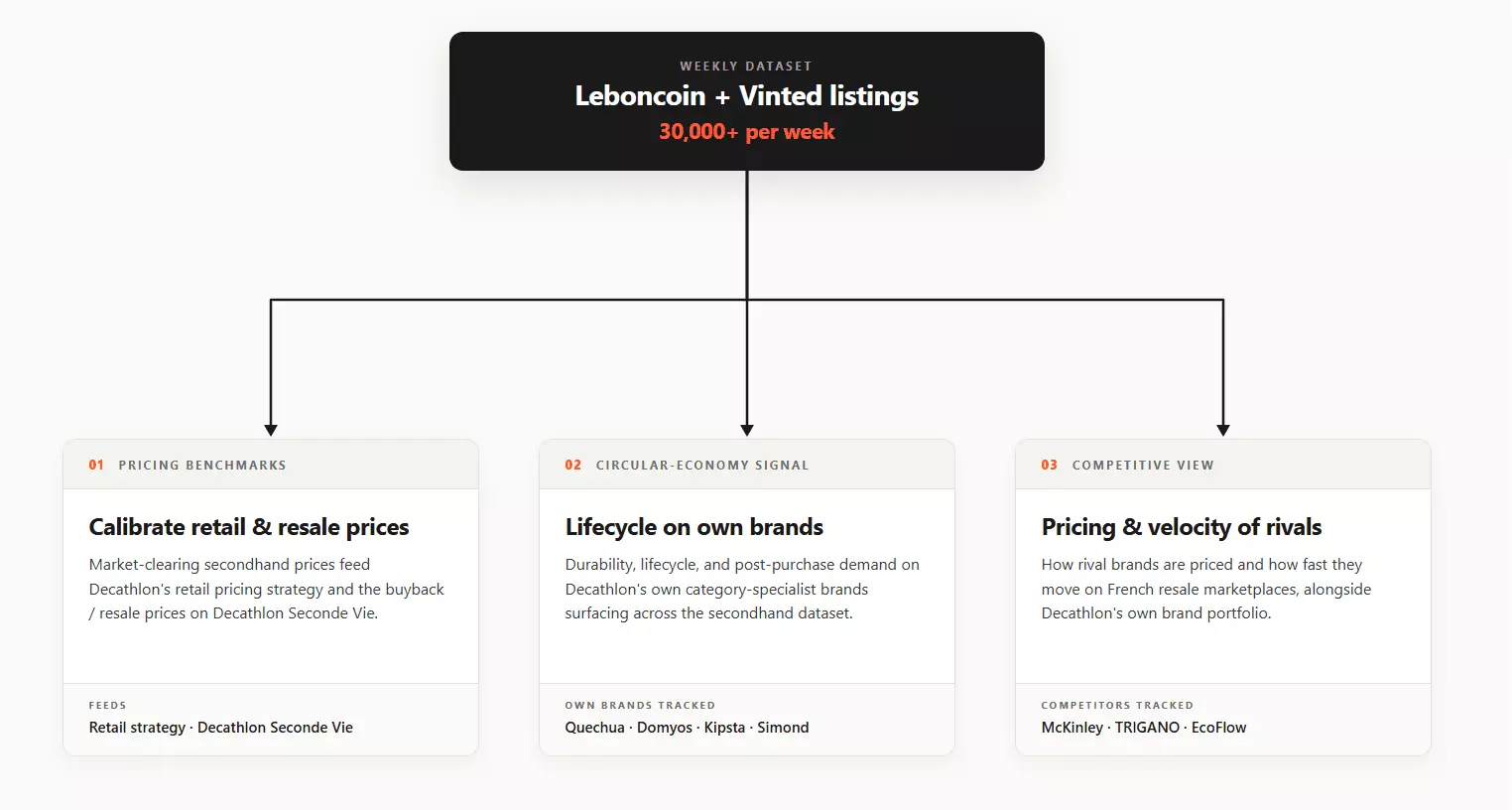
Circular-economy signal on Decathlon's own brands comes for free.
Every Quechua, Domyos, Kipsta and Simond listing surfacing on the secondhand market is a real-world data point on durability, lifecycle, and post-purchase demand.
The design teams get to see how their products age in the wild, at scale, without commissioning a study.
Competitive view on category specialists. How Intersport's McKinley is priced and how fast it moves on French resale marketplaces.
How TRIGANO sits next to Quechua at end-of-season.
The dataset surfaces Decathlon's own brands and the competitors sharing shelf space with them... in the same listings feed.
No separate competitive-intel project required.
One pull, multiple analyses. The analyst's job is asking the right questions for the product team they're supporting that quarter.
A standard tool across the data team
The most telling pattern in Decathlon's lobstr.io usage isn't the volume. It's the rotation.
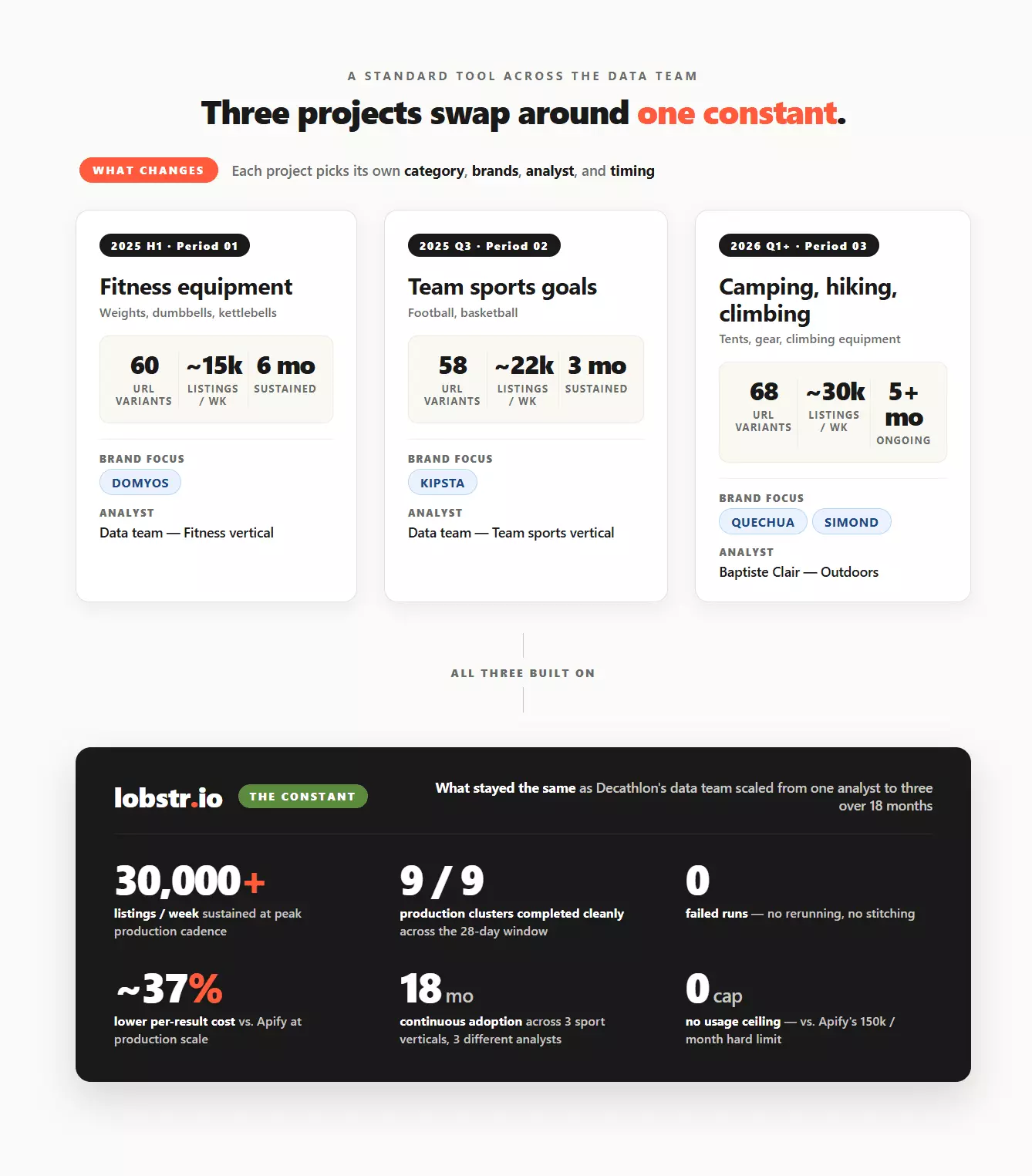
Three analysts on the data team have built variants of this same workflow over the past 18 months, each one for a different sport category that maps cleanly to a Decathlon brand:
| Period | Category | Decathlon's category specialist brand |
|---|---|---|
| 2025 H1 | Fitness equipment (weights, dumbbells, kettlebells) | Domyos |
| 2025 Q3 | Team sports goals (football, basketball) | Kipsta |
| 2026 Q1+ | Camping, hiking, climbing | Quechua / Simond |
Same scrapers. Same multi-marketplace mirror pattern.
Different keyword universe, different analyst, different product team being supported.
The workflow has become the way Decathlon's data team approaches secondhand-market analysis as a class of work.
That's institutional adoption, not a one-team experiment. It's the version of customer maturity that comes from a tool consistently doing the boring parts of the job well... year over year, category after category, analyst after analyst.
Results
As of May 2026, Decathlon Digital's outdoor data analytics workflow runs at a steady weekly cadence on both marketplaces... and the same operational pattern is in production across fitness and team sports too.
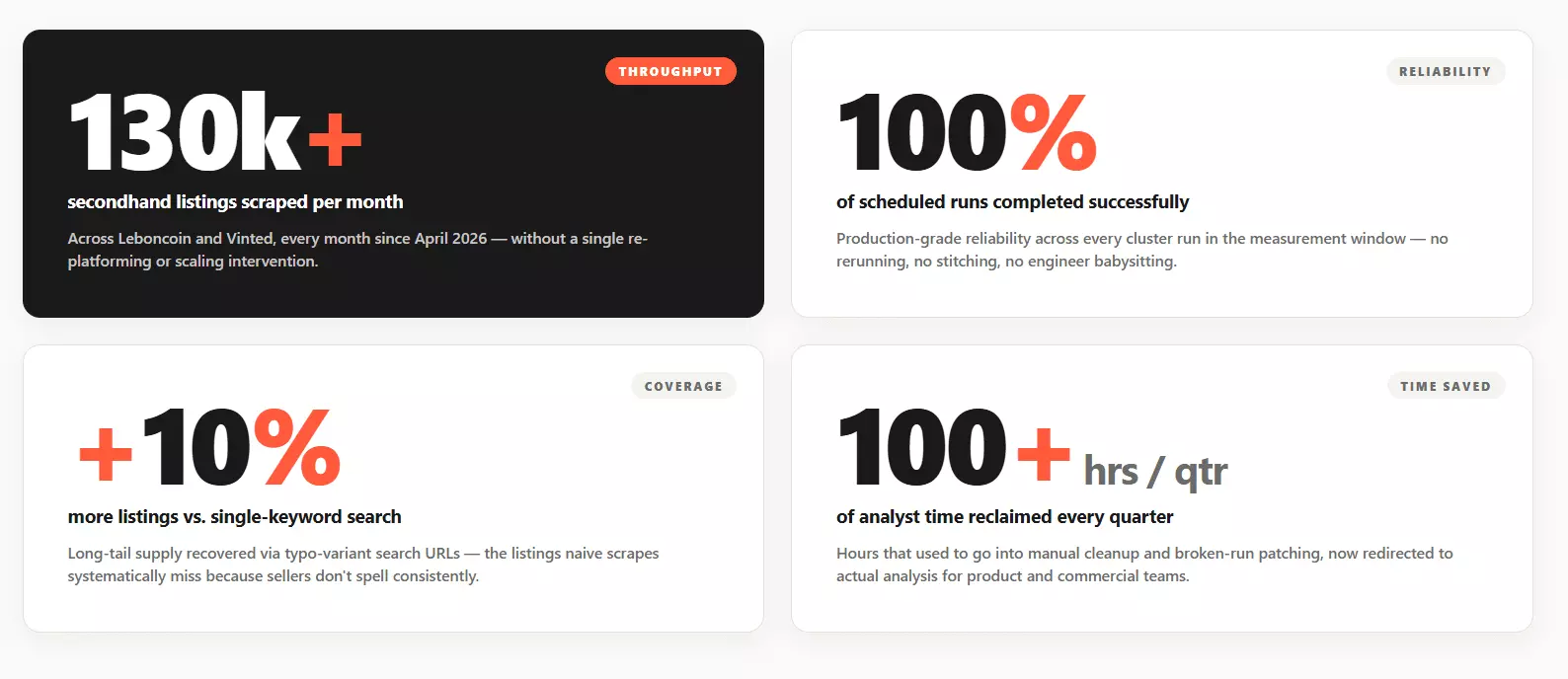
Outcomes at Decathlon's scale (as of May 2026):
- 130k+ secondhand listings scraped per month across Leboncoin and Vinted... a cadence the alternative tools tested earlier couldn't sustain economically.
- No usage ceiling. Several competing tools cap monthly usage at around 150,000 results — Decathlon's workflow alone would sit at ~80% of that ceiling, with no room for new sport verticals or re-runs. lobstr.io has no equivalent cap, so the workflow scales without re-platforming.
- 100% of scheduled runs completed successfully across the 28-day measurement window... every cluster ran clean, no rerunning, no stitching.
- ~37% lower per-result cost vs. tools tested previously at Decathlon's scale (~$2.50 vs. ~$4.00 per 1k listings) — a gap that widens as the workflow expands to more sport verticals.
- 10% more listings captured vs. naive single-keyword search — the long-tail supply posted by sellers with imperfect titles, recovered through typo-variant search URLs.
- 100+ hours saved every quarter of analyst time, redirected from manual cleanup and broken-run patching to actual analysis.
- No in-house engineering required... no scraper build, no scraper maintenance, no anti-bot arms race. Equivalent to roughly one FTE-year of avoided engineering effort at this production scale.
- Adopted across 3 sport verticals over 18 months by different analysts on the data team... institutional standardization, not a one-team experiment.
The workflow now feeds pricing, demand, and circular-economy analyses across the outdoor sport range.
The same operational pattern is available to any sport category... whenever a product team needs market intelligence on the secondhand side.
Key takeaways
- 130k+ secondhand listings scraped per month across Leboncoin and Vinted
- 100% of scheduled runs completed cleanly — production-grade reliability
- 10% coverage uplift via typo-variant search URLs
- 100+ analyst hours reclaimed every quarter
- 18 months continuous use across 3 sport verticals, 3 different analysts