
Best Realtor Scrapers in 2026 [No-Code + API]
(updated)
lobstr.io is the best realtor.com scraper in 2026 (8.7/10), tested on data, usability, scale, cost, speed, and support. It wins on the richest data (219 fields), the biggest ceiling (up to 86.4M listings/month), and $0.50/1k at scale. Apify (8.1) is the runner-up for speed and native filters, but costs 7x more all-in.
⚡ 30-Second Summary
- I tested the realtor.com scrapers that actually work at scale in 2026 ... 4 tools, one identical job, judged on data, usability, scalability, cost, speed, and support, every tool on a paid plan
- lobstr.io is the best overall pick (8.7/10). Richest data (219 meaningful fields), the largest scale ceiling (up to 86.4M listings/month on the top plan), $0.50/1k at scale, and the only tool with flood/fire/noise risk, school ratings, and full agent + office contact in every row. Pick it for high-volume, all-data pulls and lead gen. Trade-off: slowest full-data speed before you add Slots (20 listings/min at 1 Slot)
- Apify is the strong runner-up (8.1/10). Fastest full-data pull (100 listings/min), the only native filter builder + agent-search mode, and exclusive analytics no one else has (value estimates, view/save popularity, mortgage math). Pick it for filtered pulls and market analytics under ~4M/month. Trade-off: $3.50/1k all-in (7x lobstr.io at scale) and community-only support
- Piloterr is the developer/API pick (5.4/10). Clean API with MCP, responsive support, and a genuinely fast, cheap search endpoint. Pick it for basic listing fields at volume via code. Trade-off: full detail data crawls at 3 listings/min, its history/tax fields came back empty, and a failed run loses your data
- Didn't make the cut: ScrapeHero ... cheap ($0.25/1k) and fast (60/min), but too thin on data (30 fields, 18% fill) to rank among the best. Full breakdown below
- Also looked at and skipped: Bright Data and Outscraper (neither has a usable dedicated realtor.com product ... see the FAQ)
If you've tried to pull realtor.com listings at scale, you already know how this goes.
403 Forbidden and stops. The popular open-source library for this, HomeHarvest, literally tells you in its own FAQ to add delays, a VPN, or proxies to get past the block. 🙃And there's no official realtor.com API to fall back on. So you're stuck picking a tool ... and most "best realtor scraper" lists are recycled marketing that never ran a single job.
So I did. I bought the paid plan of all 4, pointed them at the same realtor.com search URLs on the same day, and counted every field, every second, and every dollar.
Just tell me which one
| If you want... | Go with | The number |
|---|---|---|
| The best all-rounder | lobstr.io | 8.7/10 weighted |
| The richest data | lobstr.io | 219 meaningful fields |
| The cheapest all-data at scale | lobstr.io | $0.50 / 1k |
| The fastest full-data pull | Apify | 100 listings/min |
| Native filters + agent search | Apify | filter builder + agent mode |
| The biggest scale ceiling | lobstr.io | up to 86.4M listings/mo |
| The best support | lobstr.io | live chat + email, 5/5 Capterra |
| A pure API for developers | Piloterr | $0.11 / 1k (search only) |
The realtor.com scraper comparison, side by side
Here's the full scorecard. Every number is a measured result from the same job, not a spec sheet.
| Criteria | lobstr.io | Apify | Piloterr |
|---|---|---|---|
| Meaningful fields | 219 | 186 | 173 |
| Avg fill (fields populated) | 75% | 54% | 48% |
| Accuracy (values correct) | ✅ | ✅ | ✅ |
| Agent + office contact | ✅ full | ⚠️ agent only | ✅ full |
| Flood / fire / noise risk | ✅ | ⚠️ flood + noise score | ❌ |
| School ratings | ✅ | ✅ | ❌ |
| Price + tax history | ✅ both | ⚠️ price only | ❌ (came back empty) |
| Value estimate (Zestimate-style) | ❌ | ✅ 🎁 | ❌ |
| Views / saves popularity | ❌ | ✅ 🎁 | ❌ |
| Filters | ⚠️ via URL + keyword | ✅ native builder | ⚠️ via URL (code) |
| Speed (listings/min, full data) | 20 (1 Slot) | 100 | 3 |
| Cost /1k all-data (entry → scale) | $2 → $0.50 | $3.50 | $5.57 → $4.63 |
| Monthly ceiling full-data (default) | 864K/Slot (up to 86.4M) | 4.32M | 130K |
| Concurrency | ✅ 20/Squid, 100/account | ⚠️ 1-5 auto | ❌ none |
| Export formats | CSV, Excel, JSON, JSONL | CSV, JSON, XML, JSONL, HTML, Excel | JSON (API) |
| API access | ✅ API + MCP | ✅ API + MCP | ✅ API + MCP |
| Data-loss protection | ✅ pause + 28d retention | ✅ stop + 30d retention | ❌ lost on failure |
| Customer support | 💯 live chat + email | 👎 issues tab (~1.3h, actor) | 💯 chat + email |
| User rating | 5/5 Capterra (33) | 5★ Apify (12) | 4.8/5 Capterra (33) |
Score summary and how I scored each criterion
| Criterion (weight) | lobstr.io | Apify | Piloterr |
|---|---|---|---|
| Data (2.0) | 9.3 | 8.4 | 8.0 |
| Usability (2.0) | 8.5 | 9.0 | 5.5 |
| Scalability (2.0) | 9.5 | 8.5 | 3.5 |
| Cost (1.8) | 9.0 | 6.5 | 5.0 |
| Speed (1.4) | 6.5 | 9.0 | 3.0 |
| Support (0.8) | 9.0 | 6.5 | 8.0 |
| Weighted overall /10 | 8.7 | 8.1 | 5.4 |
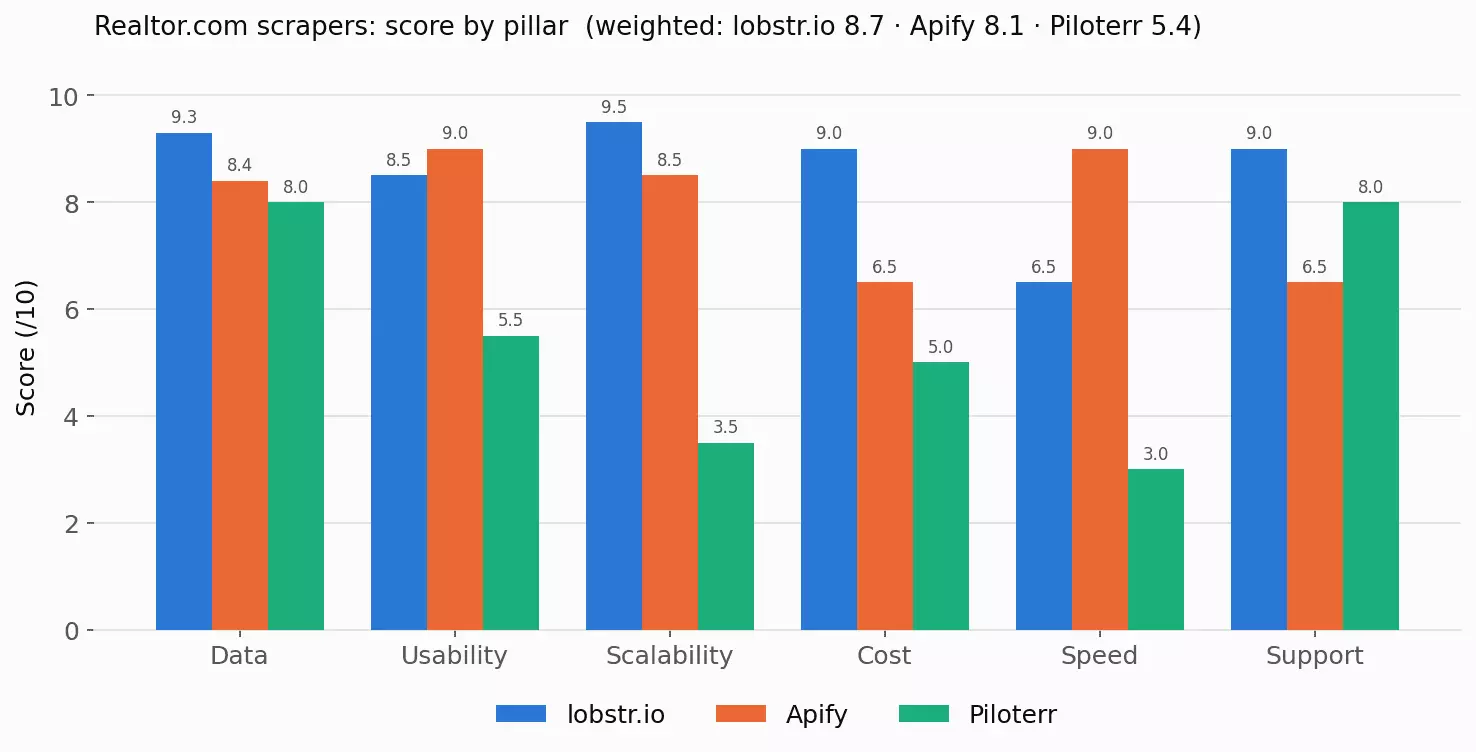
(9.3×2.0 + 8.5×2.0 + 9.5×2.0 + 9.0×1.8 + 6.5×1.4 + 9.0×0.8) ÷ 10 = 8.7.How each criterion was measured:
- Data ... total and meaningful field counts, the percentage of fields actually populated on the same listings, accuracy against the source, and each tool's exclusive fields. Scored with my
/datacomparemethodology, baselined against the richest response - Usability ... how you feed it a job, whether filters are real UI fields or hand-crafted URLs, exports, scheduling, and workflow polish
- Scalability ... the 24/7 monthly ceiling (measured rate × 43,200 minutes) per tier at a declared config, concurrency, and what happens to your data when a run fails
- Cost ... normalized to cost per 1,000 listings at entry and at scale, all-data, with the 100K anchor job priced for every tool
- Speed ... listings per minute on the same batch, measured for both the search-only tier and the full-data tier (tools quote the fast one and hide the drop)
- Support ... channels and responsiveness, from Capterra review sentiment and, for the Apify actor, its published response time plus how the developer actually handles issues
A quick honesty note on the ranking: lobstr.io wins overall, but it does not win every pillar. Apify beats it on Speed and Usability. That's the test working, not me flattering the house brand.
Is it legal to scrape realtor.com?
Disclaimer: I'm not a lawyer, and this isn't legal advice. If you're running a serious operation, talk to a professional. What follows is the general landscape based on public court rulings and realtor.com's own documents.
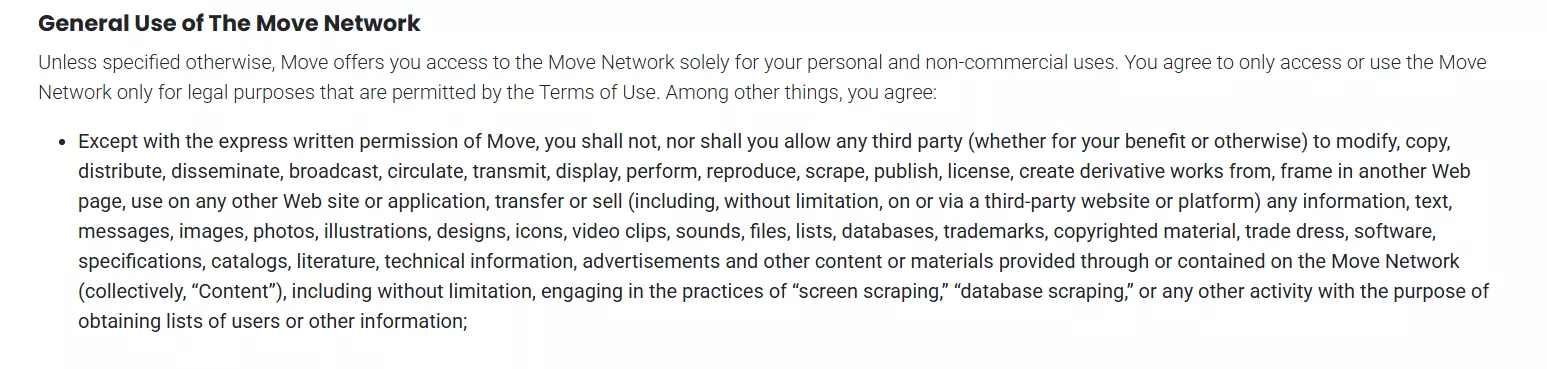
But that's a private contract. Breaking it can cost you an account, not your freedom.
So is it legal? Generally yes, for public listing data, under US law.
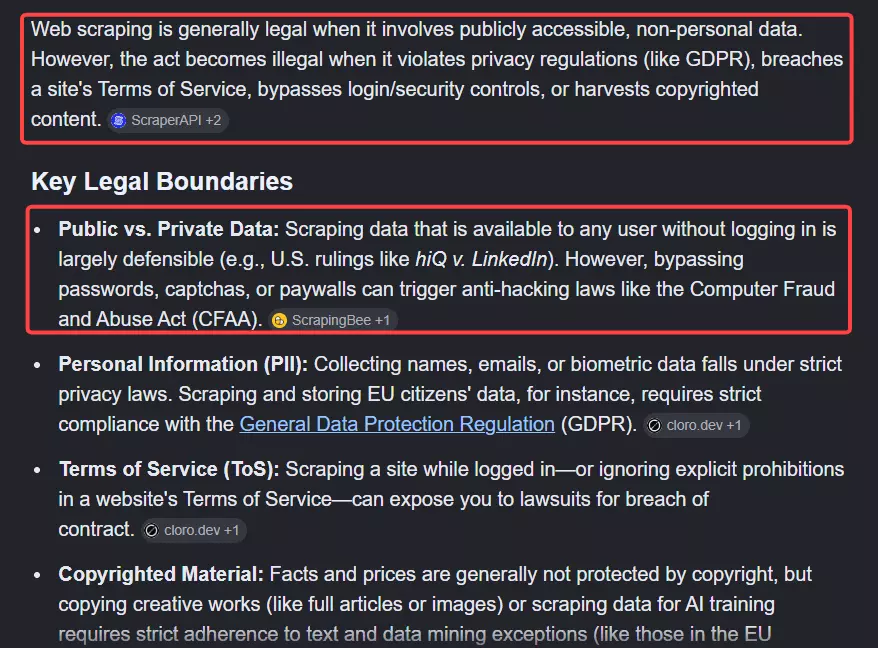
The anchor precedent is hiQ Labs v. LinkedIn (Ninth Circuit, 2022), which held that scraping publicly accessible data ... pages that don't sit behind a login ... likely does not violate the Computer Fraud and Abuse Act.
One honest caveat: that case later settled, with hiQ paying damages and destroying the scraped data. The CFAA win doesn't erase contract or downstream-use risk.
What that means in practice:
- ✅ Public listing pages are generally fine to scrape
- ❌ Anything behind a login is off the table ... that's authorized-access territory
- ❌ Don't republish listing content wholesale ... realtor.com listing copy and photos are copyrighted
- ❌ Don't abuse agent PII ... those emails and phone numbers are personal data under CCPA/GDPR the moment you do something with them
- ❌ Don't hammer the site ... be reasonable with request rates
Does realtor.com have an official API?
Short version: no. There's no official public realtor.com developer API. Realtor.com offers MLS and partner data feeds to licensed brokers, but that's not something a developer can sign up for and call.
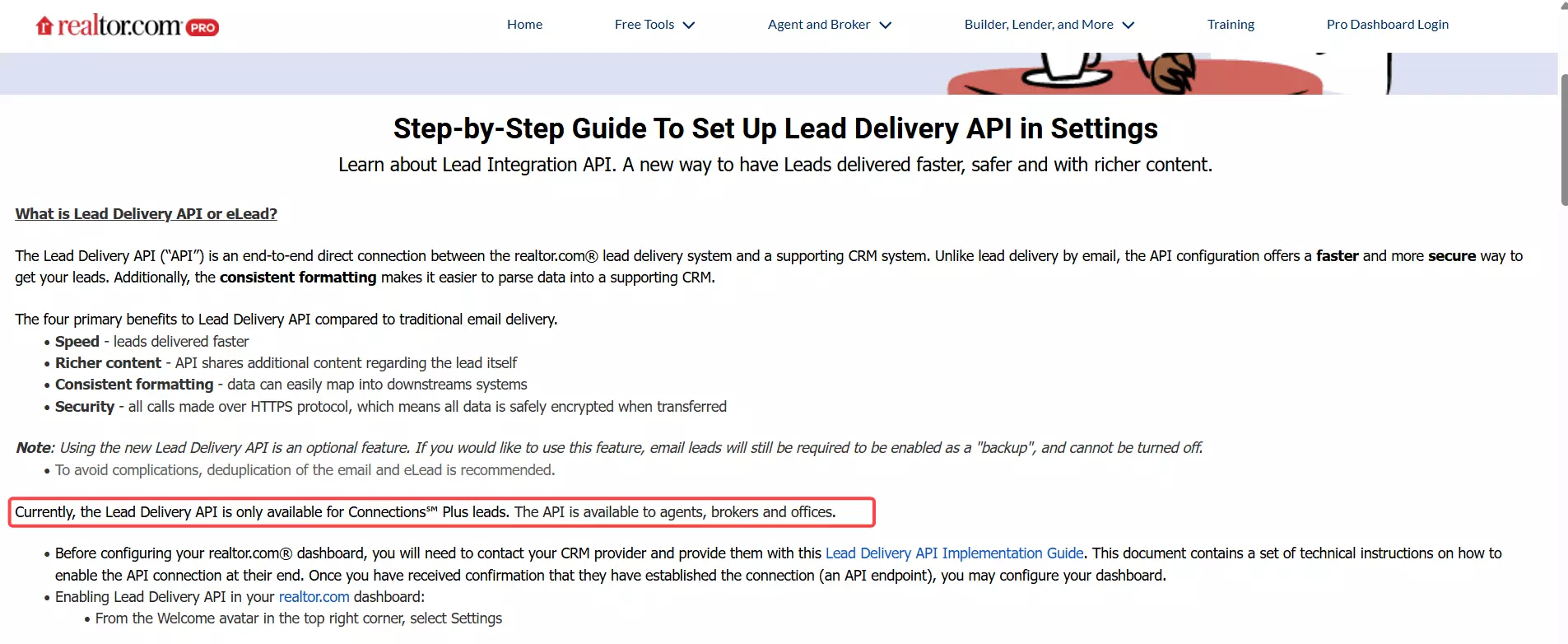
Everything you'll find labeled a "realtor.com API" is either an unofficial third-party API that reproduces the public data, or a scraper.
That's exactly why this comparison exists ... a scraper (or an API like Piloterr that wraps one) is the only real route to structured realtor.com data at scale.
So the question isn't API vs scraper. It's which scraper. Let me show you how I picked.
How I chose the best realtor.com scrapers
I started where the complaints live ... Google, the AI tools people ask first (Claude, Gemini, ChatGPT, Grok), and the review sites.
The same problems came up again and again: tools that 403 on you, data that's shallow or half-empty, and pricing that looks cheap until you hit real volume.
I tested every realtor.com scraper I could find ... dozens of them ... and narrowed to 4 worth benchmarking in depth. Three made the final list; the fourth (ScrapeHero) I fully tested but cut for thin data. I scored each on the same six things.
Data
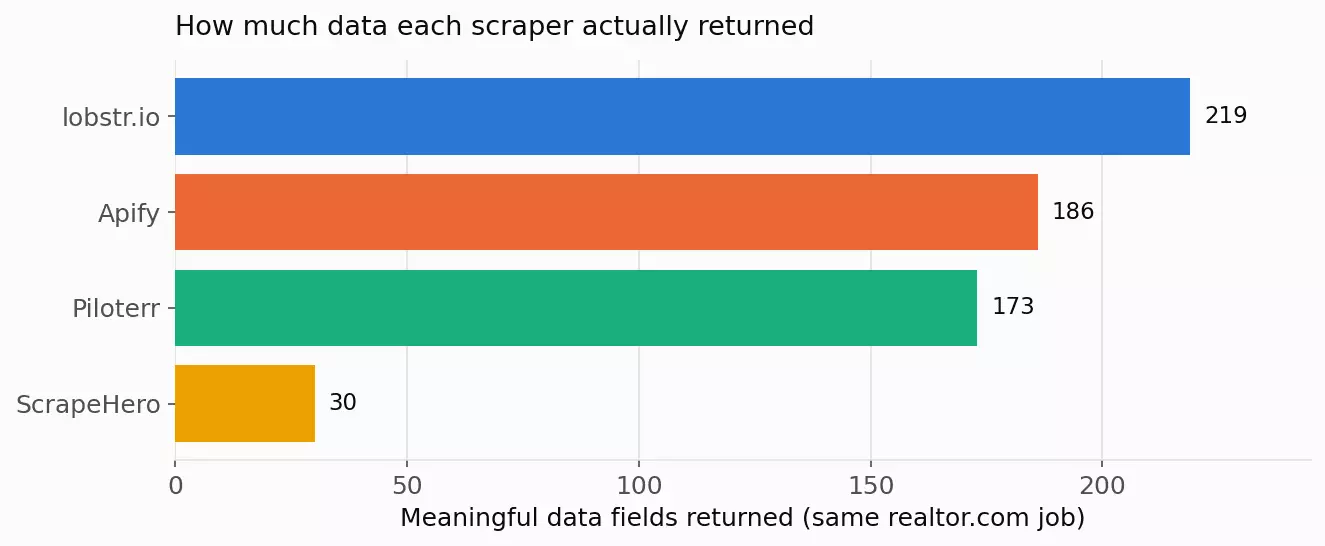
I ran the same realtor.com search URLs through every tool, then counted total and meaningful fields (stripping plumbing like internal IDs and echoed input), measured what percentage of fields were actually populated, and checked values against the source.
Usability
I judged how fast you get from a URL to data, whether filters are clean UI fields or hand-crafted URL parameters, and how much the platform helps you (scheduling, exports, monitoring).
Speed
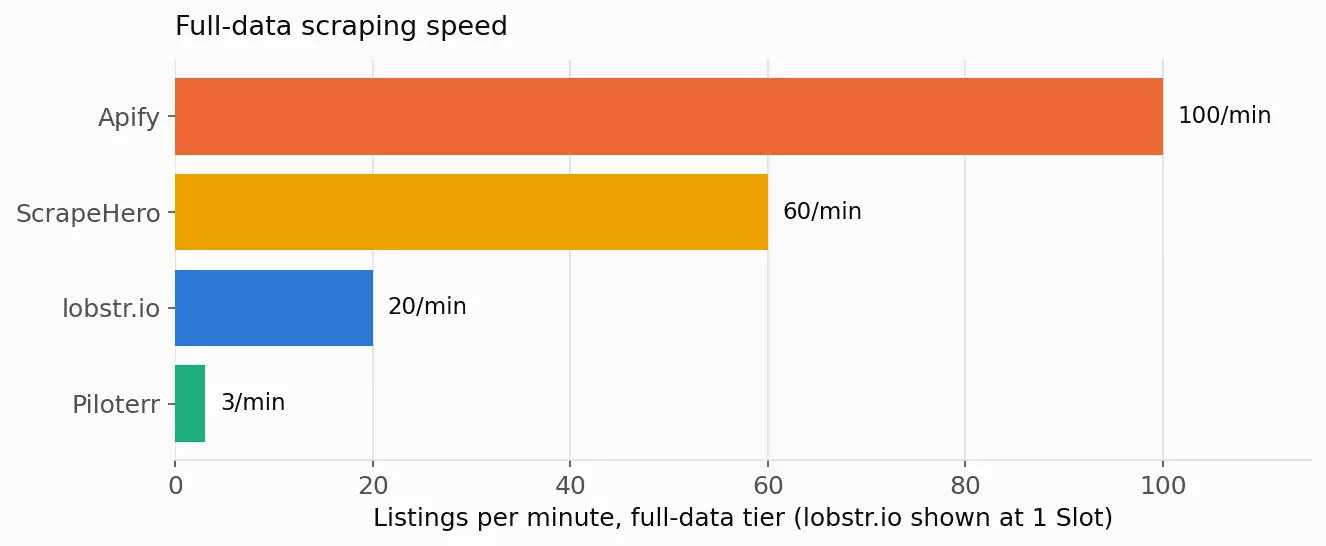
I clocked listings per minute on the same batch, for both tiers ... search-only and full-data (with all the detail fields switched on) ... because the full-data rate is where tools quietly slow down.
Cost
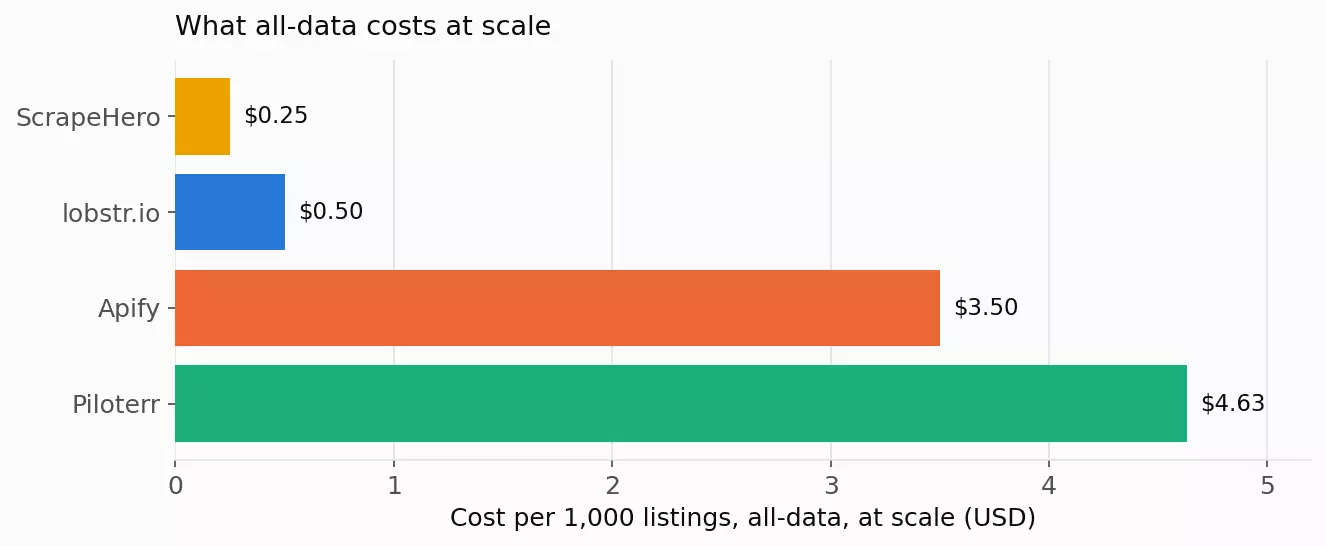
I normalized everything to cost per 1,000 listings, entry and scale, for the full all-data bundle, then priced a 100K anchor job for each tool so the numbers are comparable.
Scalability
I computed the 24/7 monthly ceiling (rate × 43,200 minutes) at a declared default config, checked the concurrency each tool allows, and tested what happens to your data when a run fails.
Support
I read the Capterra reviews for support sentiment, and for the Apify actor I used its published response time plus a look at how the developer actually resolves issues (not just marks them closed).
What I left out and why:
- General-purpose scrapers like Bright Data ... powerful, but no dedicated realtor.com product, so you're parsing raw HTML yourself
- Abandoned GitHub repos ... they break the week realtor.com changes a class name
- Visual point-and-click scrapers ... fine for 50 rows, useless at scale
Three tools made the final cut. Here they are.
Best Realtor Scrapers of 2026
You've seen the scorecard above. Here's the story behind the numbers, tool by tool.
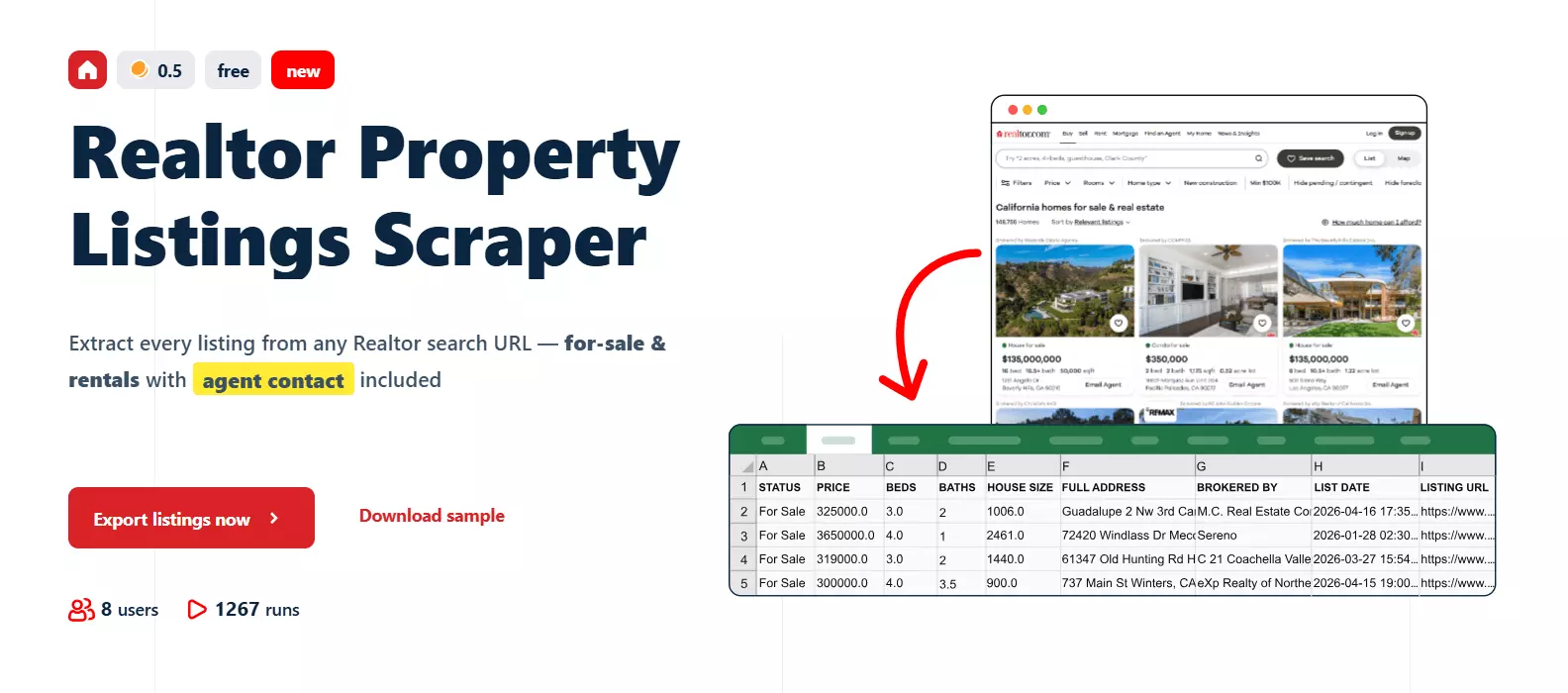
1. lobstr.io Realtor Property Listings Scraper
- User rating: 5/5 on Capterra (33 reviews)
- My score: 8.7/10
- Type: no-code cloud scraper + API
- Pricing from: $2/1k (all-data), dropping to $0.50/1k at scale
- Best for: high-volume, all-data pulls and lead generation
| Pillar | Score |
|---|---|
| Data | 9.3/10 |
| Usability | 8.5/10 |
| Scalability | 9.5/10 |
| Cost | 9.0/10 |
| Speed | 6.5/10 |
| Support | 9.0/10 |
| Overall | 8.7/10 |
| Pros | Cons |
|---|---|
| Richest data of the four (219 meaningful fields) | Slowest full-data speed before Slots (20/min) |
| Only tool with flood/fire/noise risk + school ratings | No agent-search mode (Apify has one) |
| Full agent + office contact in every row | |
| Biggest scale ceiling (up to 86.4M/month) | |
| Cleanest billing, $0.50/1k at scale, no overage | |
| Best support in the group |
Data
I baselined the whole comparison against lobstr.io because it returned the superset of fields. Here's the shape of it:
| Category | Data points |
|---|---|
| 🏠 Listing | PRICE, STATUS, LIST DATE, SOLD PRICE, PRICE PER SQFT, PRICE REDUCED AMOUNT, MLS ID |
| 📍 Location | FULL ADDRESS, STREET, CITY, STATE, ZIP CODE, COUNTY, NEIGHBORHOOD, LAT, LNG |
| 📐 Specs | BED, BATH, HOUSE SIZE, ACRE LOT, YEAR BUILT, PROPERTY TYPE, STORIES, HEATING, COOLING |
| 👤 Agent + office 🎁 | AGENT NAME, AGENT EMAIL, AGENT PHONE, OFFICE NAME, OFFICE EMAIL, OFFICE PHONE, BROKER NAME |
| 📸 Media | PHOTOS, PHOTO COUNT, VIRTUAL TOUR URL, STREET VIEW URL |
| 📜 History | PROPERTY HISTORY, TAX HISTORY, BUILDING PERMITS HISTORY |
| 🏫 Schools | SCHOOLS (name, rating, distance, grades) |
| 🛡️ Risk 🎁 | FLOOD FACTOR SCORE, FIRE FACTOR SCORE, NOISE SCORE, FEMA ZONE, ENVIRONMENTAL RISK |
The raw count isn't the real edge. Depth is. lobstr.io is the only tool that gives you flood, fire and noise risk, rated nearby schools, and full agent and office contact in the same row ... the combination you need for lead gen or risk-aware analysis. On fill, 75% of its fields populate on average, the highest in the test.
Two honest notes: its own fill sits at 75% (not higher) because some fields are genuinely conditional ... sold price, price-reduced amount, and unit only appear on the listings that have them. And accuracy was a tie at 9.5/10 across all four tools ... every tool got the actual facts right, so this isn't a lobstr.io-only win.
Usability
lobstr.io was the most polished platform of the four. The flow is a simple wizard ... create a Squid, add your realtor.com URLs, adjust settings, launch.
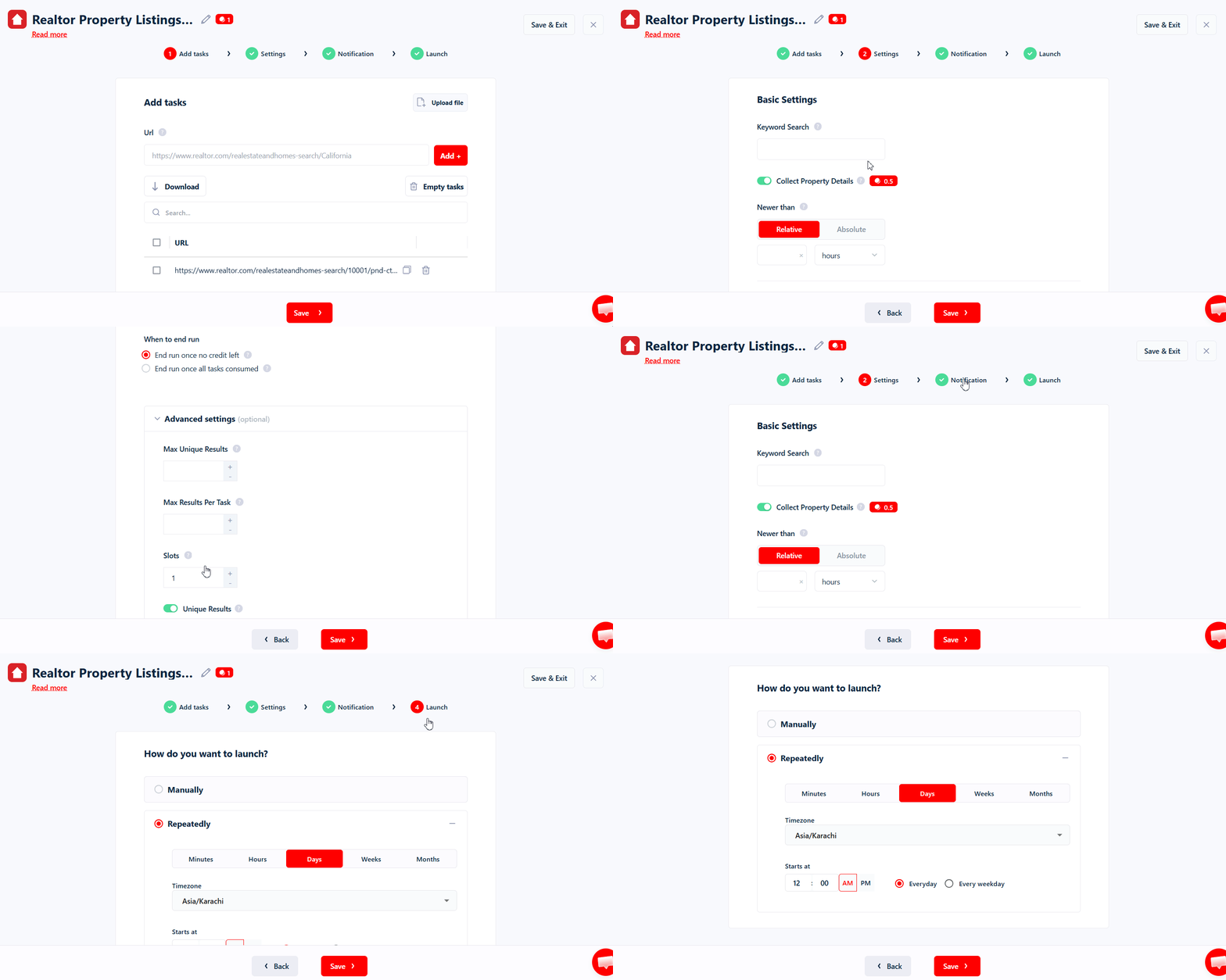
Ways to feed it a job:
- A realtor.com search URL
- A bulk list of search URLs
Settings that matter:
- Keyword search (free) ... filter listings by comma-separated keywords like
pool, waterfront, renovated - Collect property details ... the toggle that pulls the full gallery, agent/office contact, price + tax history, schools, and risk
- Newer than ... stop when listings pass an age threshold
The honest gap: filtering by price, beds, baths or property type is URL-only. You apply filters on realtor.com, copy the URL, and paste it in. It works, but Apify's native filter builder is genuinely nicer.
Speed
This is lobstr.io's soft spot. On the full-data tier (all details on) it ran at 20 listings/min on a single Slot ... the slowest of the no-code tools out of the box. Search-only is a healthier 100/min.
The full-data slowness is real, but it's the one weakness you can buy your way out of. Each Slot is another bot running in parallel, and you get up to 20 per Squid ... so a single Squid scales that 20/min to 400/min. More on that under Scalability.
Cost
lobstr.io runs on a credit subscription, 1 credit per listing, no overage.
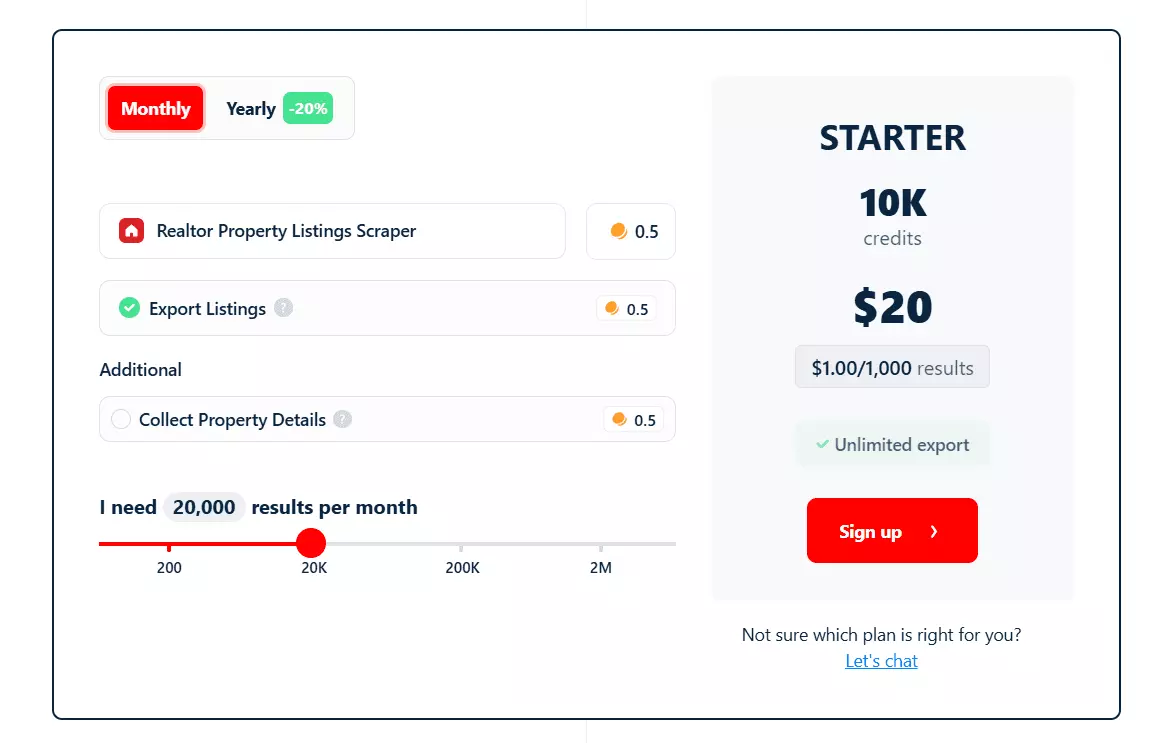
- Entry: $2/1k all-data ($1 search + $1 for the details add-on)
- At scale: $0.50/1k, all-data included
The 100K anchor job costs $50 at scale, $200 at entry. That's the second-cheapest all-data price in the test, and the billing is the cleanest ... no compute layer to budget separately, no overage surprises.
Scalability
This is lobstr.io's real moat. At 20/min full-data on a single Slot running 24/7, that's 864K listings/month ... I'm keeping the math at one Slot on purpose, to give you the most modest number.
Then you add Slots. Up to 20 per Squid takes it to 17.28M/month per Squid, and the top plan gives you up to 100 Slots across your account (spread over multiple Squids) for 86.4M/month ... far beyond anything else here. Note those are two different dimensions: 20 per Squid, 100 per account.
It also protects your data. If a run hits an error, lobstr.io pauses it until the issue is fixed, and data lives on their servers for 28 days, so you can abort and download partial results anytime.
Support
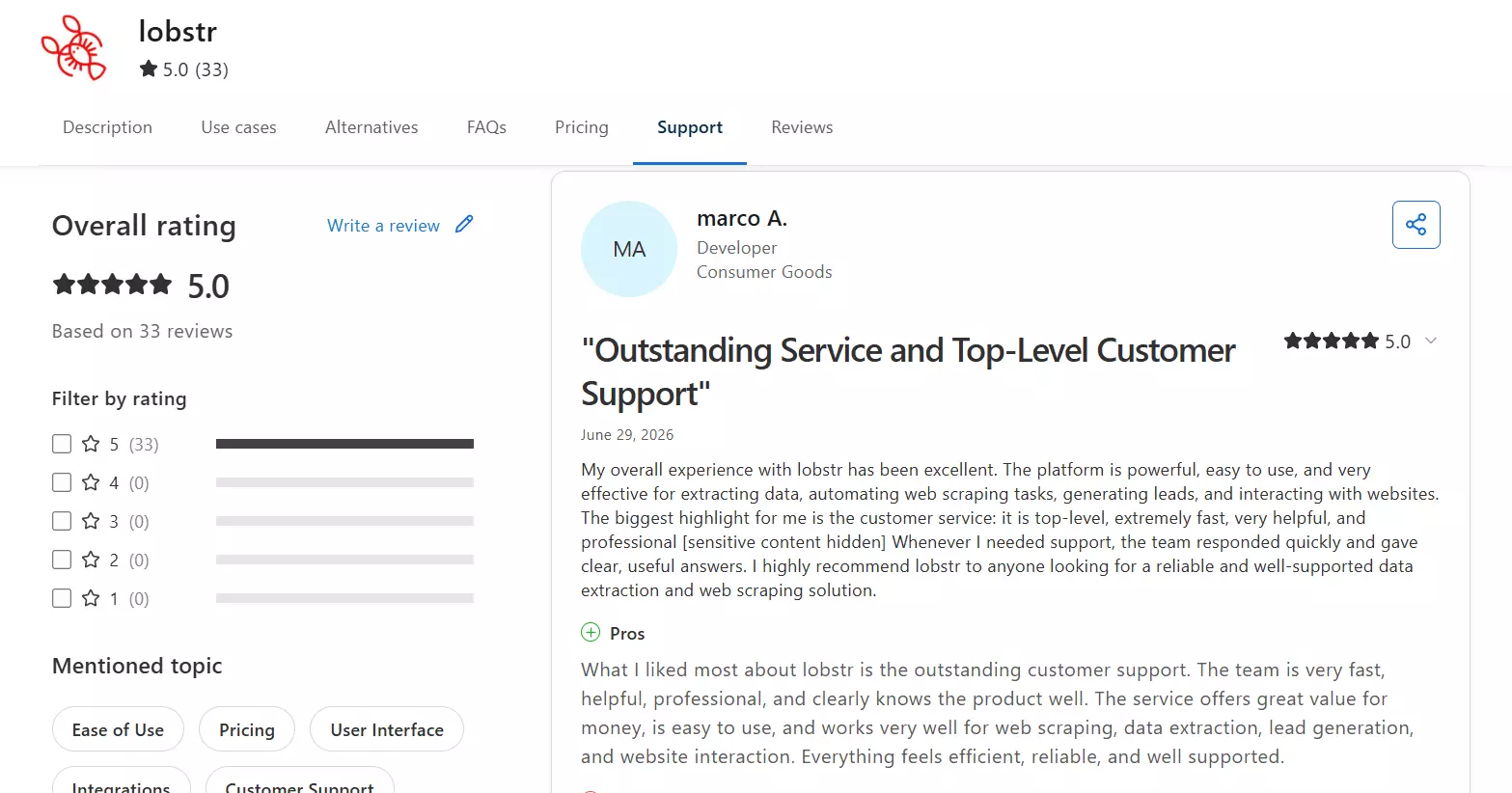
Support is live chat and email, and reviewers consistently call out the team's technical depth and responsiveness. It's the only tool here with a real-time human channel plus email.
Best for: anyone running high-volume realtor.com pulls, agent lead generation, or risk-aware market analysis who wants the deepest data, the biggest ceiling, and predictable billing ... as long as you're ready to add Slots to fix the full-data speed.
2. Apify (memo23/realtor-search-cheerio)
- User rating: 5 stars on the Apify store (12 reviews)
- My score: 8.1/10
- Type: marketplace actor (community-maintained)
- Pricing from: $1.50/1k base, $3.50/1k all-data
- Best for: filtered pulls and market analytics under ~4M/month
| Pillar | Score |
|---|---|
| Data | 8.4/10 |
| Usability | 9.0/10 |
| Scalability | 8.5/10 |
| Cost | 6.5/10 |
| Speed | 9.0/10 |
| Support | 6.5/10 |
| Overall | 8.1/10 |
memo23/realtor-search-cheerio.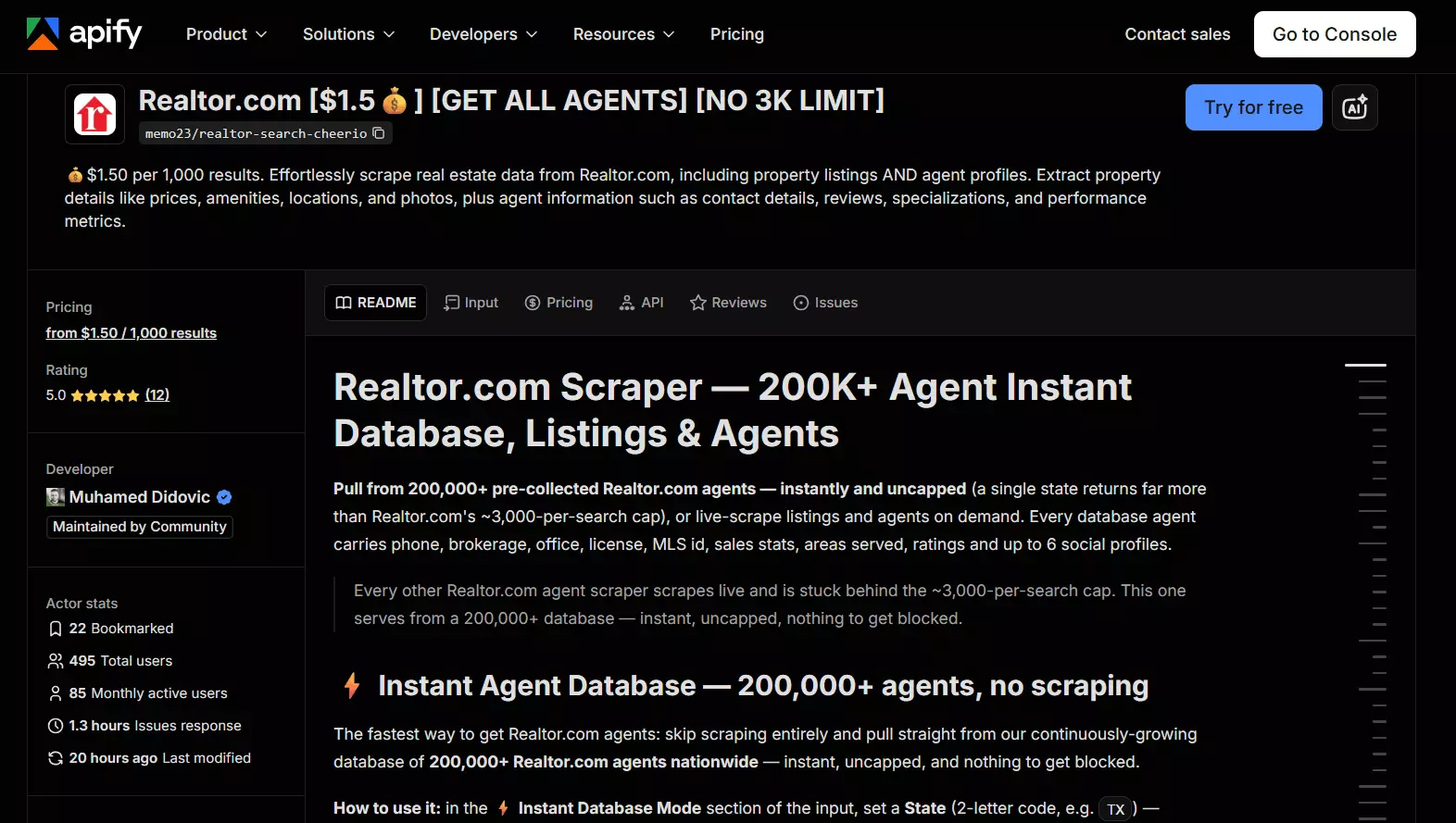
| Pros | Cons |
|---|---|
| Fastest full-data pull (100 listings/min) | Priciest bundle after Piloterr ($3.50/1k all-in) |
| Only native filter builder + agent-search mode | Community-maintained, no official Apify support |
| Exclusive analytics: value estimates, views/saves | Permit-history add-on returned empty in my run |
| Monitoring mode for daily/weekly delta runs | |
| 6 export formats + n8n/Zapier/Make |
Data
Apify returned 186 meaningful fields (Data 8.4/10) ... second-richest, and the cleanest-structured output of the group (typed values, proper nulls, ISO dates).
Where Apify genuinely wins: exclusive analytics fields nobody else returns. 🎁
| Category | Data points |
|---|---|
| 💰 Valuation 🎁 | estimates_current (Zestimate-style value), estimates_forecast, estimates_historical |
| 📈 Popularity 🎁 | views_total, saves_total, popularity_periods |
| 🏦 Mortgage + tax 🎁 | mortgage_monthly_payment, latest_tax_assessment, county_median_listing_price |
Those are the standout fields no one else returns. If your job is market analysis rather than lead gen, that popularity and valuation data is a real edge ... lobstr.io doesn't have it. Apify also matches lobstr.io on schools and price history.
Two honest gaps from my run: the paid permit-history add-on was enabled but came back empty across every record, so I couldn't score it as working. And it returns no amenity tags. Fill was 54%, mid-pack.
Usability
This is where Apify beats lobstr.io. It's the only tool with a native filter builder ... locations, statuses, property types, price, beds/baths and keywords as real fields, no URL hand-crafting.
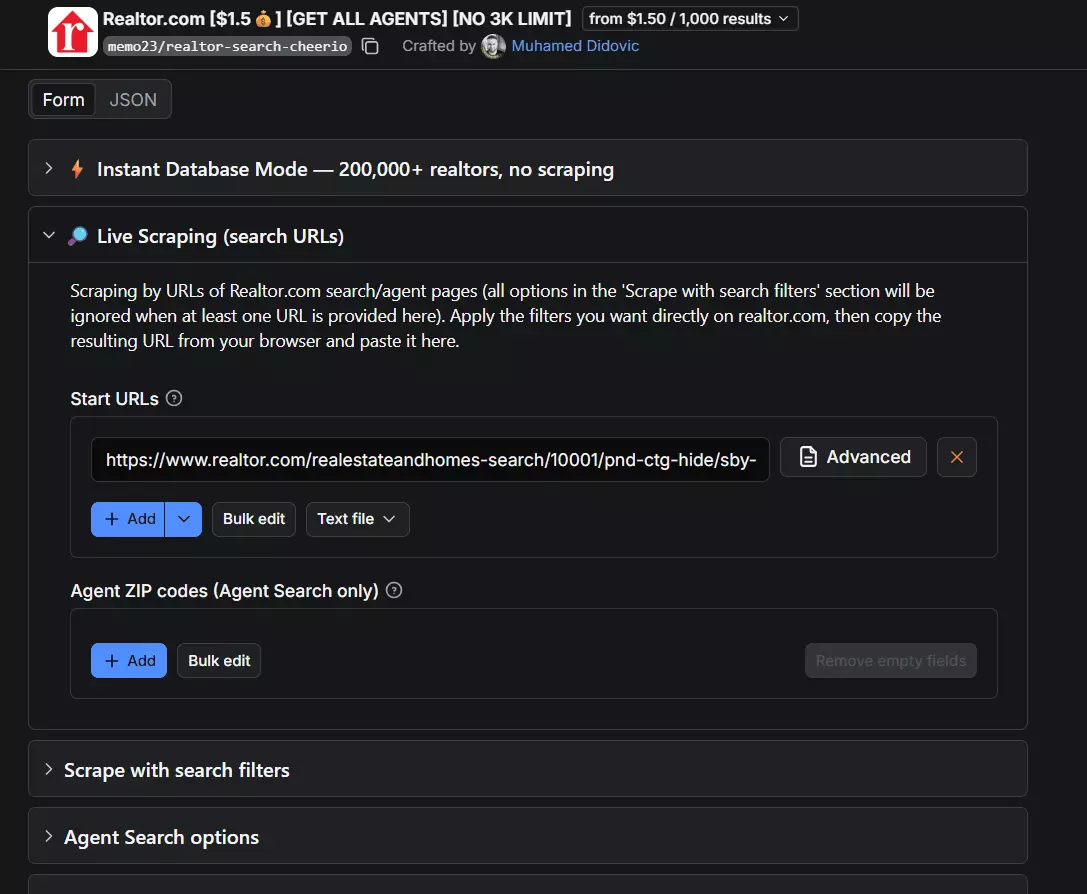
for_sale → pending → sold transition still resurfaces. Exports cover 6 formats, and it plugs into Make, n8n and Zapier.The catch is the marketplace shell: no dedicated instance management, and billing has more moving parts than a clean subscription.
Speed
Apify was the fastest tool on the full-data tier ... 100 listings/min, five times lobstr.io's single-Slot rate and well ahead of ScrapeHero's 60. Search-only ran at 150/min. That speed already reflects its automatic 1-to-5 concurrency, so there's no extra slider to pull.
The 100K anchor job finishes in about 16.7 hours of continuous runtime.
Cost
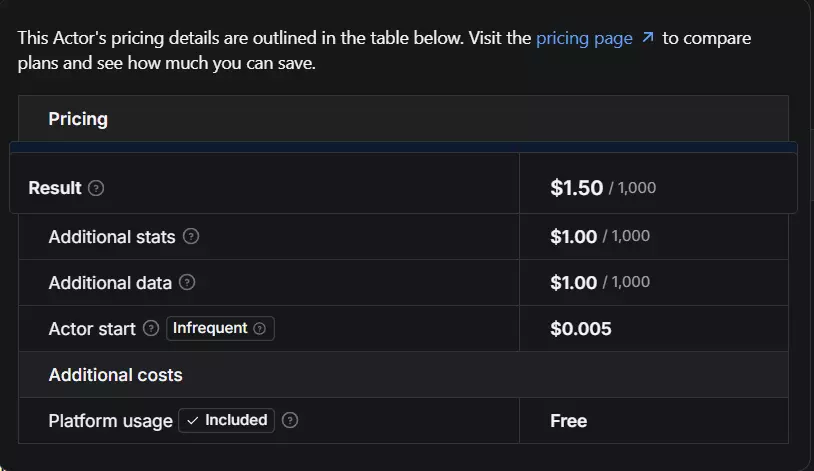
- Base: $1.50/1k for search listings
- All-data: $3.50/1k (base + $2/1k for additional details and stats)
The 100K anchor job costs $350, all-data, and unlike the others there's no scale discount ... so at volume Apify is 7x lobstr.io's $50. Watch the layered billing too: platform compute sits on top of the per-result rate.
Scalability
At 100/min full-data running 24/7, Apify's ceiling is 4.32M listings/month ... higher than lobstr.io's single-Slot number, but this is where the concurrency story flips. Apify caps you at 5 workers, so 4.32M is roughly the ceiling. lobstr.io's Slots blow past it.
memo23 developer ... who, to their credit, updates it regularly.Support
This is where Apify drops. Because it's a community actor, there's no official Apify support for it ... you email the developer or file an issue on the actor's Issues tab.
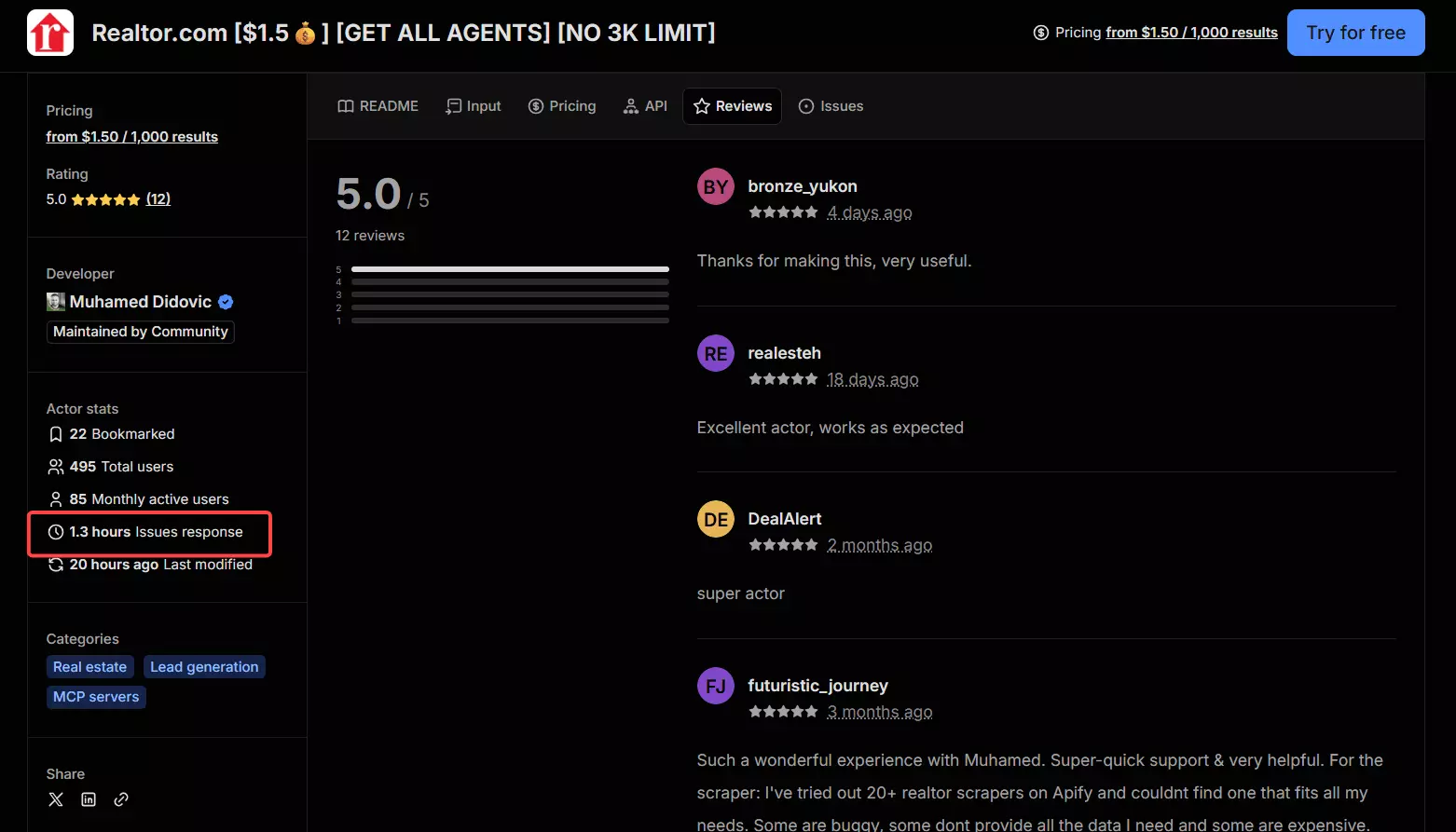
The good news: the actor's published response time is about 1.3 hours, and going through the issues, the developer actually fixes things rather than closing tickets to look tidy. Just know it's one person, not a support desk, and there's no live chat.
Best for: market analysts who want value estimates and popularity data, anyone who needs native filters or agent search, and jobs under ~4M/month where the 5-worker ceiling isn't a problem.
3. Piloterr
- User rating: 4.8/5 on Capterra (33 reviews)
- My score: 5.4/10
- Type: API
- Pricing from: $0.11/1k search-only, $4.63/1k full-data at scale
- Best for: basic listing fields at volume, via code
| Pillar | Score |
|---|---|
| Data | 8.0/10 |
| Usability | 5.5/10 |
| Scalability | 3.5/10 |
| Cost | 5.0/10 |
| Speed | 3.0/10 |
| Support | 8.0/10 |
| Overall | 5.4/10 |
property endpoint for full detail.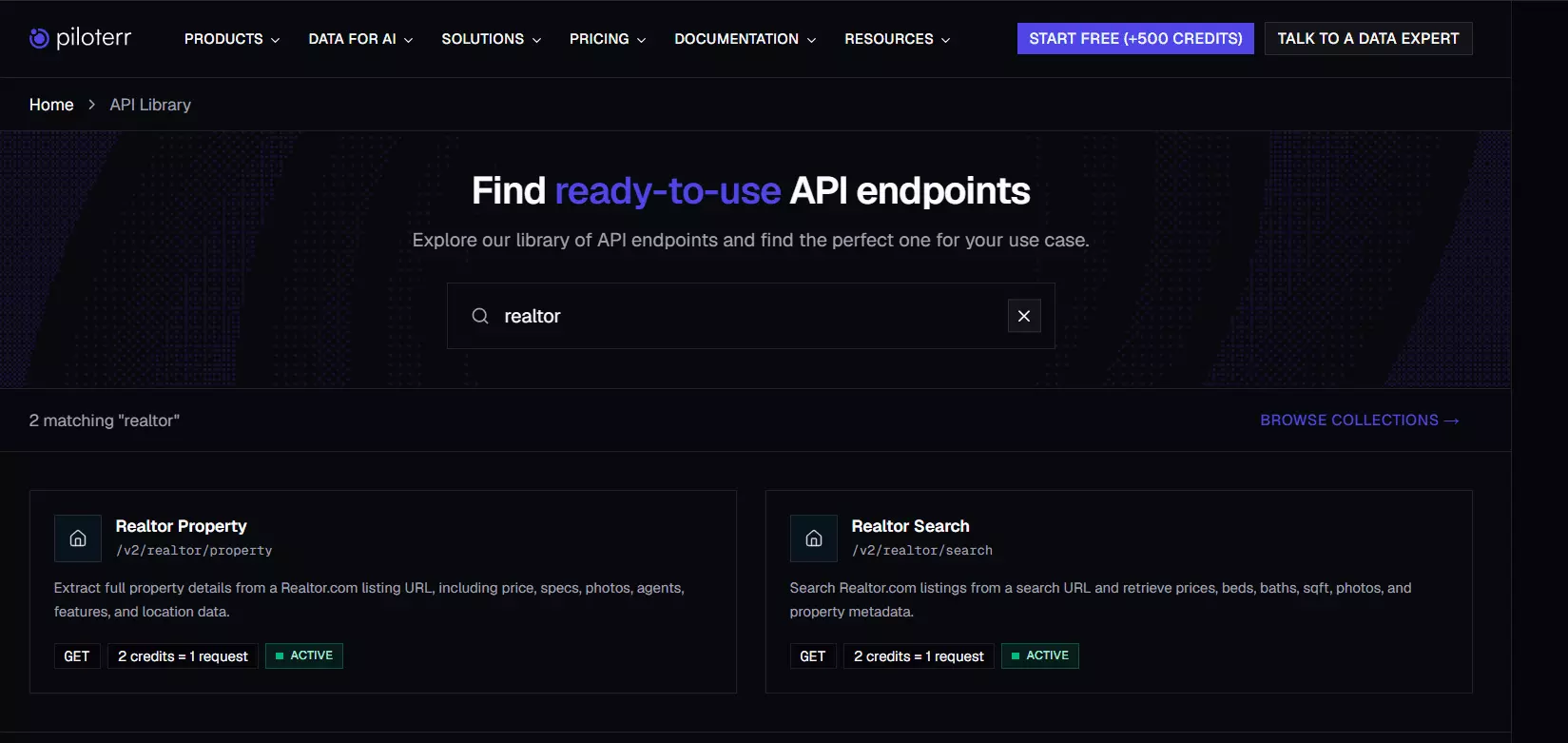
| Pros | Cons |
|---|---|
| Fast, cheap search endpoint ($0.11/1k) | Full-data crawls at 3 listings/min |
| Rich schema mirroring realtor.com internals | Property + tax history came back empty |
| Responsive chat + email support | No data retention (lost on failure) |
| Clean REST API with MCP support | No UI, no filters, no concurrency |
Data
On paper Piloterr is rich ... 173 meaningful fields (Data 8.0/10), a schema that mirrors realtor.com's internal API with deep nested agent, office and location objects.
In practice it's hollower than the count suggests. Its property history and tax history fields came back null on all 98 listings, and a long list of spec fields (pool, garage, heating, cooling, roofing, construction) were empty too. Fill landed at 48%. It does return solid core listing data, full agent + office contact, and correct values (accuracy 9.5).
property_id isn't a native Piloterr field ... I derived it from the listing slug to line records up.Usability
property endpoint with a listing URL, and build everything else yourself.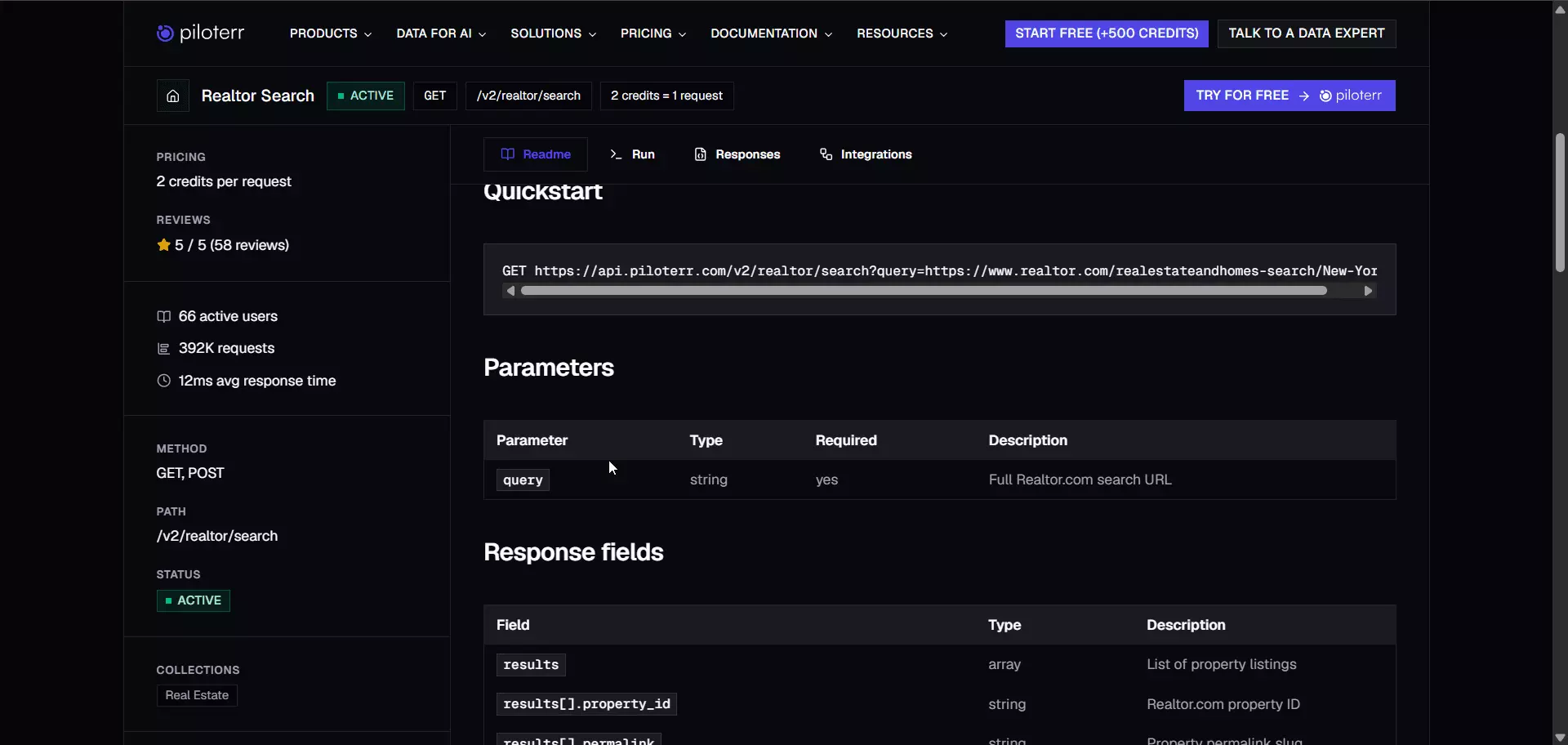
There are no filters, no UI, no settings ... which is fine if you're writing code and want full control, and a non-starter if you wanted a no-code tool. It exposes a clean REST API with MCP support for LLM tooling, so it slots straight into agent workflows. It's the API pick, and it's honest about that.
Speed
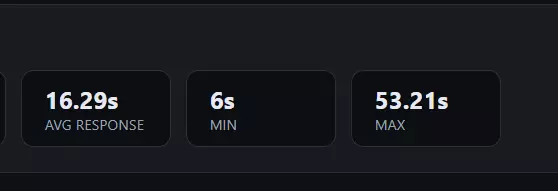
Here's the split that decides Piloterr. The search endpoint is genuinely fast ... it returns 42 listings per request, averaging ~155 listings/min (best case ~420). But the full-data tier collapses to ~3 listings/min, because every listing needs its own detail request, each taking 6 to 53 seconds.
So the 100K anchor job is either ~11 hours (search-only) or, if you want the detail fields, roughly 23 days of continuous calling. That's the killer.
Cost
Piloterr bills in credits: 2 per search page (42 listings), 2 per listing for details, at $2.72/1k credits entry and $2.26/1k at scale.
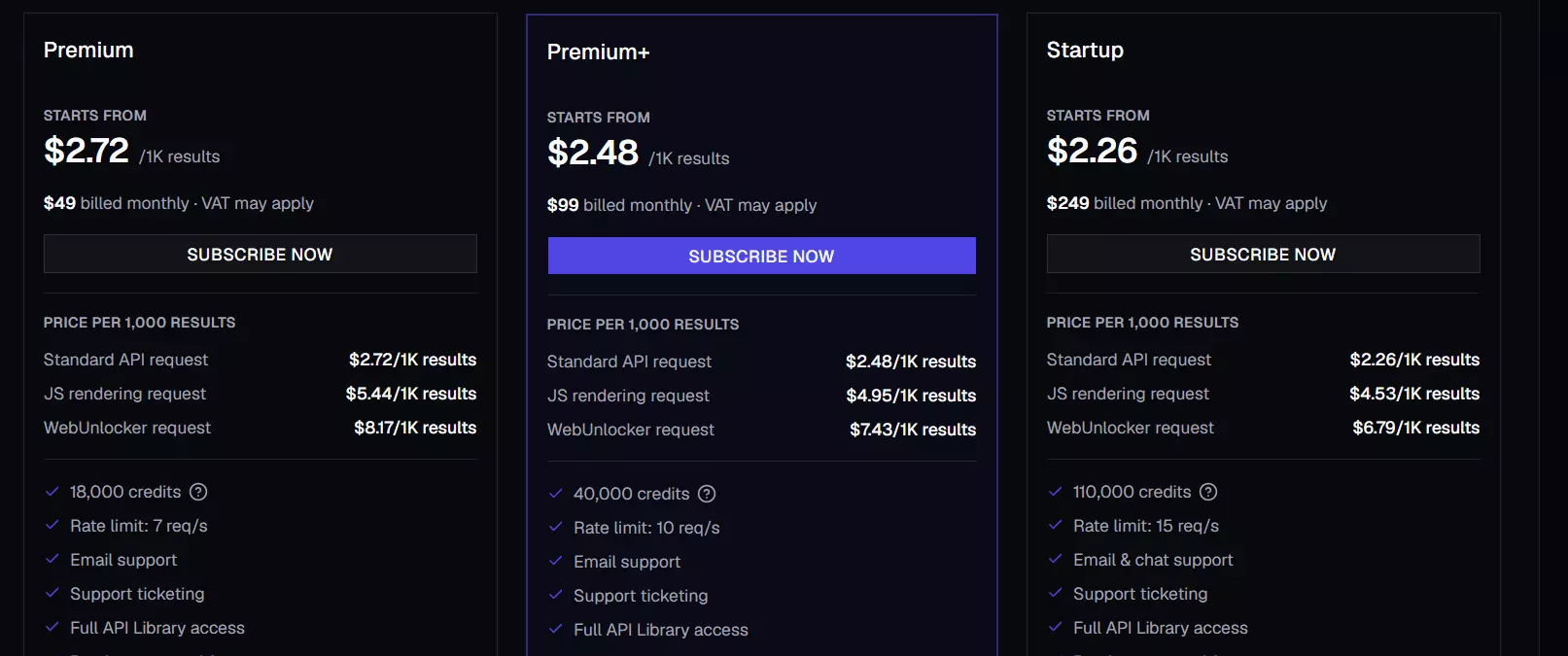
- Search-only: ~$0.13/1k entry, ~$0.11/1k at scale ... the cheapest search data of anyone
- Full-data: ~$5.57/1k entry, ~$4.63/1k at scale ... the most expensive
The 100K anchor job is about $11 search-only, but $463-557 for full data ... the priciest detail data in the test.
Scalability
At 3/min full-data with no concurrency, the ceiling is a tiny 130K listings/month. Search-only is much healthier (~6.7M/month), but the moment you need detail fields, Piloterr can't scale.
It also doesn't retain your data ... a failed or interrupted run loses everything you hadn't already saved. For an API you're expected to handle that yourself, but it's worth knowing.
HTTP 500s that had to retry, with detail requests taking anywhere up to 60 seconds each.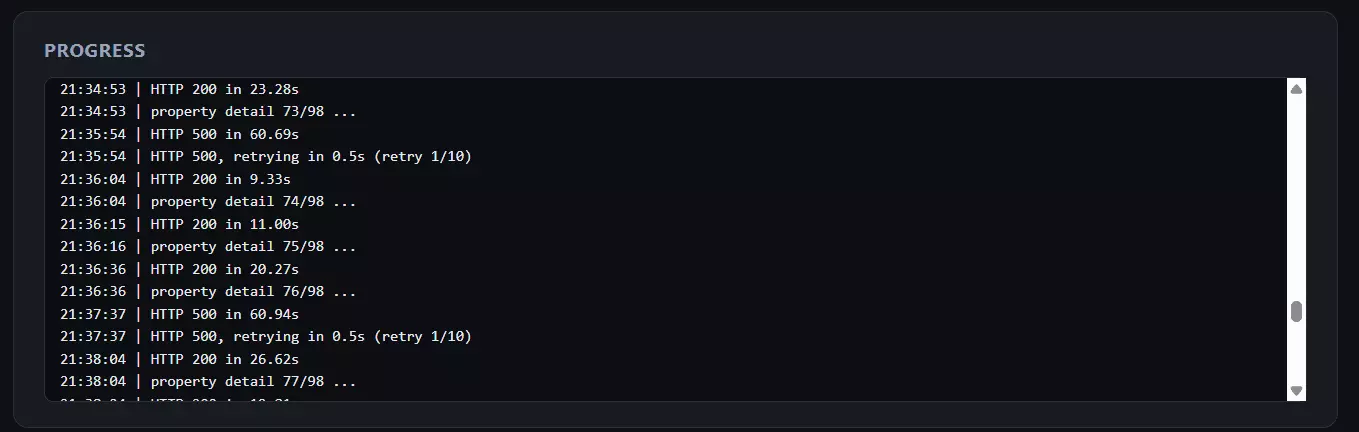
Support
Support is a real bright spot: live chat and email, responsive and active.
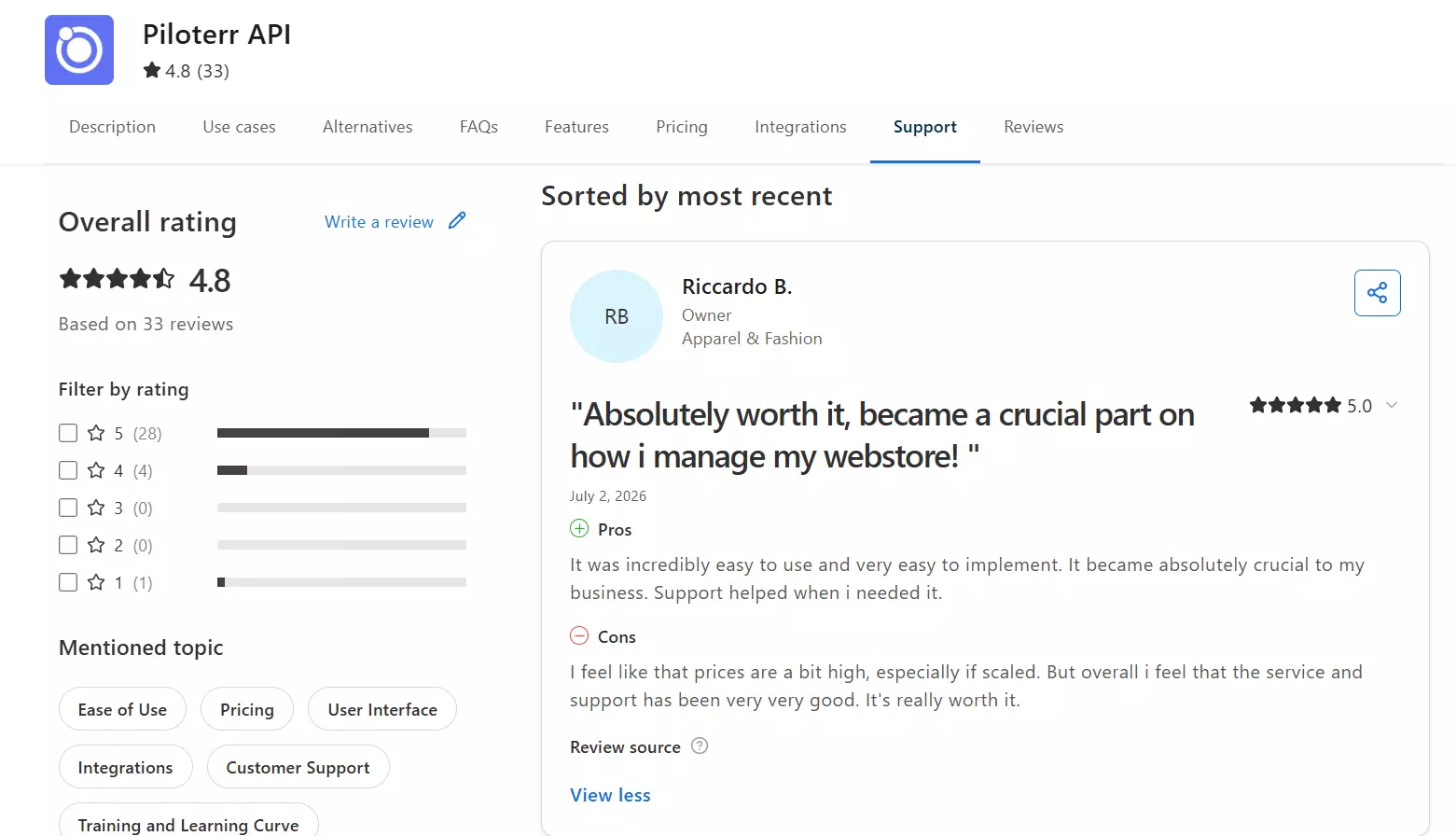
For an API product, that's better than most ... you're not left alone with the docs.
Best for: developers who need basic listing fields at volume through a clean, cheap API, and who don't need the deep detail fields (where it slows to a crawl).
The scraper that didn't make the list: ScrapeHero
I fully tested ScrapeHero too, and it runs fine. It's the cheapest tool I tried and one of the faster ones. But a "best realtor scraper" has to return data worth analyzing, and ScrapeHero's is too thin to sit next to the three above. It's cut for data, not for reliability.
Here's what cut it, in numbers:
| Tool | Meaningful fields | Avg fill | Speed (full data) | Cost /1k (scale) | Why it's cut |
|---|---|---|---|---|---|
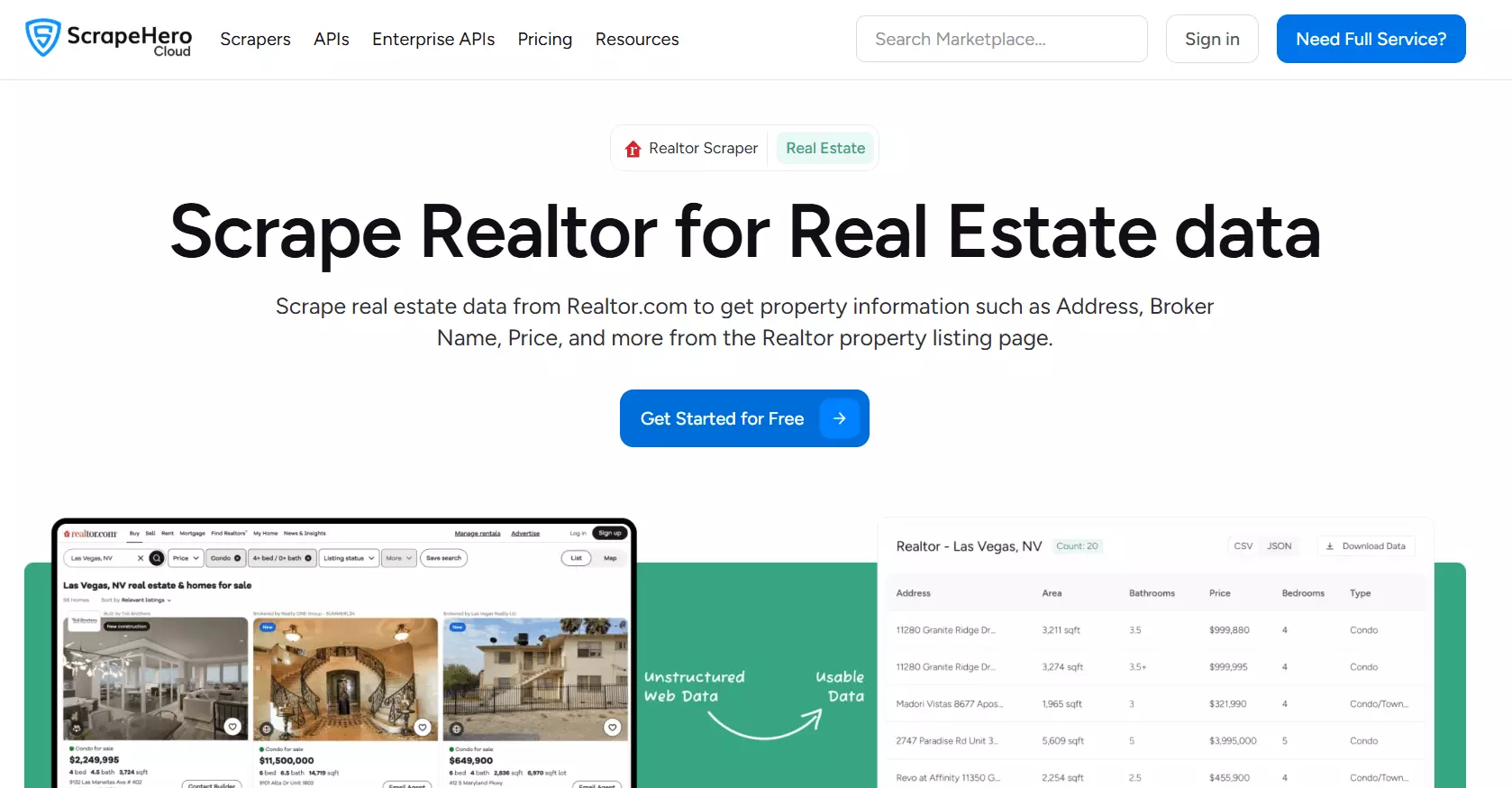
| ScrapeHero | 30 | 18% | 60/min | $0.25 | Too shallow: no history, schools, agent contact or risk |
ScrapeHero Realtor Scraper
- User rating: 4.6/5 on Capterra (26 reviews)
- Type: marketplace scraper
- Pricing from: $1.10/1k, dropping to $0.25/1k at scale
| Pros | Cons |
|---|---|
| Cheapest of everything tested ($0.25/1k) | Thinnest data (30 meaningful fields, 18% fill) |
| Decent speed (60 listings/min) | No history, schools, agent contact or risk |
| Correct on what it returns | No year built returned |
| Simple to run + API access | No settings, no data-loss protection |
Why it didn't make the final list: ScrapeHero returned 30 meaningful fields at 18% average fill ... against 219 for lobstr.io and 173 for Piloterr.
No property or tax history, no school ratings, no agent or office contact, no risk data, and it didn't even return year built on my listings. For a data-focused buyer that's a dealbreaker, so it lands here rather than in the ranked three.
Why it's still worth knowing about: it's genuinely the cheapest option at $0.25/1k (a 100K job for $25), and at 60 listings/min it's faster than lobstr.io's single-Slot full-data rate. What it does return is factually correct. If you only need price, beds, baths, sqft and address, you're paying rock-bottom for exactly that.
Data
| Category | Data points |
|---|---|
| 🏠 Listing | price, status, date_posted, listing_type, sold_price |
| 📍 Location | address, latitude, longitude |
| 📐 Specs | bedrooms, bathrooms, sqft, lot_sqft, property_type |
| 🏢 Broker | broker_name |
| 📸 Media | images, primary_image |
You get the core listing and that's about it. What's there is correct, it's just shallow.
Usability, speed and cost
You feed it a realtor.com search URL, or a keyword with a for-rent / for-sale category toggle, and run it. There are no other settings ... no detail toggles, no scheduling depth. Exports are CSV and JSON, with API access for programmatic runs.
It ran at 60 listings/min (single mode, no search-vs-full-data split), so the 100K anchor job takes about 27.8 hours. Pricing is $1.10/1k entry, $0.25/1k at scale ... the cheapest here, with the honest caveat that you're paying little because you're getting little.
One risk for big jobs: ScrapeHero doesn't retain run data, so if a run errors out, the data is gone. Build your own checkpoints.
Who it's right for: anyone who needs cheap, basic realtor.com listings at low-to-mid volume and doesn't care about history, schools, agent contact, or risk data. For anything analytical, one of the ranked three will serve you far better.
FAQ
Which realtor.com scraper returns the most data?
lobstr.io, at 219 meaningful fields (Data score 9.3/10) ... the richest set tested, and the only tool with flood/fire/noise risk, school ratings, and full agent + office contact together. Apify is second at 186 fields and adds exclusive analytics (value estimates, popularity, mortgage math) that lobstr.io doesn't have.
What's the cheapest realtor.com scraper?
ScrapeHero is technically cheapest at $0.25/1k at scale, but it didn't make my final list ... 30 fields at 18% fill is too thin to recommend. Among the tools I'd actually use, lobstr.io is cheapest for all-data at $0.50/1k, and Piloterr's search endpoint is cheaper still ($0.11/1k) if you only need basic fields.
Which realtor.com scraper is fastest?
Apify, at 100 listings/min on the full-data tier and 150 search-only. lobstr.io runs 20/min full-data on a single Slot (but scales to 400/min with 20 Slots), and Piloterr just 3/min once you pull detail fields.
Which is the best realtor.com scraper for lead generation?
lobstr.io. It's the only tool that returns full agent and office contact (name, email, phone) on every listing, plus the scale to pull them in bulk. Apify gives you primary agent contact but not the full office set.
Is scraping realtor.com legal?
Generally yes for public listing data, under US law (the hiQ Labs v. LinkedIn precedent). Realtor.com's Terms of Service prohibit automated access, but that's a private contract ... breaking it risks your account, not criminal liability. Don't scrape behind logins, don't republish listing content wholesale, and don't abuse agent PII.
No-code or API for realtor.com?
No-code (lobstr.io or Apify) for almost everyone. You get a UI, exports, scheduling and support. Go API (Piloterr) only if you're a developer who wants to wire realtor.com data directly into your own system and mostly need basic listing fields.
Does realtor.com have an official API?
No. There's no official public realtor.com developer API ... only MLS/partner feeds for licensed brokers. Every "realtor.com API" you'll find is a third-party wrapper or a scraper, which is why a scraper is the practical route to the data.
Why isn't Bright Data in the list?
Because it has no dedicated realtor.com scraper or API ... only general-purpose scraping infrastructure. You'd build and maintain the realtor.com parser yourself, which is exactly the work a ready-made scraper removes. Strong proxy and infrastructure stack, wrong fit for a point-and-shoot realtor.com pull.
Why isn't Outscraper in the list?
Because there's no self-serve realtor.com product to benchmark ... the path dead-ends at a "contact us" page with no way to sign up and run the standard job. I don't rank tools I can't actually test. Fine if you're doing a sales-led enterprise procurement, not for a self-serve pull.
Can I verify these numbers?
Conclusion
That's a wrap on the best realtor.com scrapers for 2026.
Who owns what:
- lobstr.io owns data depth, scale, clean pricing, and support. The default pick for serious, high-volume realtor.com work
- Apify owns speed, native filters, and exclusive analytics. The pick for filtered market-analysis pulls under a few million a month
- Piloterr owns a fast, cheap search API. The pick for developers who need basic fields and can skip the slow detail tier
- ScrapeHero didn't make the ranked three, but owns the cheap tier if all you need is basic listings on a budget
This list will keep evolving as these tools ship updates ... lobstr.io has speed and filter work worth watching, and the Apify actor improves over time. I'll keep it current.